

Semantic IoT Interoperability and Data Analytics Using …
253
4 Methodology for Classifying Semantic Data Using
Machine Learning
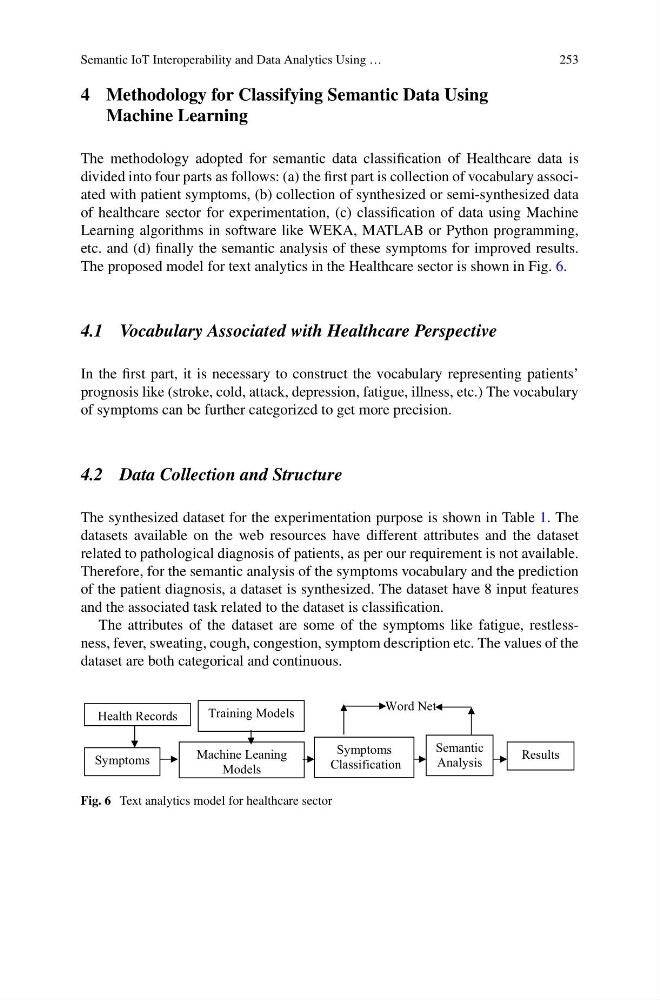
The methodology adopted for semantic data classification of Healthcare data is
divided into four parts as follows: (a) the first part is collection of vocabulary associated with patient symptoms, (b) collection of synthesized or semi-synthesized data
of healthcare sector for experimentation, (c) classification of data using Machine
Learning algorithms in software like WEKA, MATLAB or Python programming,
etc. and (d) finally the semantic analysis of these symptoms for improved results.
The proposed model for text analytics in the Healthcare sector is shown in Fig. 6.
4.1 Vocabulary Associated with Healthcare Perspective
In the first part, it is necessary to construct the vocabulary representing patients’
prognosis like (stroke, cold, attack, depression, fatigue, illness, etc.) The vocabulary
of symptoms can be further categorized to get more precision.
4.2 Data Collection and Structure
The synthesized dataset for the experimentation purpose is shown in Table 1. The
datasets available on the web resources have different attributes and the dataset
related to pathological diagnosis of patients, as per our requirement is not available.
Therefore, for the semantic analysis of the symptoms vocabulary and the prediction
of the patient diagnosis, a dataset is synthesized. The dataset have 8 input features
and the associated task related to the dataset is classification.
The attributes of the dataset are some of the symptoms like fatigue, restlessness, fever, sweating, cough, congestion, symptom description etc. The values of the
dataset are both categorical and continuous.
Symptoms
Machine Leaning
Models
Symptoms
Classification
Semantic
Analysis
Results
Health Records
Training Models
Word Net
Fig. 6 Text analytics model for healthcare sector
253
4 Methodology for Classifying Semantic Data Using
Machine Learning
The methodology adopted for semantic data classification of Healthcare data is
divided into four parts as follows: (a) the first part is collection of vocabulary associated with patient symptoms, (b) collection of synthesized or semi-synthesized data
of healthcare sector for experimentation, (c) classification of data using Machine
Learning algorithms in software like WEKA, MATLAB or Python programming,
etc. and (d) finally the semantic analysis of these symptoms for improved results.
The proposed model for text analytics in the Healthcare sector is shown in Fig. 6.
4.1 Vocabulary Associated with Healthcare Perspective
In the first part, it is necessary to construct the vocabulary representing patients’
prognosis like (stroke, cold, attack, depression, fatigue, illness, etc.) The vocabulary
of symptoms can be further categorized to get more precision.
4.2 Data Collection and Structure
The synthesized dataset for the experimentation purpose is shown in Table 1. The
datasets available on the web resources have different attributes and the dataset
related to pathological diagnosis of patients, as per our requirement is not available.
Therefore, for the semantic analysis of the symptoms vocabulary and the prediction
of the patient diagnosis, a dataset is synthesized. The dataset have 8 input features
and the associated task related to the dataset is classification.
The attributes of the dataset are some of the symptoms like fatigue, restlessness, fever, sweating, cough, congestion, symptom description etc. The values of the
dataset are both categorical and continuous.
Symptoms
Machine Leaning
Models
Symptoms
Classification
Semantic
Analysis
Results
Health Records
Training Models
Word Net
Fig. 6 Text analytics model for healthcare sector