

248
P. Guleria and M. Sood
data. Authors [12] have proposed a framework for voice signals based pathology
assessment. In Machine Learning, there are techniques like Association Rule Mining,
Neural Network-based classification techniques that help in personalized healthcare
services. The Web Ontology Language data sources of Healthcare services involves
(a) Electronic Health care, (b) Sensor data in devices, (c) Epidemics data about infections, (d) Symptoms, and Diagnosis data. Semantic web uses an ontology to represent
the terms meaning in web documents and applications. Semantic web works on the
recommendations of W3C which involves (a) XML, (b) XML Schema, (c) RDF, (d)
RDF Schema. The RDF and RDF Schema provide the vocabulary for properties and
classes of RDF [13]. OWL [14] not only presents information to humans but also
process meaningful information. The sublanguages of OWL are (a) OWL Lite, (b)
OWL DL, and (c) OWL Full.
The RDF (Research description framework) consists of metadata which classifies
the data on the WWW. The application of RDF has revolutionized the e-commerce
sector like in Amazon.com, the products are categorized.
3 Layered Framework of Interoperability in IoT
The term Interoperability means to enable information systems to interpret, understand, and share the information without ambiguity.
In order to achieve this, the devices in IoT need to work with each other on
cross-domain platforms. In semantic interoperability, devices need to confine to a
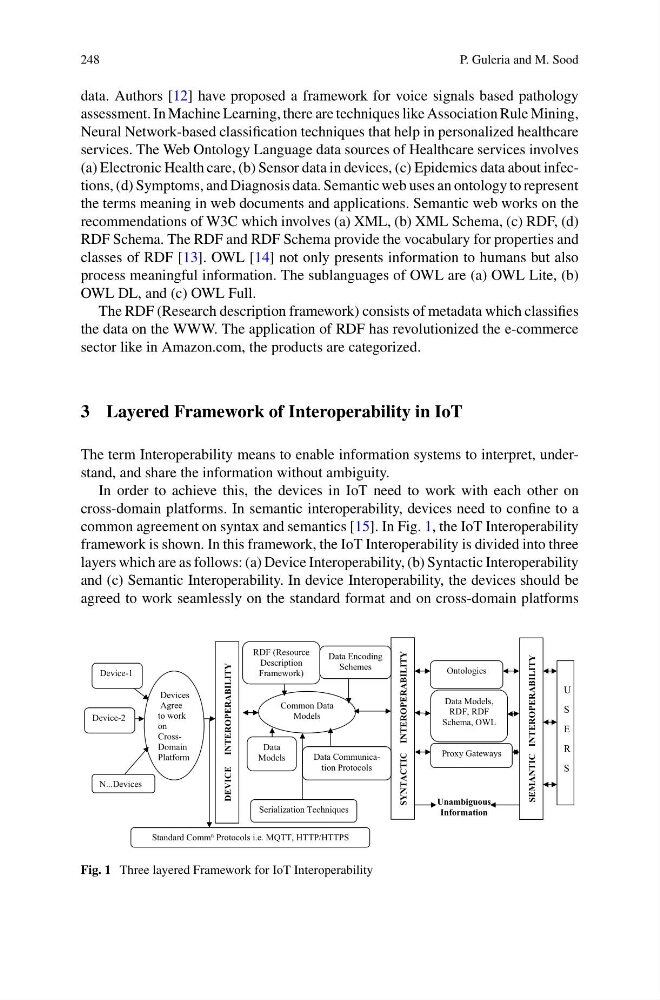
common agreement on syntax and semantics [15]. In Fig. 1, the IoT Interoperability
framework is shown. In this framework, the IoT Interoperability is divided into three
layers which are as follows: (a) Device Interoperability, (b) Syntactic Interoperability
and (c) Semantic Interoperability. In device Interoperability, the devices should be
agreed to work seamlessly on the standard format and on cross-domain platforms
Devices
Agree
to work
on
CrossDomain
Platform
DEVICE INTEROPERABILITY
Common Data
Models
SYNTACTIC INTEROPERABILITY
RDF (Resource
Description
Framework)
Data Encoding
Schemes
Data
Models
Data Communication Protocols
Serialization Techniques
Ontologies
Proxy Gateways
Data Models,
RDF, RDF
Schema, OWL
SEMANTIC INTEROPERABILITY
N...Devices
Device-2
Device-1
Standard Comm n Protocols i.e. MQTT, HTTP/HTTPS
Unambiguous
Information
U
S
E
R
S
Fig. 1 Three layered Framework for IoT Interoperability
P. Guleria and M. Sood
data. Authors [12] have proposed a framework for voice signals based pathology
assessment. In Machine Learning, there are techniques like Association Rule Mining,
Neural Network-based classification techniques that help in personalized healthcare
services. The Web Ontology Language data sources of Healthcare services involves
(a) Electronic Health care, (b) Sensor data in devices, (c) Epidemics data about infections, (d) Symptoms, and Diagnosis data. Semantic web uses an ontology to represent
the terms meaning in web documents and applications. Semantic web works on the
recommendations of W3C which involves (a) XML, (b) XML Schema, (c) RDF, (d)
RDF Schema. The RDF and RDF Schema provide the vocabulary for properties and
classes of RDF [13]. OWL [14] not only presents information to humans but also
process meaningful information. The sublanguages of OWL are (a) OWL Lite, (b)
OWL DL, and (c) OWL Full.
The RDF (Research description framework) consists of metadata which classifies
the data on the WWW. The application of RDF has revolutionized the e-commerce
sector like in Amazon.com, the products are categorized.
3 Layered Framework of Interoperability in IoT
The term Interoperability means to enable information systems to interpret, understand, and share the information without ambiguity.
In order to achieve this, the devices in IoT need to work with each other on
cross-domain platforms. In semantic interoperability, devices need to confine to a
common agreement on syntax and semantics [15]. In Fig. 1, the IoT Interoperability
framework is shown. In this framework, the IoT Interoperability is divided into three
layers which are as follows: (a) Device Interoperability, (b) Syntactic Interoperability
and (c) Semantic Interoperability. In device Interoperability, the devices should be
agreed to work seamlessly on the standard format and on cross-domain platforms
Devices
Agree
to work
on
CrossDomain
Platform
DEVICE INTEROPERABILITY
Common Data
Models
SYNTACTIC INTEROPERABILITY
RDF (Resource
Description
Framework)
Data Encoding
Schemes
Data
Models
Data Communication Protocols
Serialization Techniques
Ontologies
Proxy Gateways
Data Models,
RDF, RDF
Schema, OWL
SEMANTIC INTEROPERABILITY
N...Devices
Device-2
Device-1
Standard Comm n Protocols i.e. MQTT, HTTP/HTTPS
Unambiguous
Information
U
S
E
R
S
Fig. 1 Three layered Framework for IoT Interoperability