

226
V. Babenko et al.
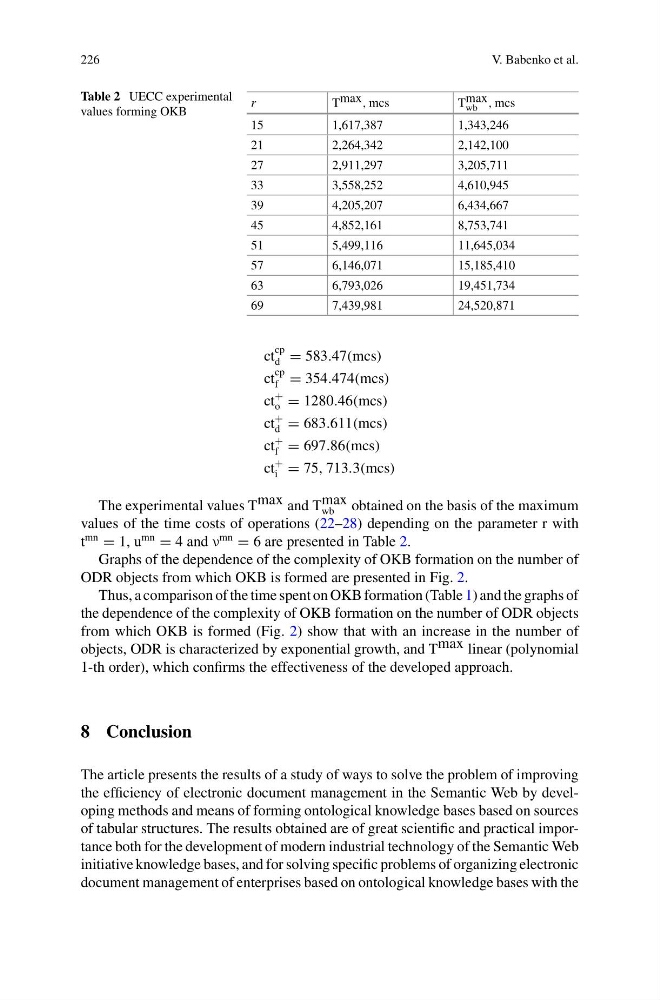
Table 2 UECC experimental
values forming OKB
r
T max , mcs
T max
wb , mcs
15
1,617,387
1,343,246
21
2,264,342
2,142,100
27
2,911,297
3,205,711
33
3,558,252
4,610,945
39
4,205,207
6,434,667
45
4,852,161
8,753,741
51
5,499,116
11,645,034
57
6,146,071
15,185,410
63
6,793,026
19,451,734
69
7,439,981
24,520,871
ct
cp
d = 583.47(mcs)
ct
cp
f = 354.474(mcs)
ct
+
o = 1280.46(mcs)
ct
+
d = 683.611(mcs)
ct
+
f = 697.86(mcs)
ct
+
i = 75, 713.3(mcs)
The experimental values T max and T max
wb
obtained on the basis of the maximum
values of the time costs of operations (22–28) depending on the parameter r with
t
mn
= 1, u
mn
= 4 and ν
mn
= 6 are presented in Table 2.
Graphs of the dependence of the complexity of OKB formation on the number of
ODR objects from which OKB is formed are presented in Fig. 2.
Thus, a comparison of the time spent on OKB formation (Table 1) and the graphs of
the dependence of the complexity of OKB formation on the number of ODR objects
from which OKB is formed (Fig. 2) show that with an increase in the number of
objects, ODR is characterized by exponential growth, and T max linear (polynomial
1-th order), which confirms the effectiveness of the developed approach.
8 Conclusion
The article presents the results of a study of ways to solve the problem of improving
the efficiency of electronic document management in the Semantic Web by developing methods and means of forming ontological knowledge bases based on sources
of tabular structures. The results obtained are of great scientific and practical importance both for the development of modern industrial technology of the Semantic Web
initiative knowledge bases, and for solving specific problems of organizing electronic
document management of enterprises based on ontological knowledge bases with the
V. Babenko et al.
Table 2 UECC experimental
values forming OKB
r
T max , mcs
T max
wb , mcs
15
1,617,387
1,343,246
21
2,264,342
2,142,100
27
2,911,297
3,205,711
33
3,558,252
4,610,945
39
4,205,207
6,434,667
45
4,852,161
8,753,741
51
5,499,116
11,645,034
57
6,146,071
15,185,410
63
6,793,026
19,451,734
69
7,439,981
24,520,871
ct
cp
d = 583.47(mcs)
ct
cp
f = 354.474(mcs)
ct
+
o = 1280.46(mcs)
ct
+
d = 683.611(mcs)
ct
+
f = 697.86(mcs)
ct
+
i = 75, 713.3(mcs)
The experimental values T max and T max
wb
obtained on the basis of the maximum
values of the time costs of operations (22–28) depending on the parameter r with
t
mn
= 1, u
mn
= 4 and ν
mn
= 6 are presented in Table 2.
Graphs of the dependence of the complexity of OKB formation on the number of
ODR objects from which OKB is formed are presented in Fig. 2.
Thus, a comparison of the time spent on OKB formation (Table 1) and the graphs of
the dependence of the complexity of OKB formation on the number of ODR objects
from which OKB is formed (Fig. 2) show that with an increase in the number of
objects, ODR is characterized by exponential growth, and T max linear (polynomial
1-th order), which confirms the effectiveness of the developed approach.
8 Conclusion
The article presents the results of a study of ways to solve the problem of improving
the efficiency of electronic document management in the Semantic Web by developing methods and means of forming ontological knowledge bases based on sources
of tabular structures. The results obtained are of great scientific and practical importance both for the development of modern industrial technology of the Semantic Web
initiative knowledge bases, and for solving specific problems of organizing electronic
document management of enterprises based on ontological knowledge bases with the