

Creation of Ontological Knowledge Bases in the Semantic Web …
219
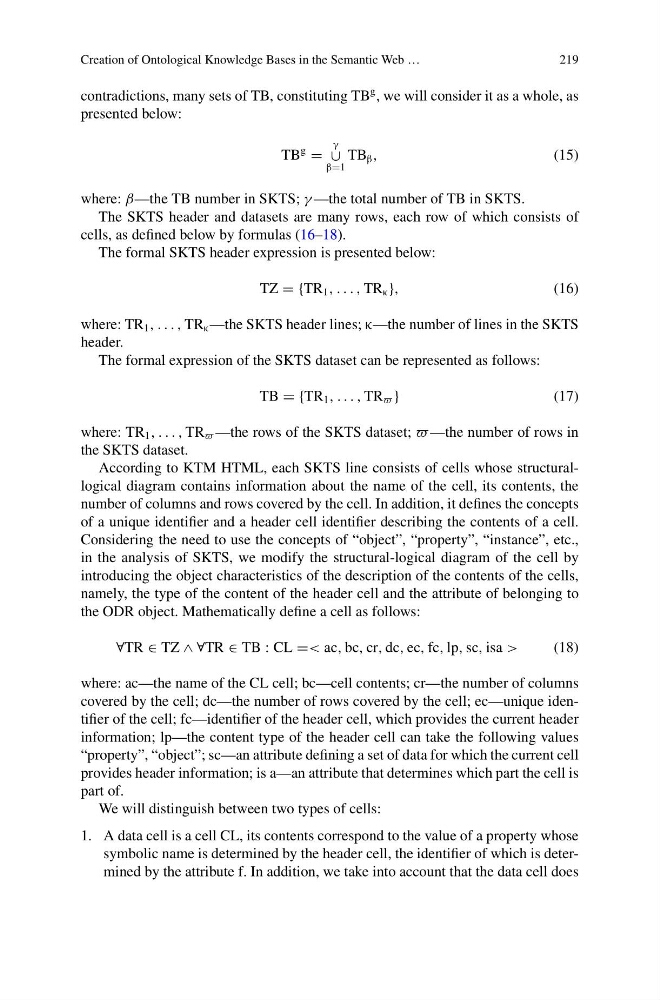
contradictions, many sets of TB, constituting TB
g , we will consider it as a whole, as
presented below:
TB
g
=
γ
∪
β=1
TB β ,
(15)
where: β—the TB number in SKTS; γ —the total number of TB in SKTS.
The SKTS header and datasets are many rows, each row of which consists of
cells, as defined below by formulas (16–18).
The formal SKTS header expression is presented below:
TZ = {TR 1 , . . . , TR κ },
(16)
where: TR 1 , . . . , TR κ —the SKTS header lines; κ—the number of lines in the SKTS
header.
The formal expression of the SKTS dataset can be represented as follows:
TB = {TR 1 , . . . , TR }
(17)
where: TR 1 , . . . , TR —the rows of the SKTS dataset; —the number of rows in
the SKTS dataset.
According to KTM HTML, each SKTS line consists of cells whose structurallogical diagram contains information about the name of the cell, its contents, the
number of columns and rows covered by the cell. In addition, it defines the concepts
of a unique identifier and a header cell identifier describing the contents of a cell.
Considering the need to use the concepts of “object”, “property”, “instance”, etc.,
in the analysis of SKTS, we modify the structural-logical diagram of the cell by
introducing the object characteristics of the description of the contents of the cells,
namely, the type of the content of the header cell and the attribute of belonging to
the ODR object. Mathematically define a cell as follows:
∀TR ∈ TZ ∧ ∀TR ∈ TB : CL =< ac, bc, cr, dc, ec, fc, lp, sc, isa >
(18)
where: ac—the name of the CL cell; bc—cell contents; cr—the number of columns
covered by the cell; dc—the number of rows covered by the cell; ec—unique identifier of the cell; fc—identifier of the header cell, which provides the current header
information; lp—the content type of the header cell can take the following values
“property”, “object”; sc—an attribute defining a set of data for which the current cell
provides header information; is a—an attribute that determines which part the cell is
part of.
We will distinguish between two types of cells:
1. A data cell is a cell CL, its contents correspond to the value of a property whose
symbolic name is determined by the header cell, the identifier of which is determined by the attribute f. In addition, we take into account that the data cell does
219
contradictions, many sets of TB, constituting TB
g , we will consider it as a whole, as
presented below:
TB
g
=
γ
∪
β=1
TB β ,
(15)
where: β—the TB number in SKTS; γ —the total number of TB in SKTS.
The SKTS header and datasets are many rows, each row of which consists of
cells, as defined below by formulas (16–18).
The formal SKTS header expression is presented below:
TZ = {TR 1 , . . . , TR κ },
(16)
where: TR 1 , . . . , TR κ —the SKTS header lines; κ—the number of lines in the SKTS
header.
The formal expression of the SKTS dataset can be represented as follows:
TB = {TR 1 , . . . , TR }
(17)
where: TR 1 , . . . , TR —the rows of the SKTS dataset; —the number of rows in
the SKTS dataset.
According to KTM HTML, each SKTS line consists of cells whose structurallogical diagram contains information about the name of the cell, its contents, the
number of columns and rows covered by the cell. In addition, it defines the concepts
of a unique identifier and a header cell identifier describing the contents of a cell.
Considering the need to use the concepts of “object”, “property”, “instance”, etc.,
in the analysis of SKTS, we modify the structural-logical diagram of the cell by
introducing the object characteristics of the description of the contents of the cells,
namely, the type of the content of the header cell and the attribute of belonging to
the ODR object. Mathematically define a cell as follows:
∀TR ∈ TZ ∧ ∀TR ∈ TB : CL =< ac, bc, cr, dc, ec, fc, lp, sc, isa >
(18)
where: ac—the name of the CL cell; bc—cell contents; cr—the number of columns
covered by the cell; dc—the number of rows covered by the cell; ec—unique identifier of the cell; fc—identifier of the header cell, which provides the current header
information; lp—the content type of the header cell can take the following values
“property”, “object”; sc—an attribute defining a set of data for which the current cell
provides header information; is a—an attribute that determines which part the cell is
part of.
We will distinguish between two types of cells:
1. A data cell is a cell CL, its contents correspond to the value of a property whose
symbolic name is determined by the header cell, the identifier of which is determined by the attribute f. In addition, we take into account that the data cell does