

182
A. Gyrard et al.
5.3 Discussions and Lessons Learned
Lessons Learned. We shared the lessons learned to fix the issues to improve the
ontologies with the tools suggested by PerfectO (see Table 3) in the “Semantic
Web Best Practices for Dummies” documentation mentioned above. A summary is
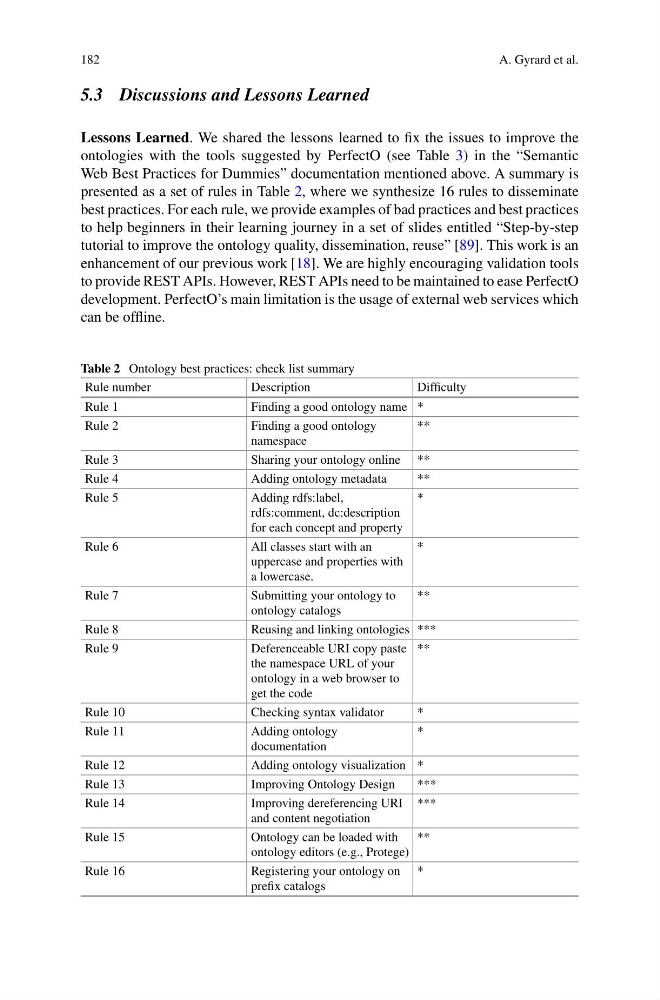
presented as a set of rules in Table 2, where we synthesize 16 rules to disseminate
best practices. For each rule, we provide examples of bad practices and best practices
to help beginners in their learning journey in a set of slides entitled “Step-by-step
tutorial to improve the ontology quality, dissemination, reuse” [89]. This work is an
enhancement of our previous work [18]. We are highly encouraging validation tools
to provide REST APIs. However, REST APIs need to be maintained to ease PerfectO
development. PerfectO’s main limitation is the usage of external web services which
can be offline.
Table 2 Ontology best practices: check list summary
Rule number
Description
Difficulty
Rule 1
Finding a good ontology name *
Rule 2
Finding a good ontology
namespace
**
Rule 3
Sharing your ontology online **
Rule 4
Adding ontology metadata
**
Rule 5
Adding rdfs:label,
rdfs:comment, dc:description
for each concept and property
*
Rule 6
All classes start with an
uppercase and properties with
a lowercase.
*
Rule 7
Submitting your ontology to
ontology catalogs
**
Rule 8
Reusing and linking ontologies ***
Rule 9
Deferenceable URI copy paste
the namespace URL of your
ontology in a web browser to
get the code
**
Rule 10
Checking syntax validator
*
Rule 11
Adding ontology
documentation
*
Rule 12
Adding ontology visualization *
Rule 13
Improving Ontology Design
***
Rule 14
Improving dereferencing URI
and content negotiation
***
Rule 15
Ontology can be loaded with
ontology editors (e.g., Protege)
**
Rule 16
Registering your ontology on
prefix catalogs
*
A. Gyrard et al.
5.3 Discussions and Lessons Learned
Lessons Learned. We shared the lessons learned to fix the issues to improve the
ontologies with the tools suggested by PerfectO (see Table 3) in the “Semantic
Web Best Practices for Dummies” documentation mentioned above. A summary is
presented as a set of rules in Table 2, where we synthesize 16 rules to disseminate
best practices. For each rule, we provide examples of bad practices and best practices
to help beginners in their learning journey in a set of slides entitled “Step-by-step
tutorial to improve the ontology quality, dissemination, reuse” [89]. This work is an
enhancement of our previous work [18]. We are highly encouraging validation tools
to provide REST APIs. However, REST APIs need to be maintained to ease PerfectO
development. PerfectO’s main limitation is the usage of external web services which
can be offline.
Table 2 Ontology best practices: check list summary
Rule number
Description
Difficulty
Rule 1
Finding a good ontology name *
Rule 2
Finding a good ontology
namespace
**
Rule 3
Sharing your ontology online **
Rule 4
Adding ontology metadata
**
Rule 5
Adding rdfs:label,
rdfs:comment, dc:description
for each concept and property
*
Rule 6
All classes start with an
uppercase and properties with
a lowercase.
*
Rule 7
Submitting your ontology to
ontology catalogs
**
Rule 8
Reusing and linking ontologies ***
Rule 9
Deferenceable URI copy paste
the namespace URL of your
ontology in a web browser to
get the code
**
Rule 10
Checking syntax validator
*
Rule 11
Adding ontology
documentation
*
Rule 12
Adding ontology visualization *
Rule 13
Improving Ontology Design
***
Rule 14
Improving dereferencing URI
and content negotiation
***
Rule 15
Ontology can be loaded with
ontology editors (e.g., Protege)
**
Rule 16
Registering your ontology on
prefix catalogs
*