

148
A. Sharma and R. B. Battula
It tends to be seen that the expansive extent of the cosmology makes it rather entangled. This is likewise in light of the fact that, it isn’t recorded all around ok, for
example the detail level and straightforward entry of the documentation don’t coordinate the range of inclusion of ideas in the model. Besides, it isn’t plainly and
expressly modularized, notwithstanding being an expansion of the SSN.
Let us note that, while there are other IoT models of expected intrigue (such
as OGC Sensor Things, FAN FPAI, UniversAAL ontologies, IoT Ontology3, M3
Vocabulary), we won’t consider them here. This is a result of space constraint, and
the way that they have produced substantially less “general intrigue”. In any case,
we intend to remember these ontologies for resulting work.
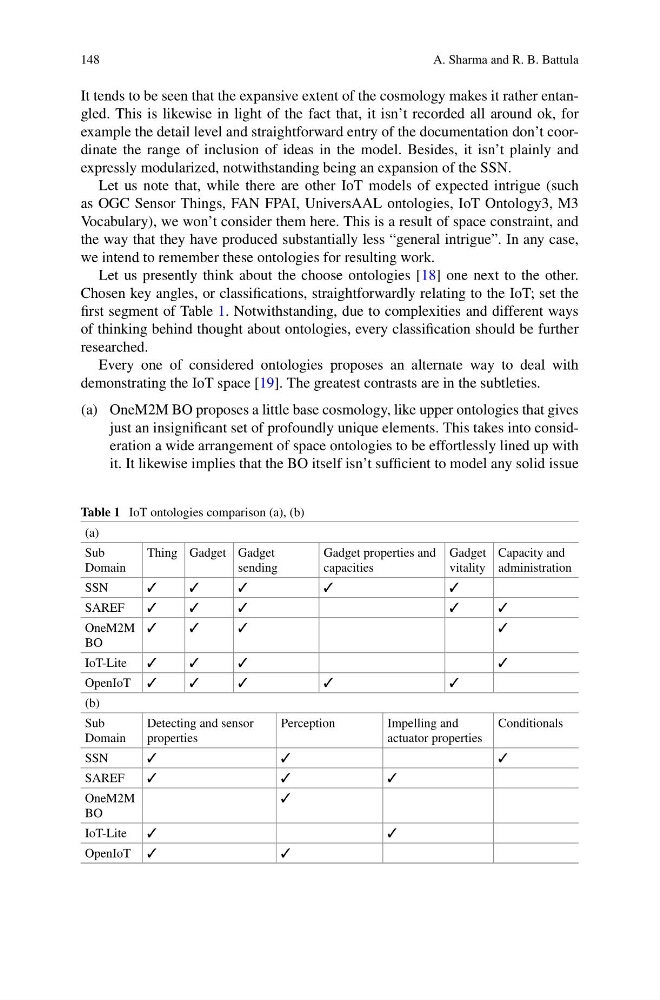
Let us presently think about the choose ontologies [18] one next to the other.
Chosen key angles, or classifications, straightforwardly relating to the IoT; set the
first segment of Table 1. Notwithstanding, due to complexities and different ways
of thinking behind thought about ontologies, every classification should be further
researched.
Every one of considered ontologies proposes an alternate way to deal with
demonstrating the IoT space [19]. The greatest contrasts are in the subtleties.
(a) OneM2M BO proposes a little base cosmology, like upper ontologies that gives
just an insignificant set of profoundly unique elements. This takes into consideration a wide arrangement of space ontologies to be effortlessly lined up with
it. It likewise implies that the BO itself isn’t sufficient to model any solid issue
Table 1 IoT ontologies comparison (a), (b)
(a)
Sub
Domain
Thing Gadget Gadget
sending
Gadget properties and
capacities
Gadget
vitality
Capacity and
administration
SSN
✓
✓
✓
✓
✓
SAREF
✓
✓
✓
✓
✓
OneM2M
BO
✓
✓
✓
✓
IoT-Lite
✓
✓
✓
✓
OpenIoT ✓
✓
✓
✓
✓
(b)
Sub
Domain
Detecting and sensor
properties
Perception
Impelling and
actuator properties
Conditionals
SSN
✓
✓
✓
SAREF
✓
✓
✓
OneM2M
BO
✓
IoT-Lite
✓
✓
OpenIoT ✓
✓
A. Sharma and R. B. Battula
It tends to be seen that the expansive extent of the cosmology makes it rather entangled. This is likewise in light of the fact that, it isn’t recorded all around ok, for
example the detail level and straightforward entry of the documentation don’t coordinate the range of inclusion of ideas in the model. Besides, it isn’t plainly and
expressly modularized, notwithstanding being an expansion of the SSN.
Let us note that, while there are other IoT models of expected intrigue (such
as OGC Sensor Things, FAN FPAI, UniversAAL ontologies, IoT Ontology3, M3
Vocabulary), we won’t consider them here. This is a result of space constraint, and
the way that they have produced substantially less “general intrigue”. In any case,
we intend to remember these ontologies for resulting work.
Let us presently think about the choose ontologies [18] one next to the other.
Chosen key angles, or classifications, straightforwardly relating to the IoT; set the
first segment of Table 1. Notwithstanding, due to complexities and different ways
of thinking behind thought about ontologies, every classification should be further
researched.
Every one of considered ontologies proposes an alternate way to deal with
demonstrating the IoT space [19]. The greatest contrasts are in the subtleties.
(a) OneM2M BO proposes a little base cosmology, like upper ontologies that gives
just an insignificant set of profoundly unique elements. This takes into consideration a wide arrangement of space ontologies to be effortlessly lined up with
it. It likewise implies that the BO itself isn’t sufficient to model any solid issue
Table 1 IoT ontologies comparison (a), (b)
(a)
Sub
Domain
Thing Gadget Gadget
sending
Gadget properties and
capacities
Gadget
vitality
Capacity and
administration
SSN
✓
✓
✓
✓
✓
SAREF
✓
✓
✓
✓
✓
OneM2M
BO
✓
✓
✓
✓
IoT-Lite
✓
✓
✓
✓
OpenIoT ✓
✓
✓
✓
✓
(b)
Sub
Domain
Detecting and sensor
properties
Perception
Impelling and
actuator properties
Conditionals
SSN
✓
✓
✓
SAREF
✓
✓
✓
OneM2M
BO
✓
IoT-Lite
✓
✓
OpenIoT ✓
✓