

Need and Relevance of Common Vocabularies and Ontologies …
137
Vehicle
Two
Wheeler
Bicycle
Scooter
Four
Wheeler
Car
Jeep
Six
Wheeler
Truck
Bus
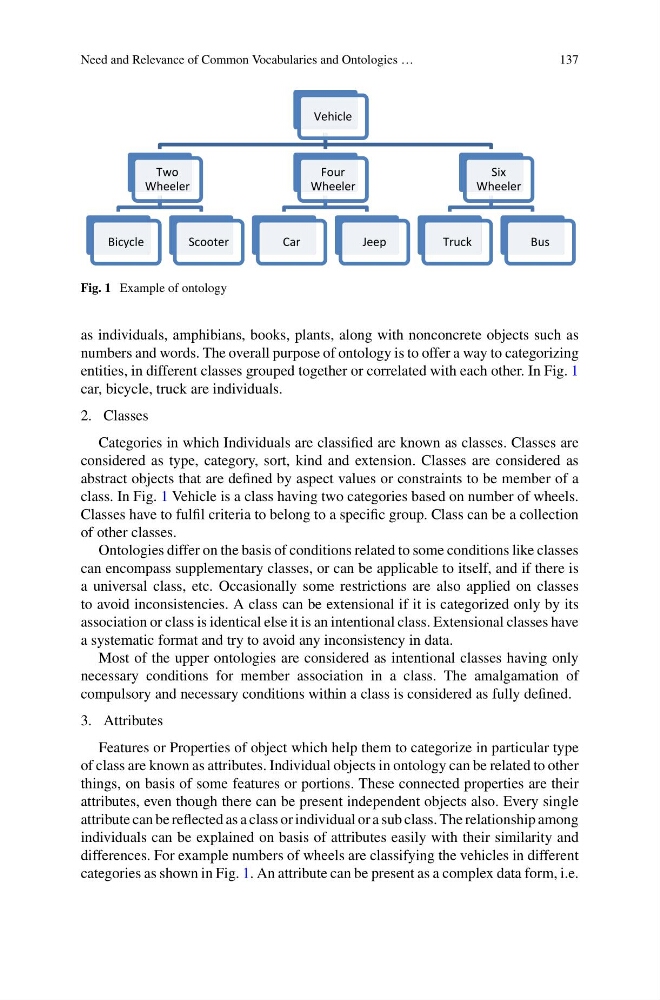
Fig. 1 Example of ontology
as individuals, amphibians, books, plants, along with nonconcrete objects such as
numbers and words. The overall purpose of ontology is to offer a way to categorizing
entities, in different classes grouped together or correlated with each other. In Fig. 1
car, bicycle, truck are individuals.
2. Classes
Categories in which Individuals are classified are known as classes. Classes are
considered as type, category, sort, kind and extension. Classes are considered as
abstract objects that are defined by aspect values or constraints to be member of a
class. In Fig. 1 Vehicle is a class having two categories based on number of wheels.
Classes have to fulfil criteria to belong to a specific group. Class can be a collection
of other classes.
Ontologies differ on the basis of conditions related to some conditions like classes
can encompass supplementary classes, or can be applicable to itself, and if there is
a universal class, etc. Occasionally some restrictions are also applied on classes
to avoid inconsistencies. A class can be extensional if it is categorized only by its
association or class is identical else it is an intentional class. Extensional classes have
a systematic format and try to avoid any inconsistency in data.
Most of the upper ontologies are considered as intentional classes having only
necessary conditions for member association in a class. The amalgamation of
compulsory and necessary conditions within a class is considered as fully defined.
3. Attributes
Features or Properties of object which help them to categorize in particular type
of class are known as attributes. Individual objects in ontology can be related to other
things, on basis of some features or portions. These connected properties are their
attributes, even though there can be present independent objects also. Every single
attribute can be reflected as a class or individual or a sub class. The relationship among
individuals can be explained on basis of attributes easily with their similarity and
differences. For example numbers of wheels are classifying the vehicles in different
categories as shown in Fig. 1. An attribute can be present as a complex data form, i.e.
137
Vehicle
Two
Wheeler
Bicycle
Scooter
Four
Wheeler
Car
Jeep
Six
Wheeler
Truck
Bus
Fig. 1 Example of ontology
as individuals, amphibians, books, plants, along with nonconcrete objects such as
numbers and words. The overall purpose of ontology is to offer a way to categorizing
entities, in different classes grouped together or correlated with each other. In Fig. 1
car, bicycle, truck are individuals.
2. Classes
Categories in which Individuals are classified are known as classes. Classes are
considered as type, category, sort, kind and extension. Classes are considered as
abstract objects that are defined by aspect values or constraints to be member of a
class. In Fig. 1 Vehicle is a class having two categories based on number of wheels.
Classes have to fulfil criteria to belong to a specific group. Class can be a collection
of other classes.
Ontologies differ on the basis of conditions related to some conditions like classes
can encompass supplementary classes, or can be applicable to itself, and if there is
a universal class, etc. Occasionally some restrictions are also applied on classes
to avoid inconsistencies. A class can be extensional if it is categorized only by its
association or class is identical else it is an intentional class. Extensional classes have
a systematic format and try to avoid any inconsistency in data.
Most of the upper ontologies are considered as intentional classes having only
necessary conditions for member association in a class. The amalgamation of
compulsory and necessary conditions within a class is considered as fully defined.
3. Attributes
Features or Properties of object which help them to categorize in particular type
of class are known as attributes. Individual objects in ontology can be related to other
things, on basis of some features or portions. These connected properties are their
attributes, even though there can be present independent objects also. Every single
attribute can be reflected as a class or individual or a sub class. The relationship among
individuals can be explained on basis of attributes easily with their similarity and
differences. For example numbers of wheels are classifying the vehicles in different
categories as shown in Fig. 1. An attribute can be present as a complex data form, i.e.