

Semantic IoT: The Key to Realizing IoT Value
93
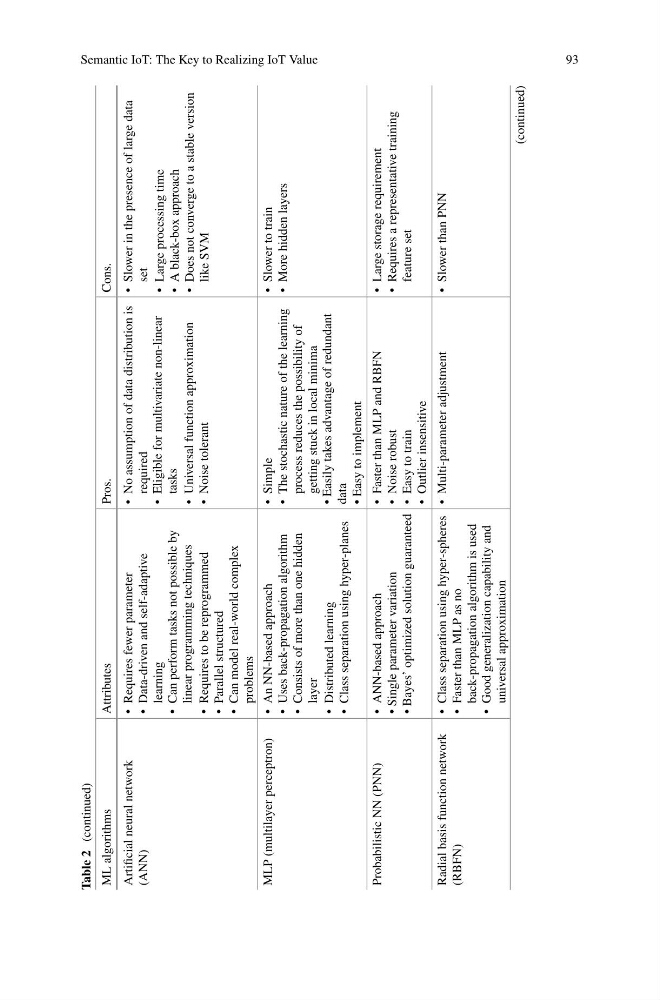
Table 2
(continued)
ML algorithms
Attributes
Pros.
Cons.
Artificial neural network
(ANN)
• Requires fewer parameter
• Data-driven and self-adaptive
learning
• Can perform tasks not possible by
linear programming techniques
• Requires to be reprogrammed
• Parallel structured
• Can model real-world complex
problems
• No assumption of data distribution is
required
• Eligible for multivariate non-linear
tasks
• Universal function approximation
• Noise tolerant
• Slower in the presence of large data
set
• Large processing time
• A black-box approach
• Does not converge to a stable version
like SVM
MLP (multilayer perceptron)
• An NN-based approach
• Uses back-propagation algorithm
• Consists of more than one hidden
layer
• Distributed learning
• Class separation using hyper-planes
• Simple
• The stochastic nature of the learning
process reduces the possibility of
getting stuck in local minima
•
Easily takes advantage of redundant
data
•
Easy to implement
• Slower to train
• More hidden layers
Probabilistic NN (PNN)
• ANN-based approach
•
Single parameter variation
•
Bayes’ optimized solution guaranteed
• Faster than MLP and RBFN
• Noise robust
• Easy to train
• Outlier insensitive
• Large storage requirement
• Requires a representative training
feature set
Radial basis function network
(RBFN)
• Class separation using hyper-spheres
• Faster than MLP as no
back-propagation algorithm is used
• Good generalization capability and
universal approximation
• Multi-parameter adjustment
• Slower than PNN
(continued)
93
Table 2
(continued)
ML algorithms
Attributes
Pros.
Cons.
Artificial neural network
(ANN)
• Requires fewer parameter
• Data-driven and self-adaptive
learning
• Can perform tasks not possible by
linear programming techniques
• Requires to be reprogrammed
• Parallel structured
• Can model real-world complex
problems
• No assumption of data distribution is
required
• Eligible for multivariate non-linear
tasks
• Universal function approximation
• Noise tolerant
• Slower in the presence of large data
set
• Large processing time
• A black-box approach
• Does not converge to a stable version
like SVM
MLP (multilayer perceptron)
• An NN-based approach
• Uses back-propagation algorithm
• Consists of more than one hidden
layer
• Distributed learning
• Class separation using hyper-planes
• Simple
• The stochastic nature of the learning
process reduces the possibility of
getting stuck in local minima
•
Easily takes advantage of redundant
data
•
Easy to implement
• Slower to train
• More hidden layers
Probabilistic NN (PNN)
• ANN-based approach
•
Single parameter variation
•
Bayes’ optimized solution guaranteed
• Faster than MLP and RBFN
• Noise robust
• Easy to train
• Outlier insensitive
• Large storage requirement
• Requires a representative training
feature set
Radial basis function network
(RBFN)
• Class separation using hyper-spheres
• Faster than MLP as no
back-propagation algorithm is used
• Good generalization capability and
universal approximation
• Multi-parameter adjustment
• Slower than PNN
(continued)