

Semantic IoT: The Key to Realizing IoT Value
85
your ability to convert data into decisions that give you the edge. Figure 2 shows the
knowledge hierarchy in SIoT that relies on the conversion of raw data into decisions.
2 Semantic Internet of Things (SIoT)
There are three paradigms to realize the IoT domain [2]. These are
• internet-oriented represented by middleware
• things oriented representation by the sensors
• Semantic-oriented described by the knowledge.
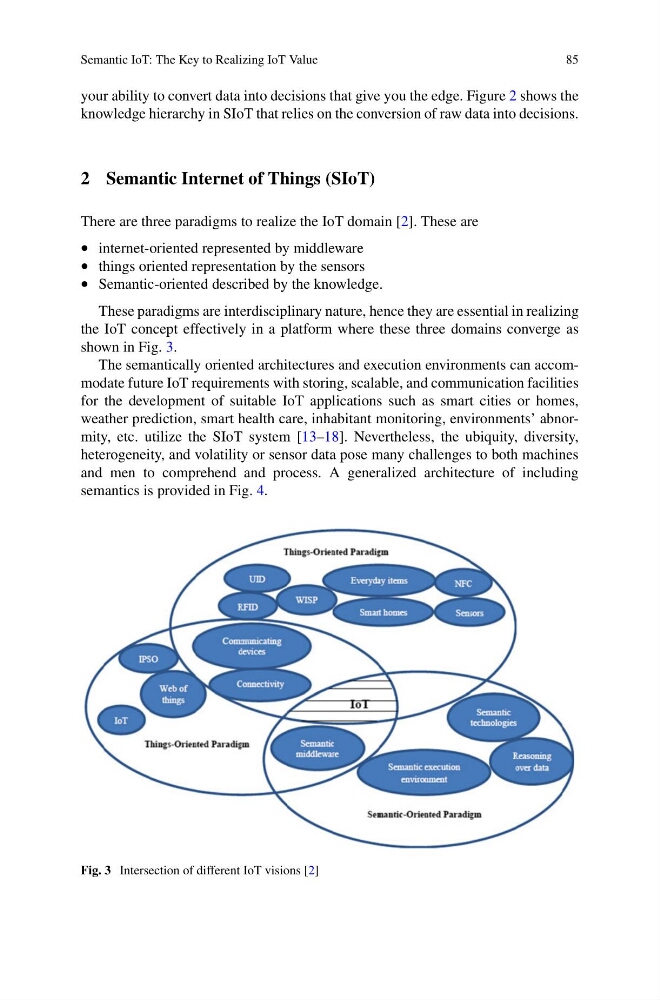
These paradigms are interdisciplinary nature, hence they are essential in realizing
the IoT concept effectively in a platform where these three domains converge as
shown in Fig. 3.
The semantically oriented architectures and execution environments can accommodate future IoT requirements with storing, scalable, and communication facilities
for the development of suitable IoT applications such as smart cities or homes,
weather prediction, smart health care, inhabitant monitoring, environments’ abnormity, etc. utilize the SIoT system [13–18]. Nevertheless, the ubiquity, diversity,
heterogeneity, and volatility or sensor data pose many challenges to both machines
and men to comprehend and process. A generalized architecture of including
semantics is provided in Fig. 4.
Fig. 3 Intersection of different IoT visions [2]
85
your ability to convert data into decisions that give you the edge. Figure 2 shows the
knowledge hierarchy in SIoT that relies on the conversion of raw data into decisions.
2 Semantic Internet of Things (SIoT)
There are three paradigms to realize the IoT domain [2]. These are
• internet-oriented represented by middleware
• things oriented representation by the sensors
• Semantic-oriented described by the knowledge.
These paradigms are interdisciplinary nature, hence they are essential in realizing
the IoT concept effectively in a platform where these three domains converge as
shown in Fig. 3.
The semantically oriented architectures and execution environments can accommodate future IoT requirements with storing, scalable, and communication facilities
for the development of suitable IoT applications such as smart cities or homes,
weather prediction, smart health care, inhabitant monitoring, environments’ abnormity, etc. utilize the SIoT system [13–18]. Nevertheless, the ubiquity, diversity,
heterogeneity, and volatility or sensor data pose many challenges to both machines
and men to comprehend and process. A generalized architecture of including
semantics is provided in Fig. 4.
Fig. 3 Intersection of different IoT visions [2]