

8
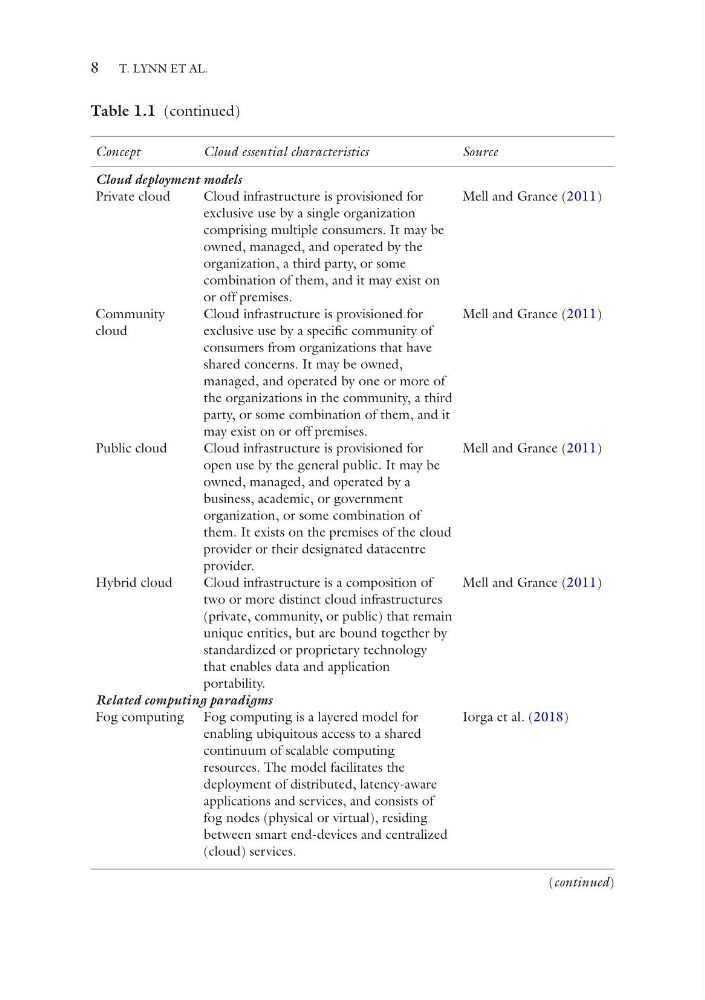
Table 1.1 (continued)
Concept
Cloud essential characteristics
Source
Cloud deployment models
Private cloud
Cloud infrastructure is provisioned for
exclusive use by a single organization
comprising multiple consumers. It may be
owned, managed, and operated by the
organization, a third party, or some
combination of them, and it may exist on
or off premises.
Mell and Grance (2011)
Community
cloud
Cloud infrastructure is provisioned for
exclusive use by a specific community of
consumers from organizations that have
shared concerns. It may be owned,
managed, and operated by one or more of
the organizations in the community, a third
party, or some combination of them, and it
may exist on or off premises.
Mell and Grance (2011)
Public cloud
Cloud infrastructure is provisioned for
open use by the general public. It may be
owned, managed, and operated by a
business, academic, or government
organization, or some combination of
them. It exists on the premises of the cloud
provider or their designated datacentre
provider.
Mell and Grance (2011)
Hybrid cloud
Cloud infrastructure is a composition of
two or more distinct cloud infrastructures
(private, community, or public) that remain
unique entities, but are bound together by
standardized or proprietary technology
that enables data and application
portability.
Mell and Grance (2011)
Related computing paradigms
Fog computing Fog computing is a layered model for
enabling ubiquitous access to a shared
continuum of scalable computing
resources. The model facilitates the
deployment of distributed, latency- aware
applications and services, and consists of
fog nodes (physical or virtual), residing
between smart end-devices and centralized
(cloud) services.
Iorga et al. (2018)
(continued)
T. LYNN ET AL.
Table 1.1 (continued)
Concept
Cloud essential characteristics
Source
Cloud deployment models
Private cloud
Cloud infrastructure is provisioned for
exclusive use by a single organization
comprising multiple consumers. It may be
owned, managed, and operated by the
organization, a third party, or some
combination of them, and it may exist on
or off premises.
Mell and Grance (2011)
Community
cloud
Cloud infrastructure is provisioned for
exclusive use by a specific community of
consumers from organizations that have
shared concerns. It may be owned,
managed, and operated by one or more of
the organizations in the community, a third
party, or some combination of them, and it
may exist on or off premises.
Mell and Grance (2011)
Public cloud
Cloud infrastructure is provisioned for
open use by the general public. It may be
owned, managed, and operated by a
business, academic, or government
organization, or some combination of
them. It exists on the premises of the cloud
provider or their designated datacentre
provider.
Mell and Grance (2011)
Hybrid cloud
Cloud infrastructure is a composition of
two or more distinct cloud infrastructures
(private, community, or public) that remain
unique entities, but are bound together by
standardized or proprietary technology
that enables data and application
portability.
Mell and Grance (2011)
Related computing paradigms
Fog computing Fog computing is a layered model for
enabling ubiquitous access to a shared
continuum of scalable computing
resources. The model facilitates the
deployment of distributed, latency- aware
applications and services, and consists of
fog nodes (physical or virtual), residing
between smart end-devices and centralized
(cloud) services.
Iorga et al. (2018)
(continued)
T. LYNN ET AL.