

135
verification methods to verify the isolated code; application execution is
performed in isolation and under strict observation. The novelty of these
methods, and many others, is in the combination of multiple approaches.
However, the challenge for industry and researchers alike is identifying the
most feasible candidates for a given use case.
7.3
relIabIlIty
It is essential that services and data in the cloud are available to users at all
times. As discussed in Chap. 2, availability is defined in the service level
agreements between cloud service providers and their customers. The
most commonly used definition of reliability in engineering applications
according to Dummer et al. (1997, p. 79) is “the characteristic of an item
expressed by the probability that it will perform a required function under
stated conditions for a stated period of time.” In general terms, service
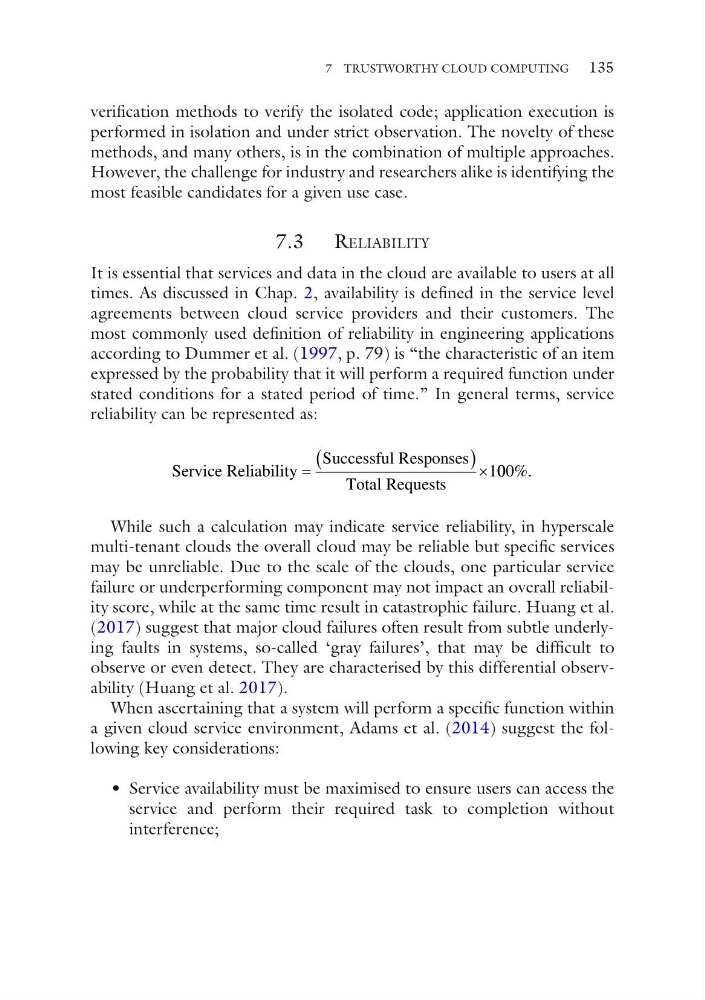
reliability can be represented as:
Service Reliability
Successful Responses
Total Requests
=
(
) ×10 00%.
While such a calculation may indicate service reliability, in hyperscale
multi-tenant clouds the overall cloud may be reliable but specific services
may be unreliable. Due to the scale of the clouds, one particular service
failure or underperforming component may not impact an overall reliability score, while at the same time result in catastrophic failure. Huang et al.
(2017) suggest that major cloud failures often result from subtle underlying faults in systems, so-called ‘gray failures’, that may be difficult to
observe or even detect. They are characterised by this differential observability (Huang et al. 2017).
When ascertaining that a system will perform a specific function within
a given cloud service environment, Adams et al. (2014) suggest the following key considerations:
• Service availability must be maximised to ensure users can access the
service and perform their required task to completion without
interference;
7 TRUSTWORTHY CLOUD COMPUTING
verification methods to verify the isolated code; application execution is
performed in isolation and under strict observation. The novelty of these
methods, and many others, is in the combination of multiple approaches.
However, the challenge for industry and researchers alike is identifying the
most feasible candidates for a given use case.
7.3
relIabIlIty
It is essential that services and data in the cloud are available to users at all
times. As discussed in Chap. 2, availability is defined in the service level
agreements between cloud service providers and their customers. The
most commonly used definition of reliability in engineering applications
according to Dummer et al. (1997, p. 79) is “the characteristic of an item
expressed by the probability that it will perform a required function under
stated conditions for a stated period of time.” In general terms, service
reliability can be represented as:
Service Reliability
Successful Responses
Total Requests
=
(
) ×10 00%.
While such a calculation may indicate service reliability, in hyperscale
multi-tenant clouds the overall cloud may be reliable but specific services
may be unreliable. Due to the scale of the clouds, one particular service
failure or underperforming component may not impact an overall reliability score, while at the same time result in catastrophic failure. Huang et al.
(2017) suggest that major cloud failures often result from subtle underlying faults in systems, so-called ‘gray failures’, that may be difficult to
observe or even detect. They are characterised by this differential observability (Huang et al. 2017).
When ascertaining that a system will perform a specific function within
a given cloud service environment, Adams et al. (2014) suggest the following key considerations:
• Service availability must be maximised to ensure users can access the
service and perform their required task to completion without
interference;
7 TRUSTWORTHY CLOUD COMPUTING