

12
H. Murai et al.
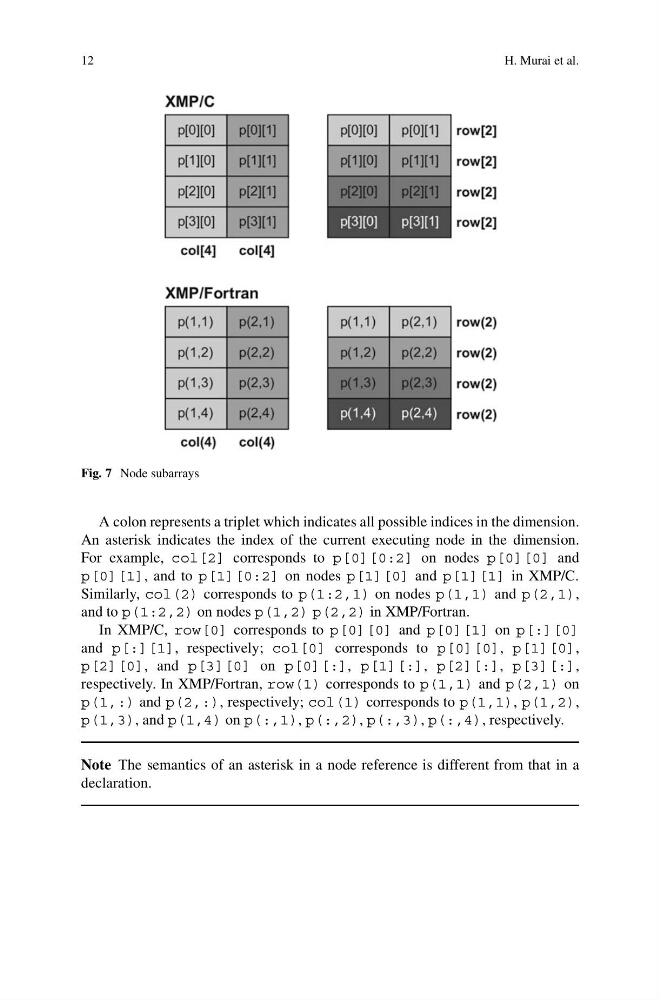
Fig. 7 Node subarrays
A colon represents a triplet which indicates all possible indices in the dimension.
An asterisk indicates the index of the current executing node in the dimension.
For example, col[2] corresponds to p[0][0:2] on nodes p[0][0] and
p[0][1], and to p[1][0:2] on nodes p[1][0] and p[1][1] in XMP/C.
Similarly, col(2) corresponds to p(1:2,1) on nodes p(1,1) and p(2,1),
and to p(1:2,2) on nodes p(1,2) p(2,2) in XMP/Fortran.
In XMP/C, row[0] corresponds to p[0][0] and p[0][1] on p[:][0]
and p[:][1], respectively; col[0] corresponds to p[0][0], p[1][0],
p[2][0], and p[3][0] on p[0][:], p[1][:], p[2][:], p[3][:],
respectively. In XMP/Fortran, row(1) corresponds to p(1,1) and p(2,1) on
p(1,:) and p(2,:), respectively; col(1) corresponds to p(1,1), p(1,2),
p(1,3), and p(1,4) on p(:,1), p(:,2), p(:,3), p(:,4), respectively.
Note The semantics of an asterisk in a node reference is different from that in a
declaration.
H. Murai et al.
Fig. 7 Node subarrays
A colon represents a triplet which indicates all possible indices in the dimension.
An asterisk indicates the index of the current executing node in the dimension.
For example, col[2] corresponds to p[0][0:2] on nodes p[0][0] and
p[0][1], and to p[1][0:2] on nodes p[1][0] and p[1][1] in XMP/C.
Similarly, col(2) corresponds to p(1:2,1) on nodes p(1,1) and p(2,1),
and to p(1:2,2) on nodes p(1,2) p(2,2) in XMP/Fortran.
In XMP/C, row[0] corresponds to p[0][0] and p[0][1] on p[:][0]
and p[:][1], respectively; col[0] corresponds to p[0][0], p[1][0],
p[2][0], and p[3][0] on p[0][:], p[1][:], p[2][:], p[3][:],
respectively. In XMP/Fortran, row(1) corresponds to p(1,1) and p(2,1) on
p(1,:) and p(2,:), respectively; col(1) corresponds to p(1,1), p(1,2),
p(1,3), and p(1,4) on p(:,1), p(:,2), p(:,3), p(:,4), respectively.
Note The semantics of an asterisk in a node reference is different from that in a
declaration.