

184
K. Tsugane et al.
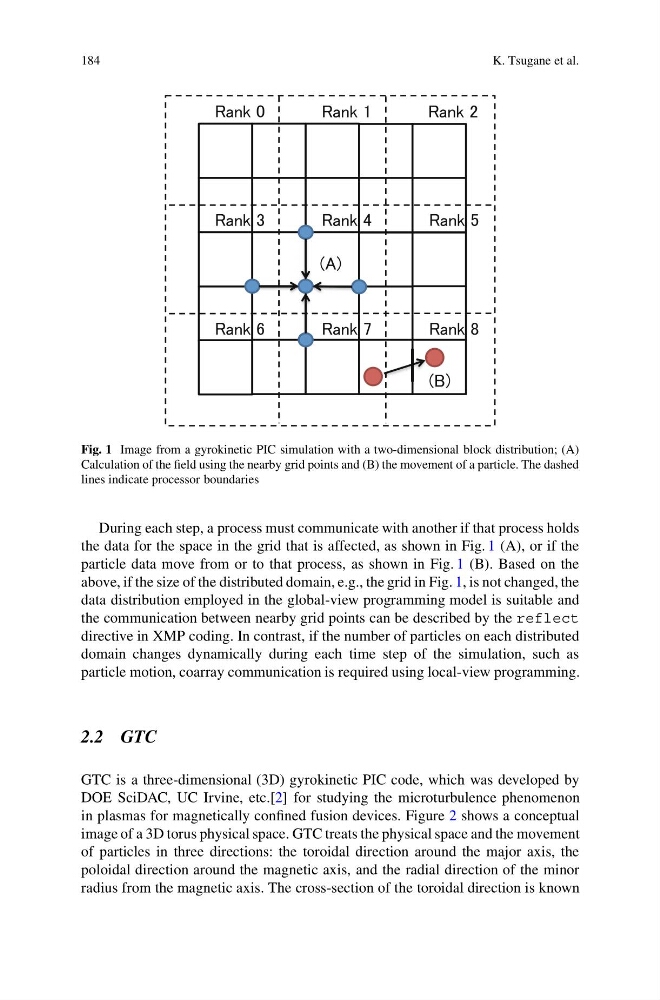
Fig. 1 Image from a gyrokinetic PIC simulation with a two-dimensional block distribution; (A)
Calculation of the field using the nearby grid points and (B) the movement of a particle. The dashed
lines indicate processor boundaries
During each step, a process must communicate with another if that process holds
the data for the space in the grid that is affected, as shown in Fig. 1 (A), or if the
particle data move from or to that process, as shown in Fig. 1 (B). Based on the
above, if the size of the distributed domain, e.g., the grid in Fig. 1, is not changed, the
data distribution employed in the global-view programming model is suitable and
the communication between nearby grid points can be described by the reflect
directive in XMP coding. In contrast, if the number of particles on each distributed
domain changes dynamically during each time step of the simulation, such as
particle motion, coarray communication is required using local-view programming.
2.2 GTC
GTC is a three-dimensional (3D) gyrokinetic PIC code, which was developed by
DOE SciDAC, UC Irvine, etc.[2] for studying the microturbulence phenomenon
in plasmas for magnetically confined fusion devices. Figure 2 shows a conceptual
image of a 3D torus physical space. GTC treats the physical space and the movement
of particles in three directions: the toroidal direction around the major axis, the
poloidal direction around the magnetic axis, and the radial direction of the minor
radius from the magnetic axis. The cross-section of the toroidal direction is known
K. Tsugane et al.
Fig. 1 Image from a gyrokinetic PIC simulation with a two-dimensional block distribution; (A)
Calculation of the field using the nearby grid points and (B) the movement of a particle. The dashed
lines indicate processor boundaries
During each step, a process must communicate with another if that process holds
the data for the space in the grid that is affected, as shown in Fig. 1 (A), or if the
particle data move from or to that process, as shown in Fig. 1 (B). Based on the
above, if the size of the distributed domain, e.g., the grid in Fig. 1, is not changed, the
data distribution employed in the global-view programming model is suitable and
the communication between nearby grid points can be described by the reflect
directive in XMP coding. In contrast, if the number of particles on each distributed
domain changes dynamically during each time step of the simulation, such as
particle motion, coarray communication is required using local-view programming.
2.2 GTC
GTC is a three-dimensional (3D) gyrokinetic PIC code, which was developed by
DOE SciDAC, UC Irvine, etc.[2] for studying the microturbulence phenomenon
in plasmas for magnetically confined fusion devices. Figure 2 shows a conceptual
image of a 3D torus physical space. GTC treats the physical space and the movement
of particles in three directions: the toroidal direction around the major axis, the
poloidal direction around the magnetic axis, and the radial direction of the minor
radius from the magnetic axis. The cross-section of the toroidal direction is known