

156
M. Nakao
0
1
9
6
4
5
2
3
8
7
0 1
9
6
4 5
2 3
8
7
0
1
9
6
4
5
2
3
8
7
1
2
2
1
3 3
3
3
2
3
3 3
2 2
2
1 1
2
3
2
2
2
3
2
3 2
2
2
2
2
2 1 1 2
2 3 1 2
1 1
1 2 1 2
2 3
2 2 2
3
2 1 2 3
1 1
2 2
2 2
3 1
1 1
2 1
1 1 3 1
3
3
2
1
2
1
1
1
1
1
2
1
2
1
2
3
1
2
3
2
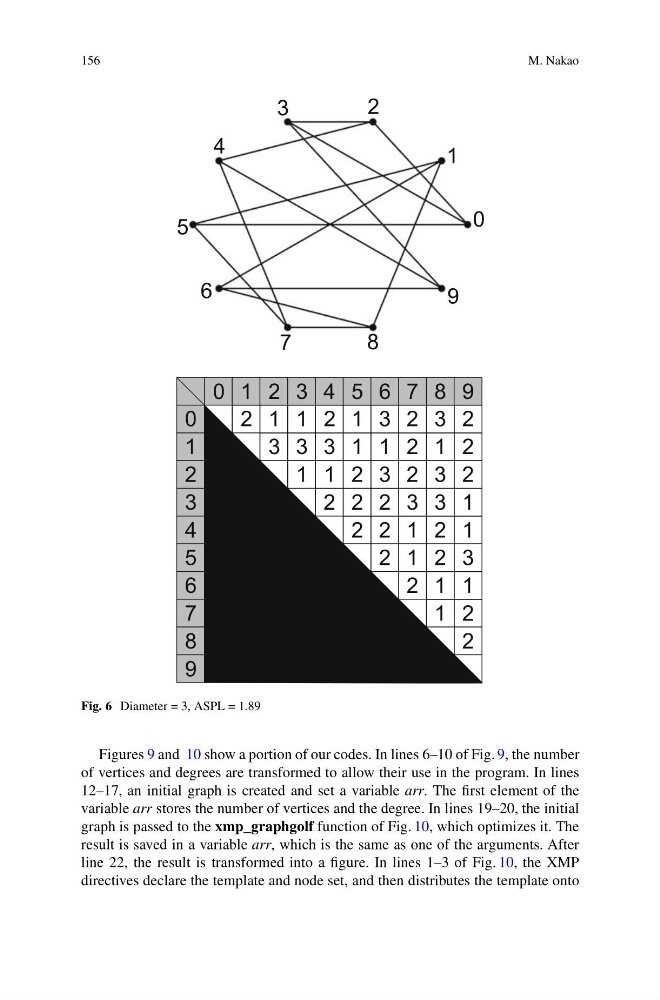
Fig. 6 Diameter = 3, ASPL = 1.89
Figures 9 and 10 show a portion of our codes. In lines 6–10 of Fig. 9, the number
of vertices and degrees are transformed to allow their use in the program. In lines
12–17, an initial graph is created and set a variable arr. The first element of the
variable arr stores the number of vertices and the degree. In lines 19–20, the initial
graph is passed to the xmp_graphgolf function of Fig. 10, which optimizes it. The
result is saved in a variable arr, which is the same as one of the arguments. After
line 22, the result is transformed into a figure. In lines 1–3 of Fig. 10, the XMP
directives declare the template and node set, and then distributes the template onto
M. Nakao
0
1
9
6
4
5
2
3
8
7
0 1
9
6
4 5
2 3
8
7
0
1
9
6
4
5
2
3
8
7
1
2
2
1
3 3
3
3
2
3
3 3
2 2
2
1 1
2
3
2
2
2
3
2
3 2
2
2
2
2
2 1 1 2
2 3 1 2
1 1
1 2 1 2
2 3
2 2 2
3
2 1 2 3
1 1
2 2
2 2
3 1
1 1
2 1
1 1 3 1
3
3
2
1
2
1
1
1
1
1
2
1
2
1
2
3
1
2
3
2
Fig. 6 Diameter = 3, ASPL = 1.89
Figures 9 and 10 show a portion of our codes. In lines 6–10 of Fig. 9, the number
of vertices and degrees are transformed to allow their use in the program. In lines
12–17, an initial graph is created and set a variable arr. The first element of the
variable arr stores the number of vertices and the degree. In lines 19–20, the initial
graph is passed to the xmp_graphgolf function of Fig. 10, which optimizes it. The
result is saved in a variable arr, which is the same as one of the arguments. After
line 22, the result is transformed into a figure. In lines 1–3 of Fig. 10, the XMP
directives declare the template and node set, and then distributes the template onto