

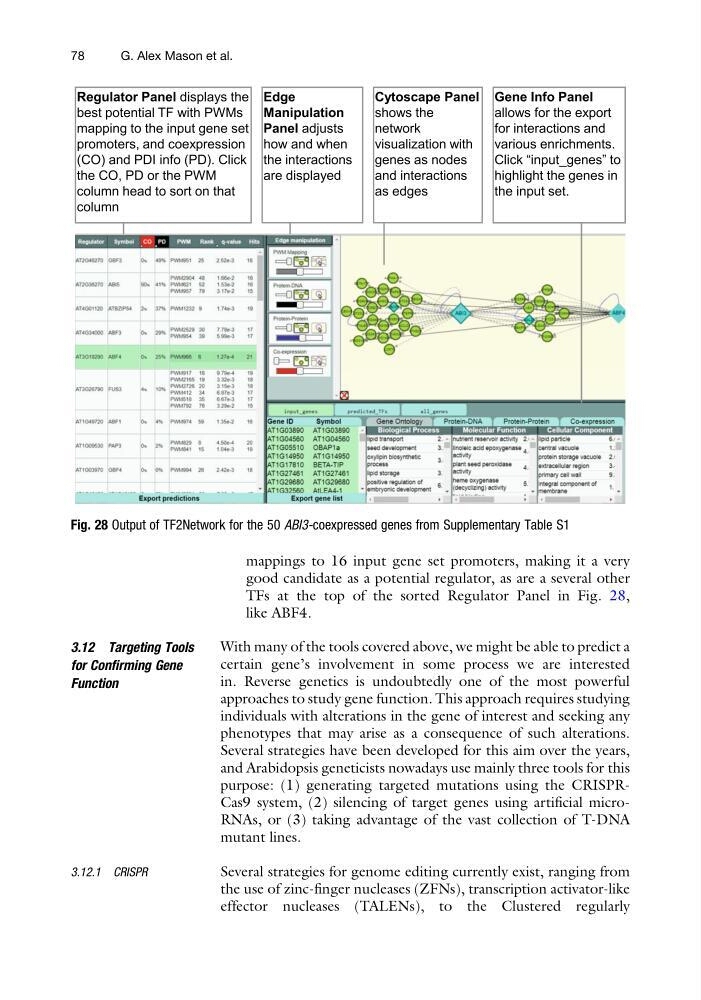
mappings to 16 input gene set promoters, making it a very
good candidate as a potential regulator, as are a several other
TFs at the top of the sorted Regulator Panel in Fig. 28,
like ABF4.
3.12 Targeting Tools
for Confirming Gene
Function
With many of the tools covered above, we might be able to predict a
certain gene’s involvement in some process we are interested
in. Reverse genetics is undoubtedly one of the most powerful
approaches to study gene function. This approach requires studying
individuals with alterations in the gene of interest and seeking any
phenotypes that may arise as a consequence of such alterations.
Several strategies have been developed for this aim over the years,
and Arabidopsis geneticists nowadays use mainly three tools for this
purpose: (1) generating targeted mutations using the CRISPRCas9 system, (2) silencing of target genes using artificial microRNAs, or (3) taking advantage of the vast collection of T-DNA
mutant lines.
3.12.1 CRISPR
Several strategies for genome editing currently exist, ranging from
the use of zinc-finger nucleases (ZFNs), transcription activator-like
effector nucleases (TALENs), to the Clustered regularly
Fig. 28 Output of TF2Network for the 50 ABI3-coexpressed genes from Supplementary Table S1
78
G. Alex Mason et al.
good candidate as a potential regulator, as are a several other
TFs at the top of the sorted Regulator Panel in Fig. 28,
like ABF4.
3.12 Targeting Tools
for Confirming Gene
Function
With many of the tools covered above, we might be able to predict a
certain gene’s involvement in some process we are interested
in. Reverse genetics is undoubtedly one of the most powerful
approaches to study gene function. This approach requires studying
individuals with alterations in the gene of interest and seeking any
phenotypes that may arise as a consequence of such alterations.
Several strategies have been developed for this aim over the years,
and Arabidopsis geneticists nowadays use mainly three tools for this
purpose: (1) generating targeted mutations using the CRISPRCas9 system, (2) silencing of target genes using artificial microRNAs, or (3) taking advantage of the vast collection of T-DNA
mutant lines.
3.12.1 CRISPR
Several strategies for genome editing currently exist, ranging from
the use of zinc-finger nucleases (ZFNs), transcription activator-like
effector nucleases (TALENs), to the Clustered regularly
Fig. 28 Output of TF2Network for the 50 ABI3-coexpressed genes from Supplementary Table S1
78
G. Alex Mason et al.