

1. Go to https://dev.bits.vib.be/ptm-viewer/index.php. Click
on “Protein Search” at the top of the page.
2. Instead of ABI3, which does not currently have any protein
modifications listed in this repository, let’s search for HSP90.1
(HEAT SHOCK PROTEIN 90.1) using the AGI ID
AT5G52640.
3. At the bottom of the page your search results should be displayed. Click on the ID “AT5G52640.1.”
4. You will now be taken to a new page displaying the experimental data describing PTMs of HSP90.1. As you can see, there are
eleven amino acid sites that span six different PTMs. If you
scroll down a bit, you can also view the eleven amino acids that
are modified in their sequence context. You may also notice
that in the “Conf” column, there are green squares. Confidence scores are based on extracted peptide scores from a
variety of sources and Plant PTM viewer labels PTMs as either
low, medium, or high confidence [62]. The greener the square,
the more experimental validations are associated with this
PTM. For details on this calculation, please see Willems et al.
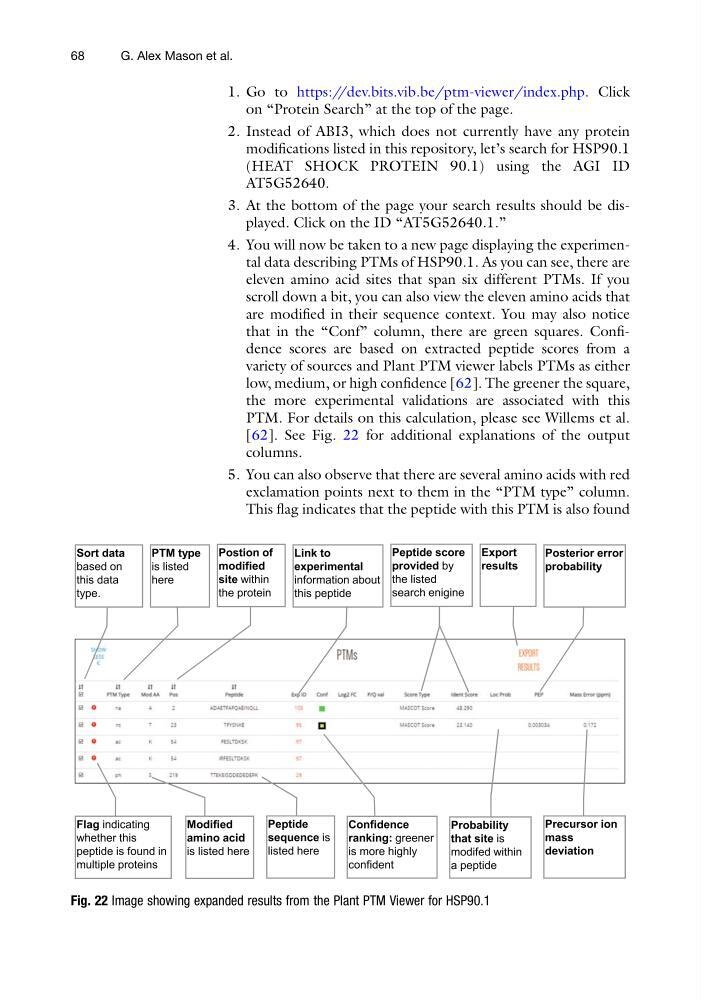
[62]. See Fig. 22 for additional explanations of the output
columns.
5. You can also observe that there are several amino acids with red
exclamation points next to them in the “PTM type” column.
This flag indicates that the peptide with this PTM is also found
Fig. 22 Image showing expanded results from the Plant PTM Viewer for HSP90.1
68
G. Alex Mason et al.
on “Protein Search” at the top of the page.
2. Instead of ABI3, which does not currently have any protein
modifications listed in this repository, let’s search for HSP90.1
(HEAT SHOCK PROTEIN 90.1) using the AGI ID
AT5G52640.
3. At the bottom of the page your search results should be displayed. Click on the ID “AT5G52640.1.”
4. You will now be taken to a new page displaying the experimental data describing PTMs of HSP90.1. As you can see, there are
eleven amino acid sites that span six different PTMs. If you
scroll down a bit, you can also view the eleven amino acids that
are modified in their sequence context. You may also notice
that in the “Conf” column, there are green squares. Confidence scores are based on extracted peptide scores from a
variety of sources and Plant PTM viewer labels PTMs as either
low, medium, or high confidence [62]. The greener the square,
the more experimental validations are associated with this
PTM. For details on this calculation, please see Willems et al.
[62]. See Fig. 22 for additional explanations of the output
columns.
5. You can also observe that there are several amino acids with red
exclamation points next to them in the “PTM type” column.
This flag indicates that the peptide with this PTM is also found
Fig. 22 Image showing expanded results from the Plant PTM Viewer for HSP90.1
68
G. Alex Mason et al.