

3.6 Label-Free
Relative Quantification
Analysis
1. MS raw output data are processed using MaxQuant [4, 22] (see
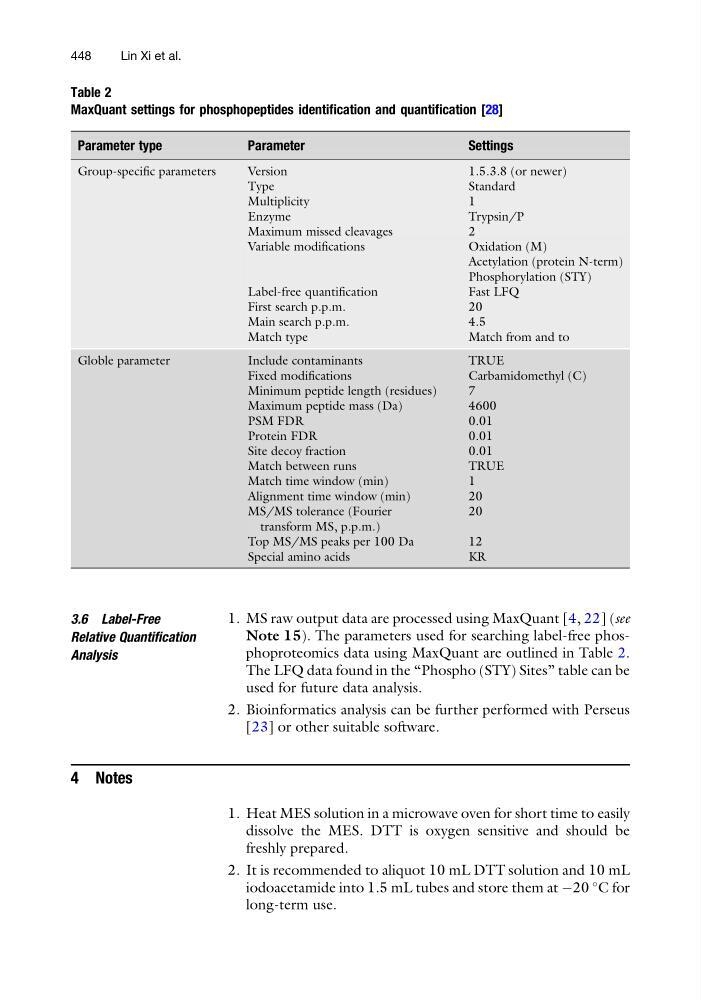
Note 15). The parameters used for searching label-free phosphoproteomics data using MaxQuant are outlined in Table 2.
The LFQ data found in the “Phospho (STY) Sites” table can be
used for future data analysis.
2. Bioinformatics analysis can be further performed with Perseus
[23] or other suitable software.
4 Notes
1. Heat MES solution in a microwave oven for short time to easily
dissolve the MES. DTT is oxygen sensitive and should be
freshly prepared.
2. It is recommended to aliquot 10 mL DTT solution and 10 mL
iodoacetamide into 1.5 mL tubes and store them at À20
C for
long-term use.
Table 2
MaxQuant settings for phosphopeptides identification and quantification [28]
Parameter type
Parameter
Settings
Group-specific parameters
Version
1.5.3.8 (or newer)
Type
Standard
Multiplicity
1
Enzyme
Trypsin/P
Maximum missed cleavages
2
Variable modifications
Oxidation (M)
Acetylation (protein N-term)
Phosphorylation (STY)
Label-free quantification
Fast LFQ
First search p.p.m.
20
Main search p.p.m.
4.5
Match type
Match from and to
Globle parameter
Include contaminants
TRUE
Fixed modifications
Carbamidomethyl (C)
Minimum peptide length (residues)
7
Maximum peptide mass (Da)
4600
PSM FDR
0.01
Protein FDR
0.01
Site decoy fraction
0.01
Match between runs
TRUE
Match time window (min)
1
Alignment time window (min)
20
MS/MS tolerance (Fourier
transform MS, p.p.m.)
20
Top MS/MS peaks per 100 Da
12
Special amino acids
KR
448
Lin Xi et al.
Relative Quantification
Analysis
1. MS raw output data are processed using MaxQuant [4, 22] (see
Note 15). The parameters used for searching label-free phosphoproteomics data using MaxQuant are outlined in Table 2.
The LFQ data found in the “Phospho (STY) Sites” table can be
used for future data analysis.
2. Bioinformatics analysis can be further performed with Perseus
[23] or other suitable software.
4 Notes
1. Heat MES solution in a microwave oven for short time to easily
dissolve the MES. DTT is oxygen sensitive and should be
freshly prepared.
2. It is recommended to aliquot 10 mL DTT solution and 10 mL
iodoacetamide into 1.5 mL tubes and store them at À20
C for
long-term use.
Table 2
MaxQuant settings for phosphopeptides identification and quantification [28]
Parameter type
Parameter
Settings
Group-specific parameters
Version
1.5.3.8 (or newer)
Type
Standard
Multiplicity
1
Enzyme
Trypsin/P
Maximum missed cleavages
2
Variable modifications
Oxidation (M)
Acetylation (protein N-term)
Phosphorylation (STY)
Label-free quantification
Fast LFQ
First search p.p.m.
20
Main search p.p.m.
4.5
Match type
Match from and to
Globle parameter
Include contaminants
TRUE
Fixed modifications
Carbamidomethyl (C)
Minimum peptide length (residues)
7
Maximum peptide mass (Da)
4600
PSM FDR
0.01
Protein FDR
0.01
Site decoy fraction
0.01
Match between runs
TRUE
Match time window (min)
1
Alignment time window (min)
20
MS/MS tolerance (Fourier
transform MS, p.p.m.)
20
Top MS/MS peaks per 100 Da
12
Special amino acids
KR
448
Lin Xi et al.