

kinase SIRK1, the water channel PIP2F, that is involved in regulation of water transport [28]. Another prominent example is the
plasma membrane H
+
-ATPases. Through the use of MS-based
membrane phosphoproteomics, eight phosphorylation sites have
been identified [17], and it has been shown that different sites
function as a molecular switch in regulation of pump activity [6].
In addition, the phosphorylation status of kinases and their substrates is of high interest in studying signaling cascades. Therefore,
the identification and quantification of the phosphorylation of
membrane proteins is crucial for studying cell signaling. However,
for many kinases the substrates are still unknown, and for many
substrates, the respective kinases are also not known.
We developed the “ShortPhos” protocol to facilitate fast and
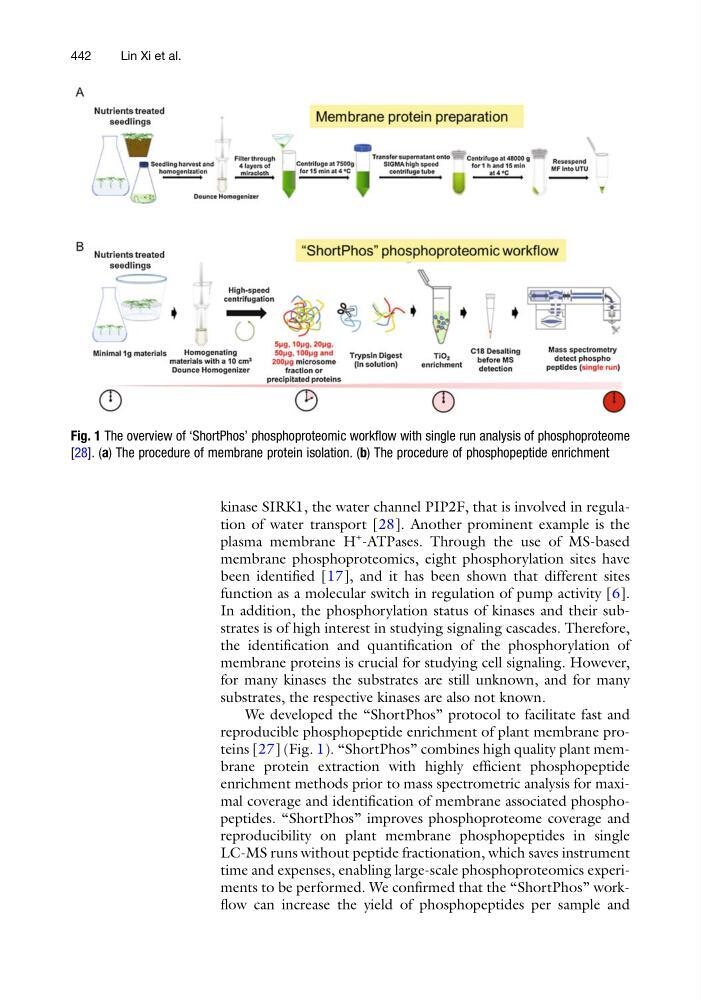
reproducible phosphopeptide enrichment of plant membrane proteins [27] (Fig. 1). “ShortPhos” combines high quality plant membrane protein extraction with highly efficient phosphopeptide
enrichment methods prior to mass spectrometric analysis for maximal coverage and identification of membrane associated phosphopeptides. “ShortPhos” improves phosphoproteome coverage and
reproducibility on plant membrane phosphopeptides in single
LC-MS runs without peptide fractionation, which saves instrument
time and expenses, enabling large-scale phosphoproteomics experiments to be performed. We confirmed that the “ShortPhos” workflow can increase the yield of phosphopeptides per sample and
Fig. 1 The overview of ‘ShortPhos’ phosphoproteomic workflow with single run analysis of phosphoproteome
[28]. (a) The procedure of membrane protein isolation. (b) The procedure of phosphopeptide enrichment
442
Lin Xi et al.
plasma membrane H
+
-ATPases. Through the use of MS-based
membrane phosphoproteomics, eight phosphorylation sites have
been identified [17], and it has been shown that different sites
function as a molecular switch in regulation of pump activity [6].
In addition, the phosphorylation status of kinases and their substrates is of high interest in studying signaling cascades. Therefore,
the identification and quantification of the phosphorylation of
membrane proteins is crucial for studying cell signaling. However,
for many kinases the substrates are still unknown, and for many
substrates, the respective kinases are also not known.
We developed the “ShortPhos” protocol to facilitate fast and
reproducible phosphopeptide enrichment of plant membrane proteins [27] (Fig. 1). “ShortPhos” combines high quality plant membrane protein extraction with highly efficient phosphopeptide
enrichment methods prior to mass spectrometric analysis for maximal coverage and identification of membrane associated phosphopeptides. “ShortPhos” improves phosphoproteome coverage and
reproducibility on plant membrane phosphopeptides in single
LC-MS runs without peptide fractionation, which saves instrument
time and expenses, enabling large-scale phosphoproteomics experiments to be performed. We confirmed that the “ShortPhos” workflow can increase the yield of phosphopeptides per sample and
Fig. 1 The overview of ‘ShortPhos’ phosphoproteomic workflow with single run analysis of phosphoproteome
[28]. (a) The procedure of membrane protein isolation. (b) The procedure of phosphopeptide enrichment
442
Lin Xi et al.