

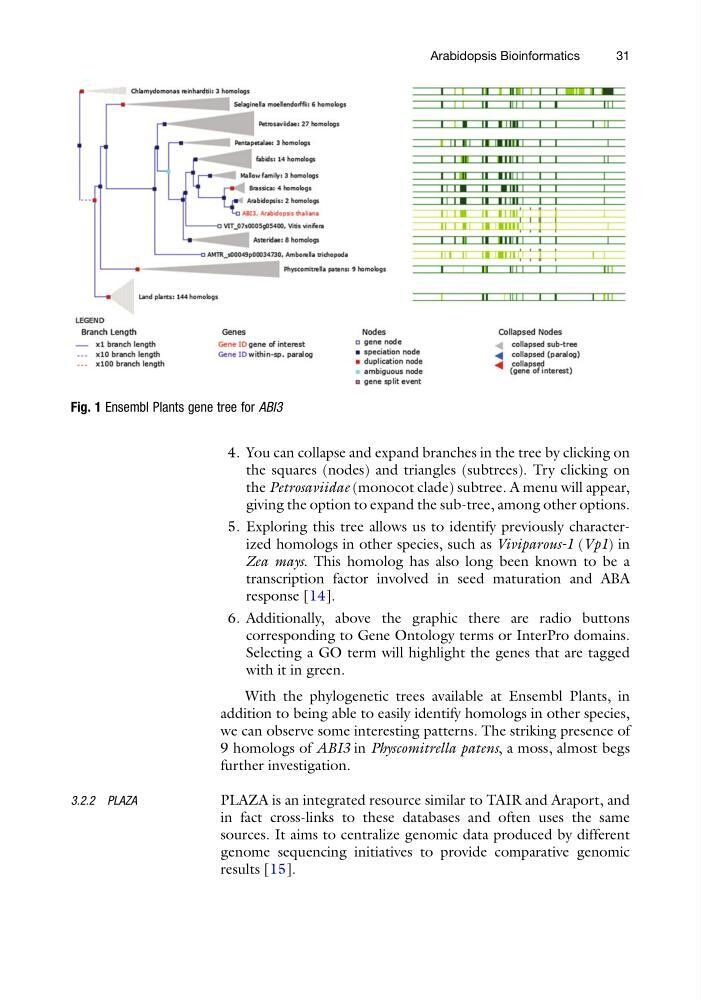
4. You can collapse and expand branches in the tree by clicking on
the squares (nodes) and triangles (subtrees). Try clicking on
the Petrosaviidae (monocot clade) subtree. A menu will appear,
giving the option to expand the sub-tree, among other options.
5. Exploring this tree allows us to identify previously characterized homologs in other species, such as Viviparous-1 (Vp1) in
Zea mays. This homolog has also long been known to be a
transcription factor involved in seed maturation and ABA
response [14].
6. Additionally, above the graphic there are radio buttons
corresponding to Gene Ontology terms or InterPro domains.
Selecting a GO term will highlight the genes that are tagged
with it in green.
With the phylogenetic trees available at Ensembl Plants, in
addition to being able to easily identify homologs in other species,
we can observe some interesting patterns. The striking presence of
9 homologs of ABI3 in Physcomitrella patens, a moss, almost begs
further investigation.
3.2.2 PLAZA
PLAZA is an integrated resource similar to TAIR and Araport, and
in fact cross-links to these databases and often uses the same
sources. It aims to centralize genomic data produced by different
genome sequencing initiatives to provide comparative genomic
results [15].
Fig. 1 Ensembl Plants gene tree for ABI3
Arabidopsis Bioinformatics
31
the squares (nodes) and triangles (subtrees). Try clicking on
the Petrosaviidae (monocot clade) subtree. A menu will appear,
giving the option to expand the sub-tree, among other options.
5. Exploring this tree allows us to identify previously characterized homologs in other species, such as Viviparous-1 (Vp1) in
Zea mays. This homolog has also long been known to be a
transcription factor involved in seed maturation and ABA
response [14].
6. Additionally, above the graphic there are radio buttons
corresponding to Gene Ontology terms or InterPro domains.
Selecting a GO term will highlight the genes that are tagged
with it in green.
With the phylogenetic trees available at Ensembl Plants, in
addition to being able to easily identify homologs in other species,
we can observe some interesting patterns. The striking presence of
9 homologs of ABI3 in Physcomitrella patens, a moss, almost begs
further investigation.
3.2.2 PLAZA
PLAZA is an integrated resource similar to TAIR and Araport, and
in fact cross-links to these databases and often uses the same
sources. It aims to centralize genomic data produced by different
genome sequencing initiatives to provide comparative genomic
results [15].
Fig. 1 Ensembl Plants gene tree for ABI3
Arabidopsis Bioinformatics
31