

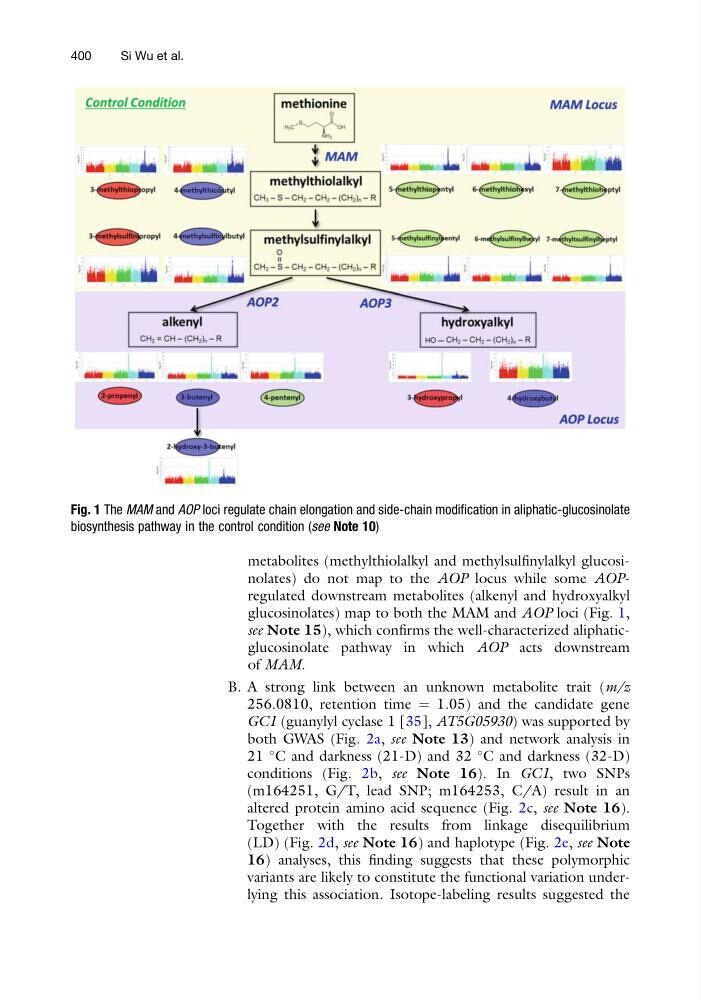
metabolites (methylthiolalkyl and methylsulfinylalkyl glucosinolates) do not map to the AOP locus while some AOPregulated downstream metabolites (alkenyl and hydroxyalkyl
glucosinolates) map to both the MAM and AOP loci (Fig. 1,
see Note 15), which confirms the well-characterized aliphaticglucosinolate pathway in which AOP acts downstream
of MAM.
B. A strong link between an unknown metabolite trait (m/z
256.0810, retention time ¼ 1.05) and the candidate gene
GC1 (guanylyl cyclase 1 [35], AT5G05930) was supported by
both GWAS (Fig. 2a, see Note 13) and network analysis in
21
C and darkness (21-D) and 32
C and darkness (32-D)
conditions (Fig. 2b, see Note 16). In GC1, two SNPs
(m164251, G/T, lead SNP; m164253, C/A) result in an
altered protein amino acid sequence (Fig. 2c, see Note 16).
Together with the results from linkage disequilibrium
(LD) (Fig. 2d, see Note 16) and haplotype (Fig. 2e, see Note
16) analyses, this finding suggests that these polymorphic
variants are likely to constitute the functional variation underlying this association. Isotope-labeling results suggested the
Fig. 1 The MAM and AOP loci regulate chain elongation and side-chain modification in aliphatic-glucosinolate
biosynthesis pathway in the control condition (see Note 10)
400
Si Wu et al.
glucosinolates) map to both the MAM and AOP loci (Fig. 1,
see Note 15), which confirms the well-characterized aliphaticglucosinolate pathway in which AOP acts downstream
of MAM.
B. A strong link between an unknown metabolite trait (m/z
256.0810, retention time ¼ 1.05) and the candidate gene
GC1 (guanylyl cyclase 1 [35], AT5G05930) was supported by
both GWAS (Fig. 2a, see Note 13) and network analysis in
21
C and darkness (21-D) and 32
C and darkness (32-D)
conditions (Fig. 2b, see Note 16). In GC1, two SNPs
(m164251, G/T, lead SNP; m164253, C/A) result in an
altered protein amino acid sequence (Fig. 2c, see Note 16).
Together with the results from linkage disequilibrium
(LD) (Fig. 2d, see Note 16) and haplotype (Fig. 2e, see Note
16) analyses, this finding suggests that these polymorphic
variants are likely to constitute the functional variation underlying this association. Isotope-labeling results suggested the
Fig. 1 The MAM and AOP loci regulate chain elongation and side-chain modification in aliphatic-glucosinolate
biosynthesis pathway in the control condition (see Note 10)
400
Si Wu et al.