

Consortium worked to create a “super-portal” to keep track of and
functionally “tag” various Arabidopsis tools—see https://conf.ara
bidopsis.org/display/COM/Resources. Finally, one of the
co-authors on this book chapter has released a free course on
Coursera.org called Plant Bioinformatics at https://www.
coursera.org/learn/plant-bioinformatics/. Many of the tools
described in this chapter are covered in this online lab course.
2 Materials
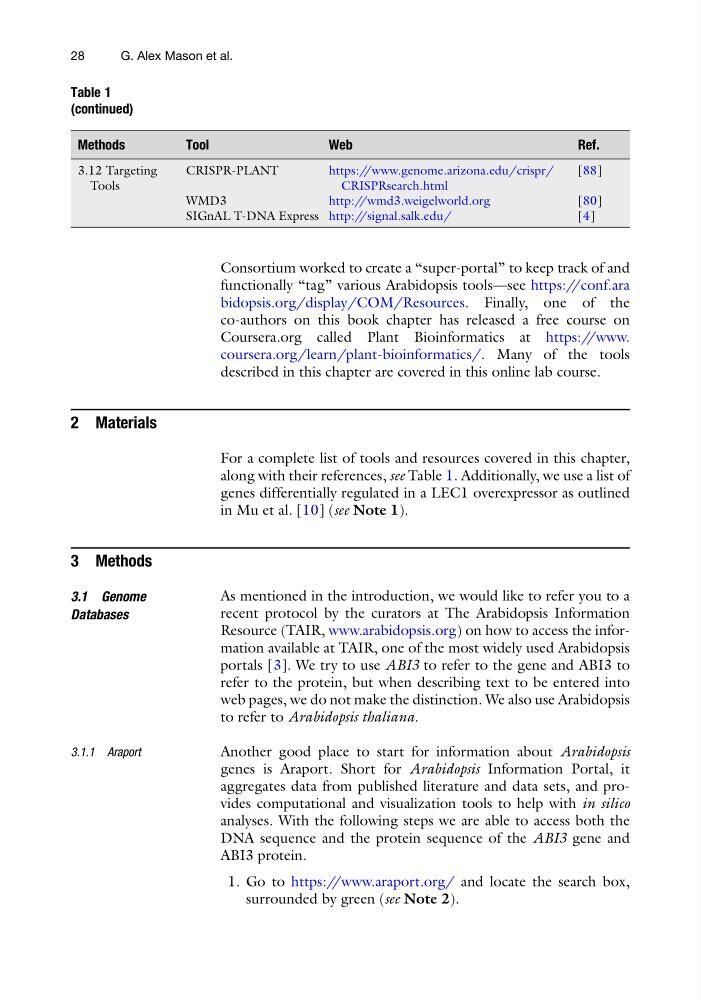
For a complete list of tools and resources covered in this chapter,
along with their references, see Table 1. Additionally, we use a list of
genes differentially regulated in a LEC1 overexpressor as outlined
in Mu et al. [10] (see Note 1).
3 Methods
3.1 Genome
Databases
As mentioned in the introduction, we would like to refer you to a
recent protocol by the curators at The Arabidopsis Information
Resource (TAIR, www.arabidopsis.org) on how to access the information available at TAIR, one of the most widely used Arabidopsis
portals [3]. We try to use ABI3 to refer to the gene and ABI3 to
refer to the protein, but when describing text to be entered into
web pages, we do not make the distinction. We also use Arabidopsis
to refer to Arabidopsis thaliana.
3.1.1 Araport
Another good place to start for information about Arabidopsis
genes is Araport. Short for Arabidopsis Information Portal, it
aggregates data from published literature and data sets, and provides computational and visualization tools to help with in silico
analyses. With the following steps we are able to access both the
DNA sequence and the protein sequence of the ABI3 gene and
ABI3 protein.
1. Go to https://www.araport.org/ and locate the search box,
surrounded by green (see Note 2).
Table 1
(continued)
Methods
Tool
Web
Ref.
3.12 Targeting
Tools
CRISPR-PLANT
https://www.genome.arizona.edu/crispr/
CRISPRsearch.html
[88]
WMD3
http://wmd3.weigelworld.org
[80]
SIGnAL T-DNA Express http://signal.salk.edu/
[4]
28
G. Alex Mason et al.
functionally “tag” various Arabidopsis tools—see https://conf.ara
bidopsis.org/display/COM/Resources. Finally, one of the
co-authors on this book chapter has released a free course on
Coursera.org called Plant Bioinformatics at https://www.
coursera.org/learn/plant-bioinformatics/. Many of the tools
described in this chapter are covered in this online lab course.
2 Materials
For a complete list of tools and resources covered in this chapter,
along with their references, see Table 1. Additionally, we use a list of
genes differentially regulated in a LEC1 overexpressor as outlined
in Mu et al. [10] (see Note 1).
3 Methods
3.1 Genome
Databases
As mentioned in the introduction, we would like to refer you to a
recent protocol by the curators at The Arabidopsis Information
Resource (TAIR, www.arabidopsis.org) on how to access the information available at TAIR, one of the most widely used Arabidopsis
portals [3]. We try to use ABI3 to refer to the gene and ABI3 to
refer to the protein, but when describing text to be entered into
web pages, we do not make the distinction. We also use Arabidopsis
to refer to Arabidopsis thaliana.
3.1.1 Araport
Another good place to start for information about Arabidopsis
genes is Araport. Short for Arabidopsis Information Portal, it
aggregates data from published literature and data sets, and provides computational and visualization tools to help with in silico
analyses. With the following steps we are able to access both the
DNA sequence and the protein sequence of the ABI3 gene and
ABI3 protein.
1. Go to https://www.araport.org/ and locate the search box,
surrounded by green (see Note 2).
Table 1
(continued)
Methods
Tool
Web
Ref.
3.12 Targeting
Tools
CRISPR-PLANT
https://www.genome.arizona.edu/crispr/
CRISPRsearch.html
[88]
WMD3
http://wmd3.weigelworld.org
[80]
SIGnAL T-DNA Express http://signal.salk.edu/
[4]
28
G. Alex Mason et al.