

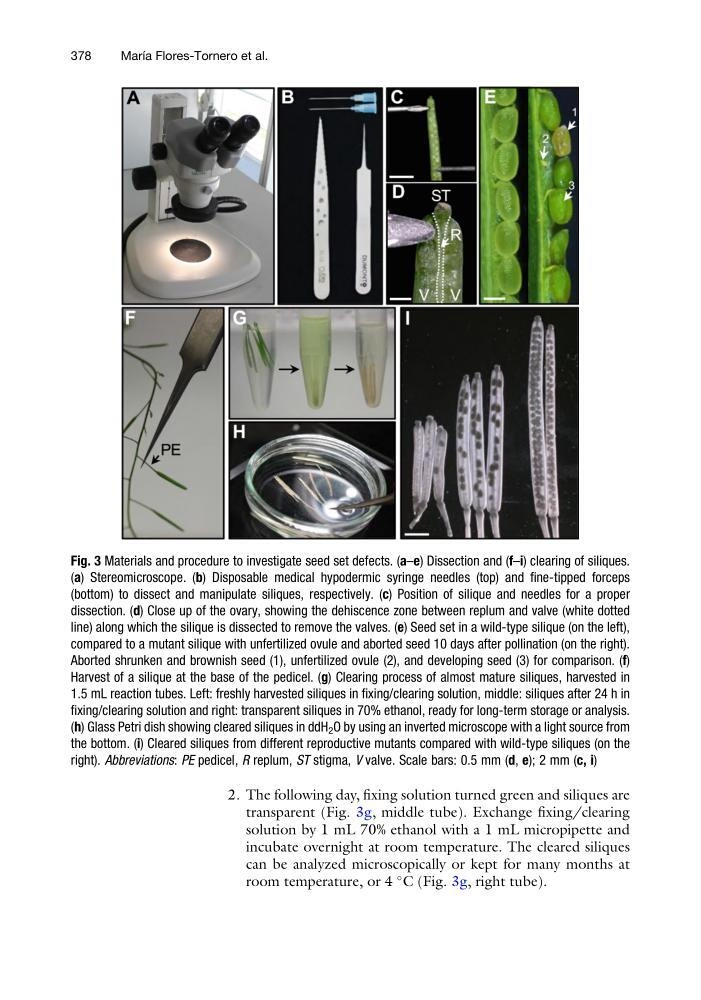
2. The following day, fixing solution turned green and siliques are
transparent (Fig. 3g, middle tube). Exchange fixing/clearing
solution by 1 mL 70% ethanol with a 1 mL micropipette and
incubate overnight at room temperature. The cleared siliques
can be analyzed microscopically or kept for many months at
room temperature, or 4
C (Fig. 3g, right tube).
Fig. 3 Materials and procedure to investigate seed set defects. (a–e) Dissection and (f–i) clearing of siliques.
(a) Stereomicroscope. (b) Disposable medical hypodermic syringe needles (top) and fine-tipped forceps
(bottom) to dissect and manipulate siliques, respectively. (c) Position of silique and needles for a proper
dissection. (d) Close up of the ovary, showing the dehiscence zone between replum and valve (white dotted
line) along which the silique is dissected to remove the valves. (e) Seed set in a wild-type silique (on the left),
compared to a mutant silique with unfertilized ovule and aborted seed 10 days after pollination (on the right).
Aborted shrunken and brownish seed (1), unfertilized ovule (2), and developing seed (3) for comparison. (f)
Harvest of a silique at the base of the pedicel. (g) Clearing process of almost mature siliques, harvested in
1.5 mL reaction tubes. Left: freshly harvested siliques in fixing/clearing solution, middle: siliques after 24 h in
fixing/clearing solution and right: transparent siliques in 70% ethanol, ready for long-term storage or analysis.
(h) Glass Petri dish showing cleared siliques in ddH 2 O by using an inverted microscope with a light source from
the bottom. (i) Cleared siliques from different reproductive mutants compared with wild-type siliques (on the
right). Abbreviations: PE pedicel, R replum, ST stigma, V valve. Scale bars: 0.5 mm (d, e); 2 mm (c, i)
378
Marı ´a Flores-Tornero et al.
transparent (Fig. 3g, middle tube). Exchange fixing/clearing
solution by 1 mL 70% ethanol with a 1 mL micropipette and
incubate overnight at room temperature. The cleared siliques
can be analyzed microscopically or kept for many months at
room temperature, or 4
C (Fig. 3g, right tube).
Fig. 3 Materials and procedure to investigate seed set defects. (a–e) Dissection and (f–i) clearing of siliques.
(a) Stereomicroscope. (b) Disposable medical hypodermic syringe needles (top) and fine-tipped forceps
(bottom) to dissect and manipulate siliques, respectively. (c) Position of silique and needles for a proper
dissection. (d) Close up of the ovary, showing the dehiscence zone between replum and valve (white dotted
line) along which the silique is dissected to remove the valves. (e) Seed set in a wild-type silique (on the left),
compared to a mutant silique with unfertilized ovule and aborted seed 10 days after pollination (on the right).
Aborted shrunken and brownish seed (1), unfertilized ovule (2), and developing seed (3) for comparison. (f)
Harvest of a silique at the base of the pedicel. (g) Clearing process of almost mature siliques, harvested in
1.5 mL reaction tubes. Left: freshly harvested siliques in fixing/clearing solution, middle: siliques after 24 h in
fixing/clearing solution and right: transparent siliques in 70% ethanol, ready for long-term storage or analysis.
(h) Glass Petri dish showing cleared siliques in ddH 2 O by using an inverted microscope with a light source from
the bottom. (i) Cleared siliques from different reproductive mutants compared with wild-type siliques (on the
right). Abbreviations: PE pedicel, R replum, ST stigma, V valve. Scale bars: 0.5 mm (d, e); 2 mm (c, i)
378
Marı ´a Flores-Tornero et al.