

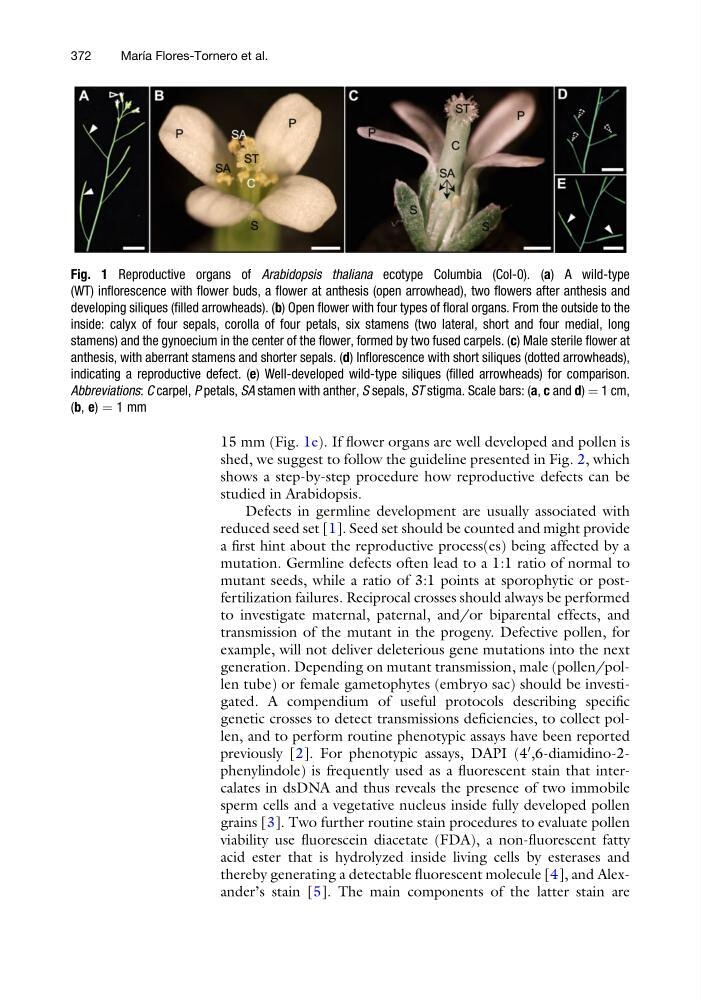
15 mm (Fig. 1e). If flower organs are well developed and pollen is
shed, we suggest to follow the guideline presented in Fig. 2, which
shows a step-by-step procedure how reproductive defects can be
studied in Arabidopsis.
Defects in germline development are usually associated with
reduced seed set [1]. Seed set should be counted and might provide
a first hint about the reproductive process(es) being affected by a
mutation. Germline defects often lead to a 1:1 ratio of normal to
mutant seeds, while a ratio of 3:1 points at sporophytic or postfertilization failures. Reciprocal crosses should always be performed
to investigate maternal, paternal, and/or biparental effects, and
transmission of the mutant in the progeny. Defective pollen, for
example, will not deliver deleterious gene mutations into the next
generation. Depending on mutant transmission, male (pollen/pollen tube) or female gametophytes (embryo sac) should be investigated. A compendium of useful protocols describing specific
genetic crosses to detect transmissions deficiencies, to collect pollen, and to perform routine phenotypic assays have been reported
previously [2]. For phenotypic assays, DAPI (4
0 ,6-diamidino-2phenylindole) is frequently used as a fluorescent stain that intercalates in dsDNA and thus reveals the presence of two immobile
sperm cells and a vegetative nucleus inside fully developed pollen
grains [3]. Two further routine stain procedures to evaluate pollen
viability use fluorescein diacetate (FDA), a non-fluorescent fatty
acid ester that is hydrolyzed inside living cells by esterases and
thereby generating a detectable fluorescent molecule [4], and Alexander’s stain [5]. The main components of the latter stain are
Fig. 1 Reproductive organs of Arabidopsis thaliana ecotype Columbia (Col-0). (a) A wild-type
(WT) inflorescence with flower buds, a flower at anthesis (open arrowhead), two flowers after anthesis and
developing siliques (filled arrowheads). (b) Open flower with four types of floral organs. From the outside to the
inside: calyx of four sepals, corolla of four petals, six stamens (two lateral, short and four medial, long
stamens) and the gynoecium in the center of the flower, formed by two fused carpels. (c) Male sterile flower at
anthesis, with aberrant stamens and shorter sepals. (d) Inflorescence with short siliques (dotted arrowheads),
indicating a reproductive defect. (e) Well-developed wild-type siliques (filled arrowheads) for comparison.
Abbreviations: C carpel, P petals, SA stamen with anther, S sepals, ST stigma. Scale bars: (a, c and d) ¼ 1 cm,
(b, e) ¼ 1 mm
372
Marı ´a Flores-Tornero et al.
shed, we suggest to follow the guideline presented in Fig. 2, which
shows a step-by-step procedure how reproductive defects can be
studied in Arabidopsis.
Defects in germline development are usually associated with
reduced seed set [1]. Seed set should be counted and might provide
a first hint about the reproductive process(es) being affected by a
mutation. Germline defects often lead to a 1:1 ratio of normal to
mutant seeds, while a ratio of 3:1 points at sporophytic or postfertilization failures. Reciprocal crosses should always be performed
to investigate maternal, paternal, and/or biparental effects, and
transmission of the mutant in the progeny. Defective pollen, for
example, will not deliver deleterious gene mutations into the next
generation. Depending on mutant transmission, male (pollen/pollen tube) or female gametophytes (embryo sac) should be investigated. A compendium of useful protocols describing specific
genetic crosses to detect transmissions deficiencies, to collect pollen, and to perform routine phenotypic assays have been reported
previously [2]. For phenotypic assays, DAPI (4
0 ,6-diamidino-2phenylindole) is frequently used as a fluorescent stain that intercalates in dsDNA and thus reveals the presence of two immobile
sperm cells and a vegetative nucleus inside fully developed pollen
grains [3]. Two further routine stain procedures to evaluate pollen
viability use fluorescein diacetate (FDA), a non-fluorescent fatty
acid ester that is hydrolyzed inside living cells by esterases and
thereby generating a detectable fluorescent molecule [4], and Alexander’s stain [5]. The main components of the latter stain are
Fig. 1 Reproductive organs of Arabidopsis thaliana ecotype Columbia (Col-0). (a) A wild-type
(WT) inflorescence with flower buds, a flower at anthesis (open arrowhead), two flowers after anthesis and
developing siliques (filled arrowheads). (b) Open flower with four types of floral organs. From the outside to the
inside: calyx of four sepals, corolla of four petals, six stamens (two lateral, short and four medial, long
stamens) and the gynoecium in the center of the flower, formed by two fused carpels. (c) Male sterile flower at
anthesis, with aberrant stamens and shorter sepals. (d) Inflorescence with short siliques (dotted arrowheads),
indicating a reproductive defect. (e) Well-developed wild-type siliques (filled arrowheads) for comparison.
Abbreviations: C carpel, P petals, SA stamen with anther, S sepals, ST stigma. Scale bars: (a, c and d) ¼ 1 cm,
(b, e) ¼ 1 mm
372
Marı ´a Flores-Tornero et al.