

(max. 20 μm). The forces can be measured only within a relatively
small and flat surface due to the mechanical measurement being
highly sensitive to irregular and inclined surfaces [22].
In plants, AFM has been used to image the orientation of
cellulose microfibrils [28, 29] and measure the mechanical properties (elasticity) in cell walls of different species [30–32]. AFM on
live plant material was carried on dividing meristematic cells of the
SAM in Arabidopsis thaliana, which showed that the growing
tissues display heterogeneous cellular stiffness [20, 22]. However,
AFM measurements often require fixation, which is destructive and
irreversibly changes the native properties of the sample.
Z position (nm)
Force (nN)
Approaching (extended)
Withdraw (retracted)
Force (nN)
Time (ms)
A
B
Peak force
Adhesion force
Peak force
Elastic Modulus (E)
Attractive force
Repulsive force
Repulsive force
Dissipation
n d
c
n c
c
n c
n d
Attractive force
d f
Flat part
Elevated part
d f
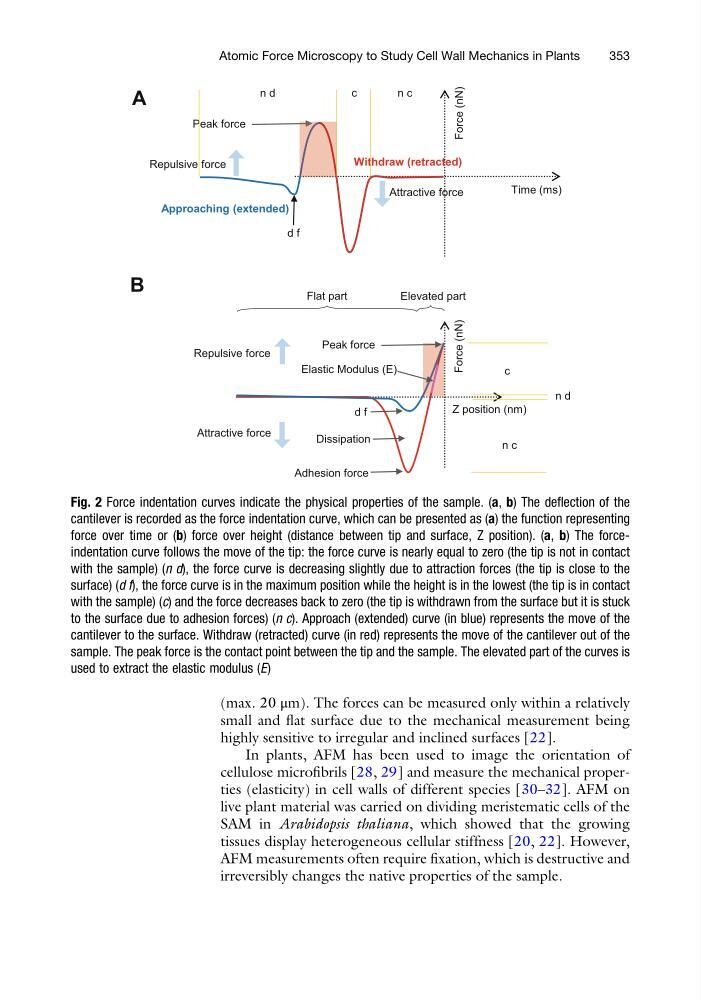
Fig. 2 Force indentation curves indicate the physical properties of the sample. (a, b) The deflection of the
cantilever is recorded as the force indentation curve, which can be presented as (a) the function representing
force over time or (b) force over height (distance between tip and surface, Z position). (a, b) The forceindentation curve follows the move of the tip: the force curve is nearly equal to zero (the tip is not in contact
with the sample) (n d), the force curve is decreasing slightly due to attraction forces (the tip is close to the
surface) (d f), the force curve is in the maximum position while the height is in the lowest (the tip is in contact
with the sample) (c) and the force decreases back to zero (the tip is withdrawn from the surface but it is stuck
to the surface due to adhesion forces) (n c). Approach (extended) curve (in blue) represents the move of the
cantilever to the surface. Withdraw (retracted) curve (in red) represents the move of the cantilever out of the
sample. The peak force is the contact point between the tip and the sample. The elevated part of the curves is
used to extract the elastic modulus (E)
Atomic Force Microscopy to Study Cell Wall Mechanics in Plants
353
small and flat surface due to the mechanical measurement being
highly sensitive to irregular and inclined surfaces [22].
In plants, AFM has been used to image the orientation of
cellulose microfibrils [28, 29] and measure the mechanical properties (elasticity) in cell walls of different species [30–32]. AFM on
live plant material was carried on dividing meristematic cells of the
SAM in Arabidopsis thaliana, which showed that the growing
tissues display heterogeneous cellular stiffness [20, 22]. However,
AFM measurements often require fixation, which is destructive and
irreversibly changes the native properties of the sample.
Z position (nm)
Force (nN)
Approaching (extended)
Withdraw (retracted)
Force (nN)
Time (ms)
A
B
Peak force
Adhesion force
Peak force
Elastic Modulus (E)
Attractive force
Repulsive force
Repulsive force
Dissipation
n d
c
n c
c
n c
n d
Attractive force
d f
Flat part
Elevated part
d f
Fig. 2 Force indentation curves indicate the physical properties of the sample. (a, b) The deflection of the
cantilever is recorded as the force indentation curve, which can be presented as (a) the function representing
force over time or (b) force over height (distance between tip and surface, Z position). (a, b) The forceindentation curve follows the move of the tip: the force curve is nearly equal to zero (the tip is not in contact
with the sample) (n d), the force curve is decreasing slightly due to attraction forces (the tip is close to the
surface) (d f), the force curve is in the maximum position while the height is in the lowest (the tip is in contact
with the sample) (c) and the force decreases back to zero (the tip is withdrawn from the surface but it is stuck
to the surface due to adhesion forces) (n c). Approach (extended) curve (in blue) represents the move of the
cantilever to the surface. Withdraw (retracted) curve (in red) represents the move of the cantilever out of the
sample. The peak force is the contact point between the tip and the sample. The elevated part of the curves is
used to extract the elastic modulus (E)
Atomic Force Microscopy to Study Cell Wall Mechanics in Plants
353