

3.2 High-Pressure
Freezing
1. 1 mm segments of root tips, whole developing seeds, or excised
developing embryos, excised anthers, and small (not bigger
than 0.5 mm) pieces of cotyledons are loaded in a type B
freezing planchette containing cryoprotectant (0.1 M sucrose
or 1-hexadecene).
2. Another freezing planchette is placed on top to close the
chamber. It is important to completely fill the chamber with
cryoprotectant, not leaving air bubbles that could collapse
during high-pressure freezing.
3. Place freezing planchettes in the sample holder and freeze them
under high pressure.
4. If using an HPM010 or Wohlwend HPF unit, under liquid
nitrogen, pick the freezing planchettes with the tips of a pair of
forceps precooled in liquid nitrogen. The Leica EM ICE unit
collects the freezing carriers automatically. The freezing
planchettes containing the samples can either be stored in
liquid nitrogen (see Note 5) or placed directly in cryosubstitution medium.
3.3 FreezeSubstitution and Resin
Embedding
The freeze-substitution medium and resin should be chosen
according to the type of analysis one wants to perform. To achieve
good preservation and staining of membranes and microtubules,
freeze-substitution in 2% OsO 4 in acetone followed by Eponate
12 embedding is recommended. However, OsO 4 and epoxy-based
resins such as Eponate 12 are not suitable for most immunolabeling
approaches. Cryosubstitution in acetone without fixatives or low
concentrations of glutaraldehyde (0.2%) and uranyl acetate (0.2%)
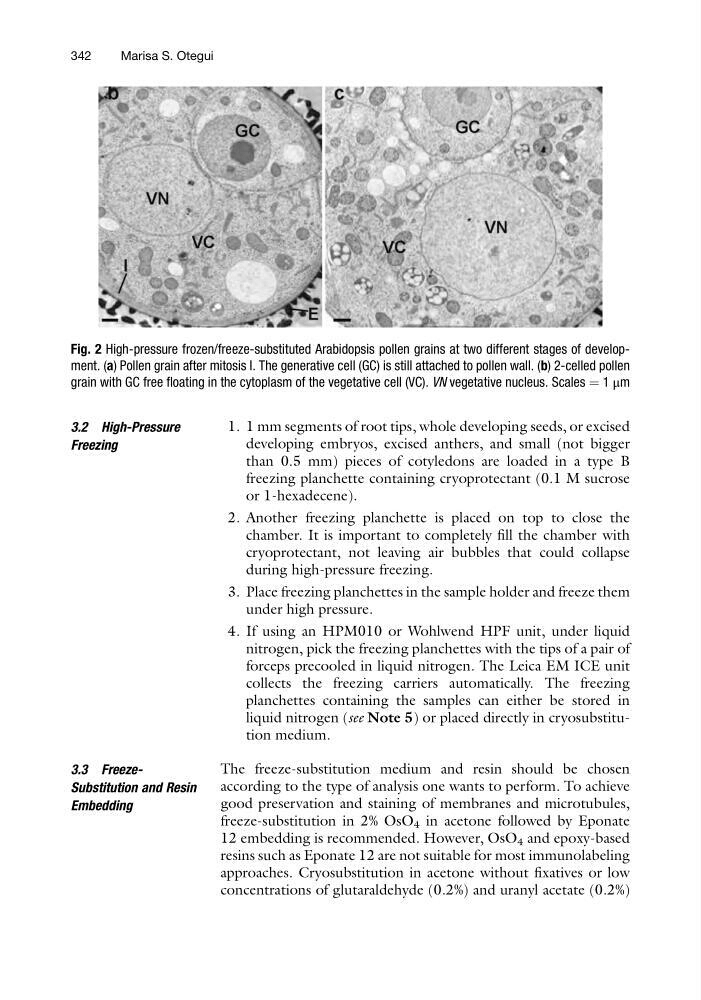
Fig. 2 High-pressure frozen/freeze-substituted Arabidopsis pollen grains at two different stages of development. (a) Pollen grain after mitosis I. The generative cell (GC) is still attached to pollen wall. (b) 2-celled pollen
grain with GC free floating in the cytoplasm of the vegetative cell (VC). VN vegetative nucleus. Scales ¼ 1 μm
342
Marisa S. Otegui
Freezing
1. 1 mm segments of root tips, whole developing seeds, or excised
developing embryos, excised anthers, and small (not bigger
than 0.5 mm) pieces of cotyledons are loaded in a type B
freezing planchette containing cryoprotectant (0.1 M sucrose
or 1-hexadecene).
2. Another freezing planchette is placed on top to close the
chamber. It is important to completely fill the chamber with
cryoprotectant, not leaving air bubbles that could collapse
during high-pressure freezing.
3. Place freezing planchettes in the sample holder and freeze them
under high pressure.
4. If using an HPM010 or Wohlwend HPF unit, under liquid
nitrogen, pick the freezing planchettes with the tips of a pair of
forceps precooled in liquid nitrogen. The Leica EM ICE unit
collects the freezing carriers automatically. The freezing
planchettes containing the samples can either be stored in
liquid nitrogen (see Note 5) or placed directly in cryosubstitution medium.
3.3 FreezeSubstitution and Resin
Embedding
The freeze-substitution medium and resin should be chosen
according to the type of analysis one wants to perform. To achieve
good preservation and staining of membranes and microtubules,
freeze-substitution in 2% OsO 4 in acetone followed by Eponate
12 embedding is recommended. However, OsO 4 and epoxy-based
resins such as Eponate 12 are not suitable for most immunolabeling
approaches. Cryosubstitution in acetone without fixatives or low
concentrations of glutaraldehyde (0.2%) and uranyl acetate (0.2%)
Fig. 2 High-pressure frozen/freeze-substituted Arabidopsis pollen grains at two different stages of development. (a) Pollen grain after mitosis I. The generative cell (GC) is still attached to pollen wall. (b) 2-celled pollen
grain with GC free floating in the cytoplasm of the vegetative cell (VC). VN vegetative nucleus. Scales ¼ 1 μm
342
Marisa S. Otegui