

While floral dip transformation can be generalized to other
Brassicaceae species, it may not be effective for all species without
modification. As research expands in other Brassicaceae, the techniques that were developed in Arabidopsis are being adapted to
perform Agrobacterium transformation for other species. Speciesspecific protocols for floral dip transformation have been developed
(e.g., Brassica napus [21], Camelina sativa [22], and T. arvense
[8]).
4 Notes
1. When preparing the 50% bleach solution, fresh bleach should
be used.
2. To rinse the seeds, remove the bleach solution from the microcentrifuge tube by pipetting. After adding sterile distilled water
to the tube, close the tube and invert to mix. Allow seeds to
settle to the bottom of the tube before removing the solution
during each rinse cycle. After the seventh rinse, add 1 mL of
sterile distilled water to aid in suspension of the seeds for
plating.
3. Gather all the materials needed to perform gas sterilization
(bleach, HCl, a large Parafilm
® strip to seal the container, a
beaker, and a plastic sterilization container). The plastic sterilization container should be large enough to hold the rack of
seeds and the beaker that will contain the solution of bleach
and HCl. Once the sterilization process has started, it should
be done in quick succession.
4. The volume of bleach required to produce the Cl 2 gas will need
to be at least 22 times the volume of HCl. It is recommended
to use excess bleach as the reaction will consume the HCl and
bleach by releasing Cl 2 gas with NaCl and water as byproducts.
The excess bleach allows for the additional consumption of
HCl during the venting, which decreases the amount of
NaHCO 3 needed to neutralize the solution. Example: 3 mL
of HCl would require at least 66 mL of bleach for the reaction
but 100 mL of bleach is recommended.
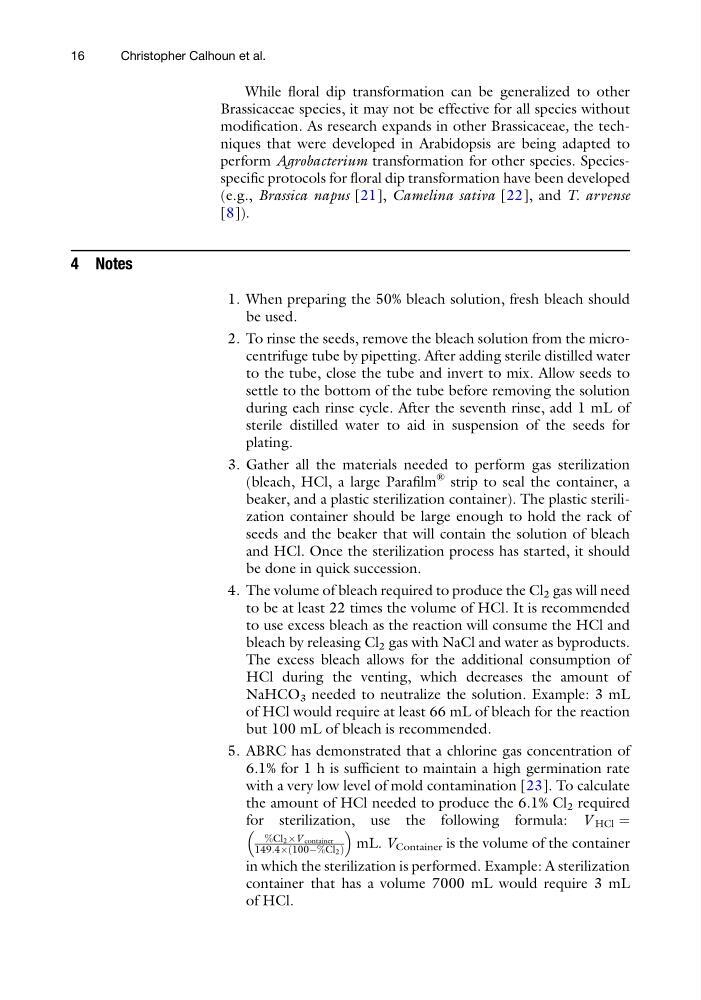
5. ABRC has demonstrated that a chlorine gas concentration of
6.1% for 1 h is sufficient to maintain a high germination rate
with a very low level of mold contamination [23]. To calculate
the amount of HCl needed to produce the 6.1% Cl 2 required
for sterilization, use the following formula: V HCl ¼
%Cl 2 ÂV container
149:4Â 100À%Cl 2
ð
Þ
mL. V Container is the volume of the container
in which the sterilization is performed. Example: A sterilization
container that has a volume 7000 mL would require 3 mL
of HCl.
16
Christopher Calhoun et al.
Brassicaceae species, it may not be effective for all species without
modification. As research expands in other Brassicaceae, the techniques that were developed in Arabidopsis are being adapted to
perform Agrobacterium transformation for other species. Speciesspecific protocols for floral dip transformation have been developed
(e.g., Brassica napus [21], Camelina sativa [22], and T. arvense
[8]).
4 Notes
1. When preparing the 50% bleach solution, fresh bleach should
be used.
2. To rinse the seeds, remove the bleach solution from the microcentrifuge tube by pipetting. After adding sterile distilled water
to the tube, close the tube and invert to mix. Allow seeds to
settle to the bottom of the tube before removing the solution
during each rinse cycle. After the seventh rinse, add 1 mL of
sterile distilled water to aid in suspension of the seeds for
plating.
3. Gather all the materials needed to perform gas sterilization
(bleach, HCl, a large Parafilm
® strip to seal the container, a
beaker, and a plastic sterilization container). The plastic sterilization container should be large enough to hold the rack of
seeds and the beaker that will contain the solution of bleach
and HCl. Once the sterilization process has started, it should
be done in quick succession.
4. The volume of bleach required to produce the Cl 2 gas will need
to be at least 22 times the volume of HCl. It is recommended
to use excess bleach as the reaction will consume the HCl and
bleach by releasing Cl 2 gas with NaCl and water as byproducts.
The excess bleach allows for the additional consumption of
HCl during the venting, which decreases the amount of
NaHCO 3 needed to neutralize the solution. Example: 3 mL
of HCl would require at least 66 mL of bleach for the reaction
but 100 mL of bleach is recommended.
5. ABRC has demonstrated that a chlorine gas concentration of
6.1% for 1 h is sufficient to maintain a high germination rate
with a very low level of mold contamination [23]. To calculate
the amount of HCl needed to produce the 6.1% Cl 2 required
for sterilization, use the following formula: V HCl ¼
%Cl 2 ÂV container
149:4Â 100À%Cl 2
ð
Þ
mL. V Container is the volume of the container
in which the sterilization is performed. Example: A sterilization
container that has a volume 7000 mL would require 3 mL
of HCl.
16
Christopher Calhoun et al.