

membrane fusions, do not perturb organellar structure through
oligomerization (as observed for transgenic expression of fusion
proteins between transmembrane proteins and β-glucuronidase
[62]).
Given the abilities of plants to express different engineered FPs,
what have been the major applications? It has long been established
that GFP expression can be used for flow analysis and sorting of
plant protoplasts, based either on transient or transgenic expression
[11–16, 18, 63–72]. Similarly, the signal from GFP targeted to the
nucleus can be used for flow analysis and sorting of plant nuclei
[41, 49]. Extending this approach for isolation of specific cell types
has been productively achieved via FP expression within transgenic
plants either under the transcriptional control of cell type-specific
promoters or using promoter/enhancer trap lines (http://www.
arabidopsis.org/abrc/haseloff.htm). Reports involving flow sorting of protoplasts and/or nuclei based on accumulation of FPs
within specific cell types have steadily increased in number
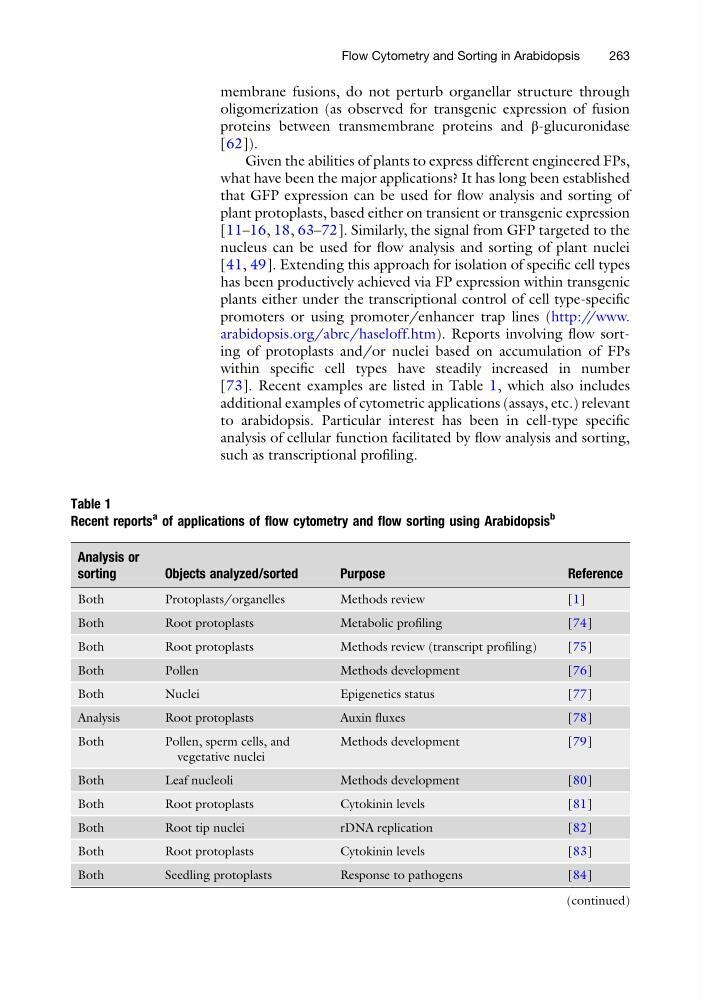
[73]. Recent examples are listed in Table 1, which also includes
additional examples of cytometric applications (assays, etc.) relevant
to arabidopsis. Particular interest has been in cell-type specific
analysis of cellular function facilitated by flow analysis and sorting,
such as transcriptional profiling.
Table 1
Recent reports
a of applications of flow cytometry and flow sorting using Arabidopsis
b
Analysis or
sorting
Objects analyzed/sorted
Purpose
Reference
Both
Protoplasts/organelles
Methods review
[1]
Both
Root protoplasts
Metabolic profiling
[74]
Both
Root protoplasts
Methods review (transcript profiling)
[75]
Both
Pollen
Methods development
[76]
Both
Nuclei
Epigenetics status
[77]
Analysis
Root protoplasts
Auxin fluxes
[78]
Both
Pollen, sperm cells, and
vegetative nuclei
Methods development
[79]
Both
Leaf nucleoli
Methods development
[80]
Both
Root protoplasts
Cytokinin levels
[81]
Both
Root tip nuclei
rDNA replication
[82]
Both
Root protoplasts
Cytokinin levels
[83]
Both
Seedling protoplasts
Response to pathogens
[84]
(continued)
Flow Cytometry and Sorting in Arabidopsis
263
oligomerization (as observed for transgenic expression of fusion
proteins between transmembrane proteins and β-glucuronidase
[62]).
Given the abilities of plants to express different engineered FPs,
what have been the major applications? It has long been established
that GFP expression can be used for flow analysis and sorting of
plant protoplasts, based either on transient or transgenic expression
[11–16, 18, 63–72]. Similarly, the signal from GFP targeted to the
nucleus can be used for flow analysis and sorting of plant nuclei
[41, 49]. Extending this approach for isolation of specific cell types
has been productively achieved via FP expression within transgenic
plants either under the transcriptional control of cell type-specific
promoters or using promoter/enhancer trap lines (http://www.
arabidopsis.org/abrc/haseloff.htm). Reports involving flow sorting of protoplasts and/or nuclei based on accumulation of FPs
within specific cell types have steadily increased in number
[73]. Recent examples are listed in Table 1, which also includes
additional examples of cytometric applications (assays, etc.) relevant
to arabidopsis. Particular interest has been in cell-type specific
analysis of cellular function facilitated by flow analysis and sorting,
such as transcriptional profiling.
Table 1
Recent reports
a of applications of flow cytometry and flow sorting using Arabidopsis
b
Analysis or
sorting
Objects analyzed/sorted
Purpose
Reference
Both
Protoplasts/organelles
Methods review
[1]
Both
Root protoplasts
Metabolic profiling
[74]
Both
Root protoplasts
Methods review (transcript profiling)
[75]
Both
Pollen
Methods development
[76]
Both
Nuclei
Epigenetics status
[77]
Analysis
Root protoplasts
Auxin fluxes
[78]
Both
Pollen, sperm cells, and
vegetative nuclei
Methods development
[79]
Both
Leaf nucleoli
Methods development
[80]
Both
Root protoplasts
Cytokinin levels
[81]
Both
Root tip nuclei
rDNA replication
[82]
Both
Root protoplasts
Cytokinin levels
[83]
Both
Seedling protoplasts
Response to pathogens
[84]
(continued)
Flow Cytometry and Sorting in Arabidopsis
263