

3.9 Assigning SNPs
to Genes
SNPs that pass the p-value threshold corrected for the multiple
hypothesis test could be false positives. Manual examination of
Manhattan plots often allows us to identify false positives with
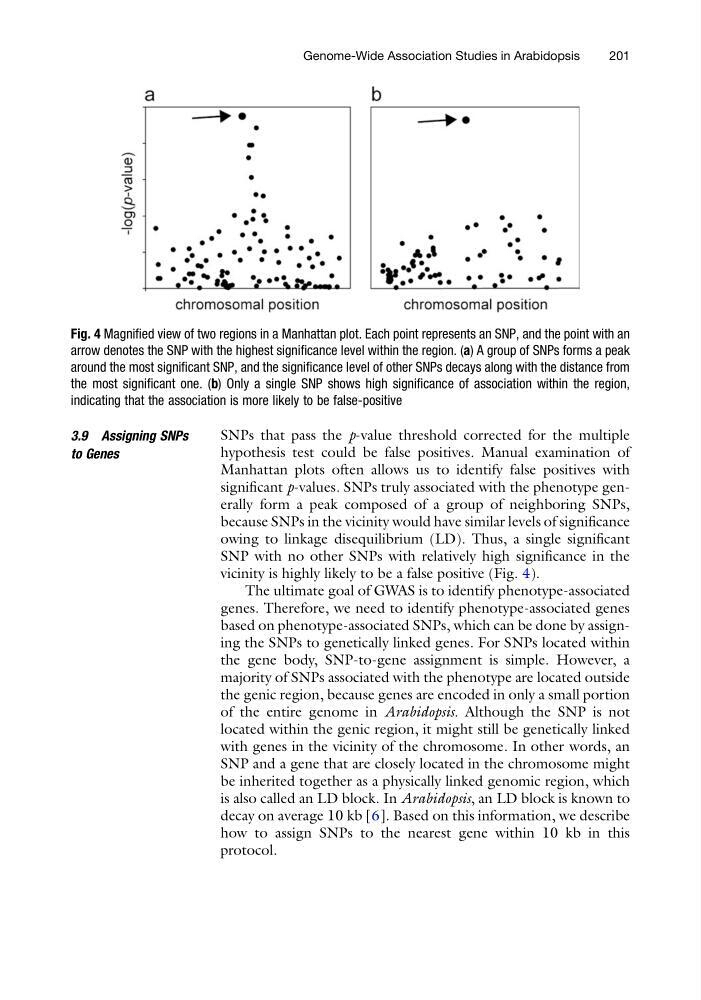
significant p-values. SNPs truly associated with the phenotype generally form a peak composed of a group of neighboring SNPs,
because SNPs in the vicinity would have similar levels of significance
owing to linkage disequilibrium (LD). Thus, a single significant
SNP with no other SNPs with relatively high significance in the
vicinity is highly likely to be a false positive (Fig. 4).
The ultimate goal of GWAS is to identify phenotype-associated
genes. Therefore, we need to identify phenotype-associated genes
based on phenotype-associated SNPs, which can be done by assigning the SNPs to genetically linked genes. For SNPs located within
the gene body, SNP-to-gene assignment is simple. However, a
majority of SNPs associated with the phenotype are located outside
the genic region, because genes are encoded in only a small portion
of the entire genome in Arabidopsis. Although the SNP is not
located within the genic region, it might still be genetically linked
with genes in the vicinity of the chromosome. In other words, an
SNP and a gene that are closely located in the chromosome might
be inherited together as a physically linked genomic region, which
is also called an LD block. In Arabidopsis, an LD block is known to
decay on average 10 kb [6]. Based on this information, we describe
how to assign SNPs to the nearest gene within 10 kb in this
protocol.
Fig. 4 Magnified view of two regions in a Manhattan plot. Each point represents an SNP, and the point with an
arrow denotes the SNP with the highest significance level within the region. (a) A group of SNPs forms a peak
around the most significant SNP, and the significance level of other SNPs decays along with the distance from
the most significant one. (b) Only a single SNP shows high significance of association within the region,
indicating that the association is more likely to be false-positive
Genome-Wide Association Studies in Arabidopsis
201
to Genes
SNPs that pass the p-value threshold corrected for the multiple
hypothesis test could be false positives. Manual examination of
Manhattan plots often allows us to identify false positives with
significant p-values. SNPs truly associated with the phenotype generally form a peak composed of a group of neighboring SNPs,
because SNPs in the vicinity would have similar levels of significance
owing to linkage disequilibrium (LD). Thus, a single significant
SNP with no other SNPs with relatively high significance in the
vicinity is highly likely to be a false positive (Fig. 4).
The ultimate goal of GWAS is to identify phenotype-associated
genes. Therefore, we need to identify phenotype-associated genes
based on phenotype-associated SNPs, which can be done by assigning the SNPs to genetically linked genes. For SNPs located within
the gene body, SNP-to-gene assignment is simple. However, a
majority of SNPs associated with the phenotype are located outside
the genic region, because genes are encoded in only a small portion
of the entire genome in Arabidopsis. Although the SNP is not
located within the genic region, it might still be genetically linked
with genes in the vicinity of the chromosome. In other words, an
SNP and a gene that are closely located in the chromosome might
be inherited together as a physically linked genomic region, which
is also called an LD block. In Arabidopsis, an LD block is known to
decay on average 10 kb [6]. Based on this information, we describe
how to assign SNPs to the nearest gene within 10 kb in this
protocol.
Fig. 4 Magnified view of two regions in a Manhattan plot. Each point represents an SNP, and the point with an
arrow denotes the SNP with the highest significance level within the region. (a) A group of SNPs forms a peak
around the most significant SNP, and the significance level of other SNPs decays along with the distance from
the most significant one. (b) Only a single SNP shows high significance of association within the region,
indicating that the association is more likely to be false-positive
Genome-Wide Association Studies in Arabidopsis
201