

map
for (i in seq(1,dim(map)[1])){
for (j in seq(1,dim(map)[2])){
if (j==2){
new_map[i,j] <- paste(map[i,1],trimws(map[j,4]),sep=’_’)
}
else {
new_map[i,j] <- trimws(map[i,j])
}
}
}
write.table(new_map,file="1001genomes_snps_maf0.1._ACGTN.map",sep="\t",quote=F,row.names=F,col.names=F)
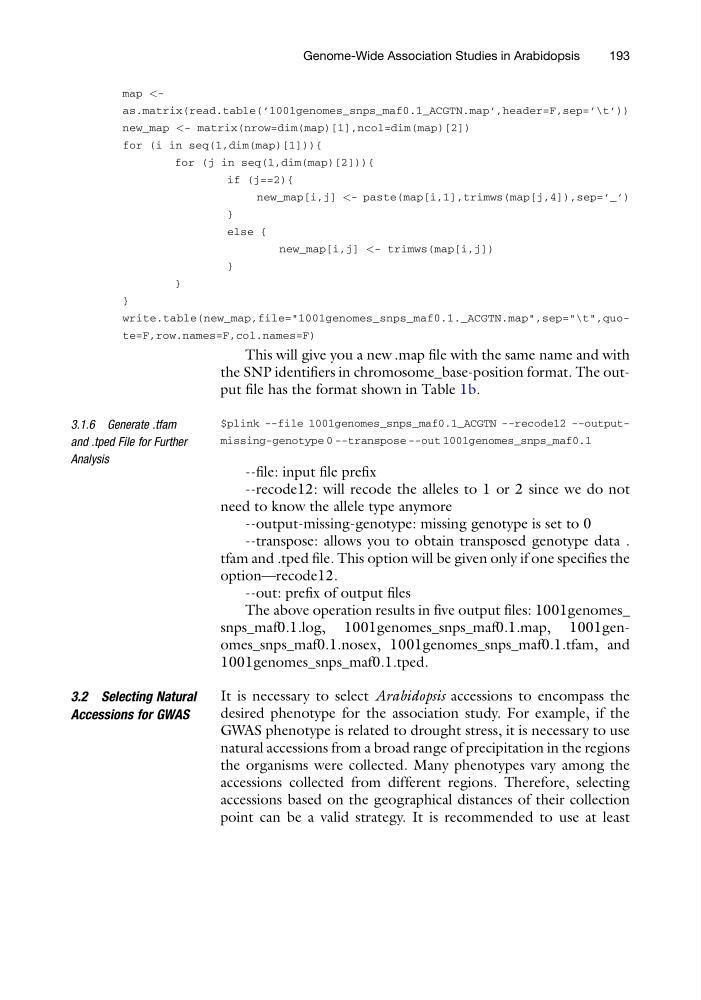
This will give you a new .map file with the same name and with
the SNP identifiers in chromosome_base-position format. The output file has the format shown in Table 1b.
3.1.6 Generate .tfam
and .tped File for Further
Analysis
$plink --file 1001genomes_snps_maf0.1_ACGTN --recode12 --outputmissing-genotype 0 --transpose --out 1001genomes_snps_maf0.1
--file: input file prefix
--recode12: will recode the alleles to 1 or 2 since we do not
need to know the allele type anymore
--output-missing-genotype: missing genotype is set to 0
--transpose: allows you to obtain transposed genotype data .
tfam and .tped file. This option will be given only if one specifies the
option—recode12.
--out: prefix of output files
The above operation results in five output files: 1001genomes_
snps_maf0.1.log, 1001genomes_snps_maf0.1.map, 1001genomes_snps_maf0.1.nosex, 1001genomes_snps_maf0.1.tfam, and
1001genomes_snps_maf0.1.tped.
3.2 Selecting Natural
Accessions for GWAS
It is necessary to select Arabidopsis accessions to encompass the
desired phenotype for the association study. For example, if the
GWAS phenotype is related to drought stress, it is necessary to use
natural accessions from a broad range of precipitation in the regions
the organisms were collected. Many phenotypes vary among the
accessions collected from different regions. Therefore, selecting
accessions based on the geographical distances of their collection
point can be a valid strategy. It is recommended to use at least
Genome-Wide Association Studies in Arabidopsis
193
for (i in seq(1,dim(map)[1])){
for (j in seq(1,dim(map)[2])){
if (j==2){
new_map[i,j] <- paste(map[i,1],trimws(map[j,4]),sep=’_’)
}
else {
new_map[i,j] <- trimws(map[i,j])
}
}
}
write.table(new_map,file="1001genomes_snps_maf0.1._ACGTN.map",sep="\t",quote=F,row.names=F,col.names=F)
This will give you a new .map file with the same name and with
the SNP identifiers in chromosome_base-position format. The output file has the format shown in Table 1b.
3.1.6 Generate .tfam
and .tped File for Further
Analysis
$plink --file 1001genomes_snps_maf0.1_ACGTN --recode12 --outputmissing-genotype 0 --transpose --out 1001genomes_snps_maf0.1
--file: input file prefix
--recode12: will recode the alleles to 1 or 2 since we do not
need to know the allele type anymore
--output-missing-genotype: missing genotype is set to 0
--transpose: allows you to obtain transposed genotype data .
tfam and .tped file. This option will be given only if one specifies the
option—recode12.
--out: prefix of output files
The above operation results in five output files: 1001genomes_
snps_maf0.1.log, 1001genomes_snps_maf0.1.map, 1001genomes_snps_maf0.1.nosex, 1001genomes_snps_maf0.1.tfam, and
1001genomes_snps_maf0.1.tped.
3.2 Selecting Natural
Accessions for GWAS
It is necessary to select Arabidopsis accessions to encompass the
desired phenotype for the association study. For example, if the
GWAS phenotype is related to drought stress, it is necessary to use
natural accessions from a broad range of precipitation in the regions
the organisms were collected. Many phenotypes vary among the
accessions collected from different regions. Therefore, selecting
accessions based on the geographical distances of their collection
point can be a valid strategy. It is recommended to use at least
Genome-Wide Association Studies in Arabidopsis
193