

1.6 μL dNTP (2.5 mM).
0.05 μL Taq polymerase.
0.4 μL Forward external primer (10 μM).
0.4 μL Reverse External primer (10 μM).
Add ddH 2 O to 20 μL.
Perform PCR: 95
C for 5 min, 25 cycles of 94
C for 30 s,
60
C for 30 s and 72
C for 1 min, and additional 5 min of
72
C (see Note 8).
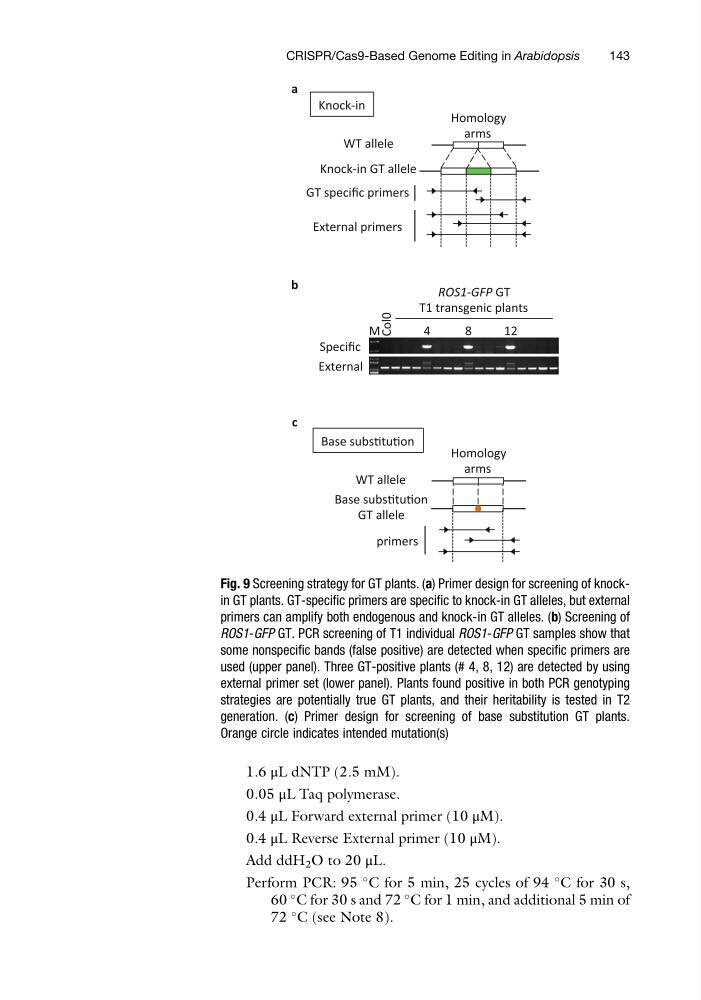
Fig. 9 Screening strategy for GT plants. (a) Primer design for screening of knockin GT plants. GT-specific primers are specific to knock-in GT alleles, but external
primers can amplify both endogenous and knock-in GT alleles. (b) Screening of
ROS1-GFP GT. PCR screening of T1 individual ROS1-GFP GT samples show that
some nonspecific bands (false positive) are detected when specific primers are
used (upper panel). Three GT-positive plants (# 4, 8, 12) are detected by using
external primer set (lower panel). Plants found positive in both PCR genotyping
strategies are potentially true GT plants, and their heritability is tested in T2
generation. (c) Primer design for screening of base substitution GT plants.
Orange circle indicates intended mutation(s)
CRISPR/Cas9-Based Genome Editing in Arabidopsis
143
0.05 μL Taq polymerase.
0.4 μL Forward external primer (10 μM).
0.4 μL Reverse External primer (10 μM).
Add ddH 2 O to 20 μL.
Perform PCR: 95
C for 5 min, 25 cycles of 94
C for 30 s,
60
C for 30 s and 72
C for 1 min, and additional 5 min of
72
C (see Note 8).
Fig. 9 Screening strategy for GT plants. (a) Primer design for screening of knockin GT plants. GT-specific primers are specific to knock-in GT alleles, but external
primers can amplify both endogenous and knock-in GT alleles. (b) Screening of
ROS1-GFP GT. PCR screening of T1 individual ROS1-GFP GT samples show that
some nonspecific bands (false positive) are detected when specific primers are
used (upper panel). Three GT-positive plants (# 4, 8, 12) are detected by using
external primer set (lower panel). Plants found positive in both PCR genotyping
strategies are potentially true GT plants, and their heritability is tested in T2
generation. (c) Primer design for screening of base substitution GT plants.
Orange circle indicates intended mutation(s)
CRISPR/Cas9-Based Genome Editing in Arabidopsis
143