

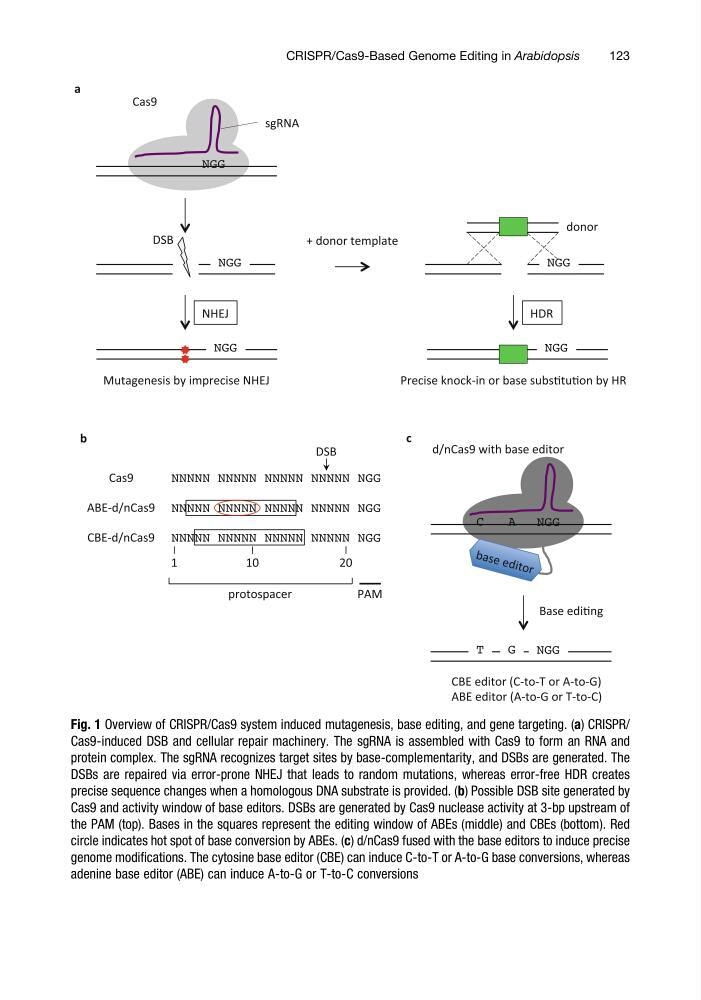
Fig. 1 Overview of CRISPR/Cas9 system induced mutagenesis, base editing, and gene targeting. (a) CRISPR/
Cas9-induced DSB and cellular repair machinery. The sgRNA is assembled with Cas9 to form an RNA and
protein complex. The sgRNA recognizes target sites by base-complementarity, and DSBs are generated. The
DSBs are repaired via error-prone NHEJ that leads to random mutations, whereas error-free HDR creates
precise sequence changes when a homologous DNA substrate is provided. (b) Possible DSB site generated by
Cas9 and activity window of base editors. DSBs are generated by Cas9 nuclease activity at 3-bp upstream of
the PAM (top). Bases in the squares represent the editing window of ABEs (middle) and CBEs (bottom). Red
circle indicates hot spot of base conversion by ABEs. (c) d/nCas9 fused with the base editors to induce precise
genome modifications. The cytosine base editor (CBE) can induce C-to-T or A-to-G base conversions, whereas
adenine base editor (ABE) can induce A-to-G or T-to-C conversions
CRISPR/Cas9-Based Genome Editing in Arabidopsis
123
Cas9-induced DSB and cellular repair machinery. The sgRNA is assembled with Cas9 to form an RNA and
protein complex. The sgRNA recognizes target sites by base-complementarity, and DSBs are generated. The
DSBs are repaired via error-prone NHEJ that leads to random mutations, whereas error-free HDR creates
precise sequence changes when a homologous DNA substrate is provided. (b) Possible DSB site generated by
Cas9 and activity window of base editors. DSBs are generated by Cas9 nuclease activity at 3-bp upstream of
the PAM (top). Bases in the squares represent the editing window of ABEs (middle) and CBEs (bottom). Red
circle indicates hot spot of base conversion by ABEs. (c) d/nCas9 fused with the base editors to induce precise
genome modifications. The cytosine base editor (CBE) can induce C-to-T or A-to-G base conversions, whereas
adenine base editor (ABE) can induce A-to-G or T-to-C conversions
CRISPR/Cas9-Based Genome Editing in Arabidopsis
123