

3 Selected Design and Analysis Techniques for Contemporary Symmetric Encryption
59
error-correcting coding (ECC) technique is available. This availability means that
the implementation complexities of the source of randomness and the ECC do not
imply a heavy implementation overhead in suitable scenarios.
The scheme employs a homophonic approach for a purpose different from
the ones this coding techniques were designed for. The main purpose is not just
randomization of the source message vectors (the goal of homophonic coding) nor
secrecy without a secret key (the goal of wire-tap channel coding) but enhancing the
cryptographic security of certain encryption schemes by employing the underlying
features of homophonic or wire-tap channel coding. The goal is the security
enhancement of a cryptographic keystream generator for encryption by employing
a dedicated coding scheme where the codewords provide additional “masking” of
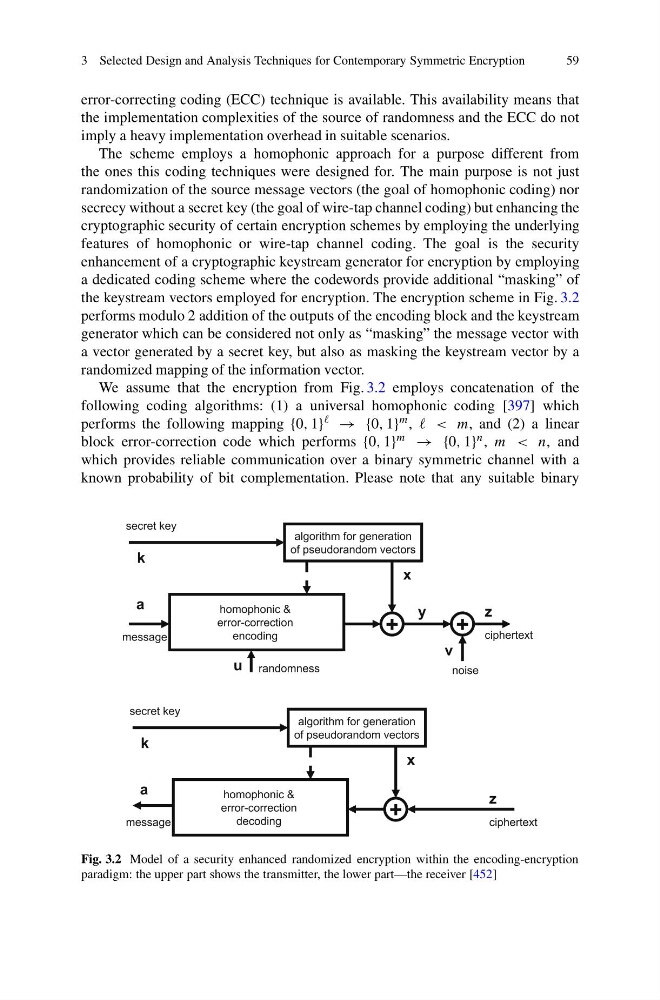
the keystream vectors employed for encryption. The encryption scheme in Fig. 3.2
performs modulo 2 addition of the outputs of the encoding block and the keystream
generator which can be considered not only as “masking” the message vector with
a vector generated by a secret key, but also as masking the keystream vector by a
randomized mapping of the information vector.
We assume that the encryption from Fig. 3.2 employs concatenation of the
following coding algorithms: (1) a universal homophonic coding [397] which
performs the following mapping {0, 1} → {0, 1} m , < m, and (2) a linear
block error-correction code which performs {0, 1} m → {0, 1} n , m < n, and
which provides reliable communication over a binary symmetric channel with a
known probability of bit complementation. Please note that any suitable binary
Fig. 3.2 Model of a security enhanced randomized encryption within the encoding-encryption
paradigm: the upper part shows the transmitter, the lower part—the receiver [452]
59
error-correcting coding (ECC) technique is available. This availability means that
the implementation complexities of the source of randomness and the ECC do not
imply a heavy implementation overhead in suitable scenarios.
The scheme employs a homophonic approach for a purpose different from
the ones this coding techniques were designed for. The main purpose is not just
randomization of the source message vectors (the goal of homophonic coding) nor
secrecy without a secret key (the goal of wire-tap channel coding) but enhancing the
cryptographic security of certain encryption schemes by employing the underlying
features of homophonic or wire-tap channel coding. The goal is the security
enhancement of a cryptographic keystream generator for encryption by employing
a dedicated coding scheme where the codewords provide additional “masking” of
the keystream vectors employed for encryption. The encryption scheme in Fig. 3.2
performs modulo 2 addition of the outputs of the encoding block and the keystream
generator which can be considered not only as “masking” the message vector with
a vector generated by a secret key, but also as masking the keystream vector by a
randomized mapping of the information vector.
We assume that the encryption from Fig. 3.2 employs concatenation of the
following coding algorithms: (1) a universal homophonic coding [397] which
performs the following mapping {0, 1} → {0, 1} m , < m, and (2) a linear
block error-correction code which performs {0, 1} m → {0, 1} n , m < n, and
which provides reliable communication over a binary symmetric channel with a
known probability of bit complementation. Please note that any suitable binary
Fig. 3.2 Model of a security enhanced randomized encryption within the encoding-encryption
paradigm: the upper part shows the transmitter, the lower part—the receiver [452]