

140
L. Batina et al.
8.3.2 Standard Template Attack
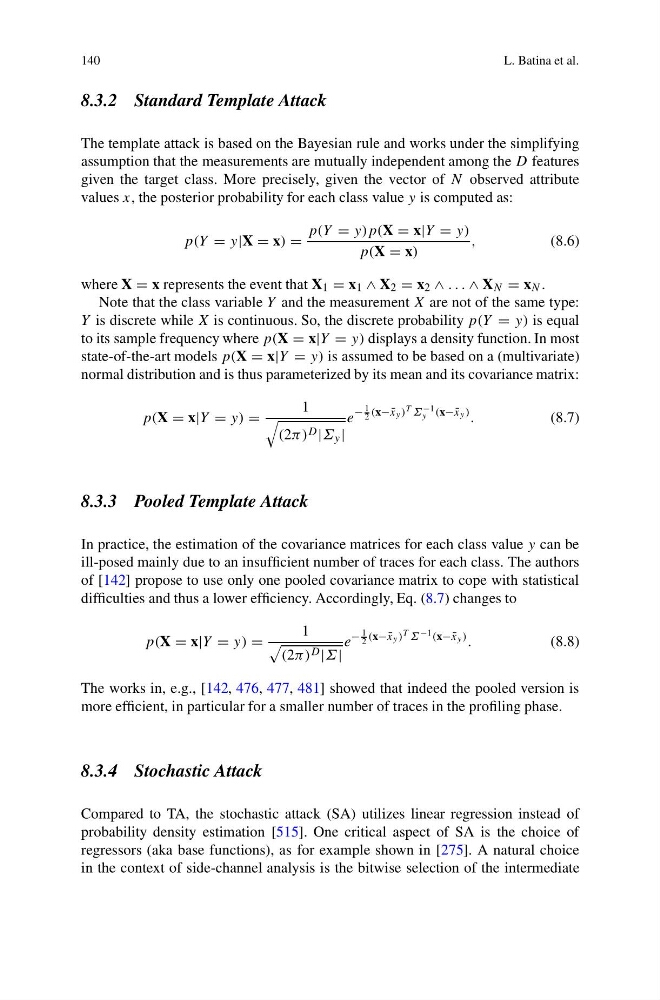
The template attack is based on the Bayesian rule and works under the simplifying
assumption that the measurements are mutually independent among the D features
given the target class. More precisely, given the vector of N observed attribute
values x, the posterior probability for each class value y is computed as:
p(Y = y|X = x) =
p(Y = y)p(X = x|Y = y)
p(X = x)
,
(8.6)
where X = x represents the event that X 1 = x 1 ∧ X 2 = x 2 ∧ . . . ∧ X N = x N .
Note that the class variable Y and the measurement X are not of the same type:
Y is discrete while X is continuous. So, the discrete probability p(Y = y) is equal
to its sample frequency where p(X = x|Y = y) displays a density function. In most
state-of-the-art models p(X = x|Y = y) is assumed to be based on a (multivariate)
normal distribution and is thus parameterized by its mean and its covariance matrix:
p(X = x|Y = y) =
1
(2π) D |Σ y |
e
−
1
2 (x− ¯
x y ) T Σ −1
y (x− ¯
x y ) .
(8.7)
8.3.3 Pooled Template Attack
In practice, the estimation of the covariance matrices for each class value y can be
ill-posed mainly due to an insufficient number of traces for each class. The authors
of [142] propose to use only one pooled covariance matrix to cope with statistical
difficulties and thus a lower efficiency. Accordingly, Eq. (8.7) changes to
p(X = x|Y = y) =
1
(2π) D |Σ|
e
−
1
2 (x− ¯
x y ) T Σ −1 (x− ¯
x y ) .
(8.8)
The works in, e.g., [142, 476, 477, 481] showed that indeed the pooled version is
more efficient, in particular for a smaller number of traces in the profiling phase.
8.3.4 Stochastic Attack
Compared to TA, the stochastic attack (SA) utilizes linear regression instead of
probability density estimation [515]. One critical aspect of SA is the choice of
regressors (aka base functions), as for example shown in [275]. A natural choice
in the context of side-channel analysis is the bitwise selection of the intermediate
L. Batina et al.
8.3.2 Standard Template Attack
The template attack is based on the Bayesian rule and works under the simplifying
assumption that the measurements are mutually independent among the D features
given the target class. More precisely, given the vector of N observed attribute
values x, the posterior probability for each class value y is computed as:
p(Y = y|X = x) =
p(Y = y)p(X = x|Y = y)
p(X = x)
,
(8.6)
where X = x represents the event that X 1 = x 1 ∧ X 2 = x 2 ∧ . . . ∧ X N = x N .
Note that the class variable Y and the measurement X are not of the same type:
Y is discrete while X is continuous. So, the discrete probability p(Y = y) is equal
to its sample frequency where p(X = x|Y = y) displays a density function. In most
state-of-the-art models p(X = x|Y = y) is assumed to be based on a (multivariate)
normal distribution and is thus parameterized by its mean and its covariance matrix:
p(X = x|Y = y) =
1
(2π) D |Σ y |
e
−
1
2 (x− ¯
x y ) T Σ −1
y (x− ¯
x y ) .
(8.7)
8.3.3 Pooled Template Attack
In practice, the estimation of the covariance matrices for each class value y can be
ill-posed mainly due to an insufficient number of traces for each class. The authors
of [142] propose to use only one pooled covariance matrix to cope with statistical
difficulties and thus a lower efficiency. Accordingly, Eq. (8.7) changes to
p(X = x|Y = y) =
1
(2π) D |Σ|
e
−
1
2 (x− ¯
x y ) T Σ −1 (x− ¯
x y ) .
(8.8)
The works in, e.g., [142, 476, 477, 481] showed that indeed the pooled version is
more efficient, in particular for a smaller number of traces in the profiling phase.
8.3.4 Stochastic Attack
Compared to TA, the stochastic attack (SA) utilizes linear regression instead of
probability density estimation [515]. One critical aspect of SA is the choice of
regressors (aka base functions), as for example shown in [275]. A natural choice
in the context of side-channel analysis is the bitwise selection of the intermediate