

136
L. Batina et al.
t ∈ T and the key k ∗ ∈ K to an intermediate value that is assumed to relate to the
deterministic part of the measured leakage x. For example,
y(t, k) = Sbox[T ⊕ k],
(8.1)
where Sbox[·] is a substitution operation. The measured leakage x can then be
written as
x = ϕ(y(t, k
∗ )) + r,
(8.2)
where r denotes independent additive noise and ϕ is a device-specific (unknown)
deterministic function mapping the intermediate variable to the leakage space.
In the rest of this chapter, we are particularly interested in multivariate leakage
x = x 1 , . . . , x D , where D is the number of time samples, i.e., features (also called
attributes or points of interest).
Now, it is considered that the attacker has the following information at his
disposal to conduct the attack:
• profiling phase: N traces (measurements) x p 1 , . . . , x p N , the secret key
k ∗
p , and plaintexts/ciphertexts t p 1 , . . . , t p N , such that he can calculate
y(t p 1 , k ∗
p ), . . . , y(t p N , k ∗
p ).
• attacking phase: Q traces x a 1 , . . . , x a Q (independent from the profiling traces),
plaintexts/ciphertexts t a 1 , . . . , t a Q .
In the attacking phase the goal is to make predictions about y(t a 1 , k ∗
a ), . . . ,
y(t a N , k ∗
a ), where k ∗
a is the secret key on the attacking device. Note, even before
running the attack, there are several steps one could do in order to make the attack
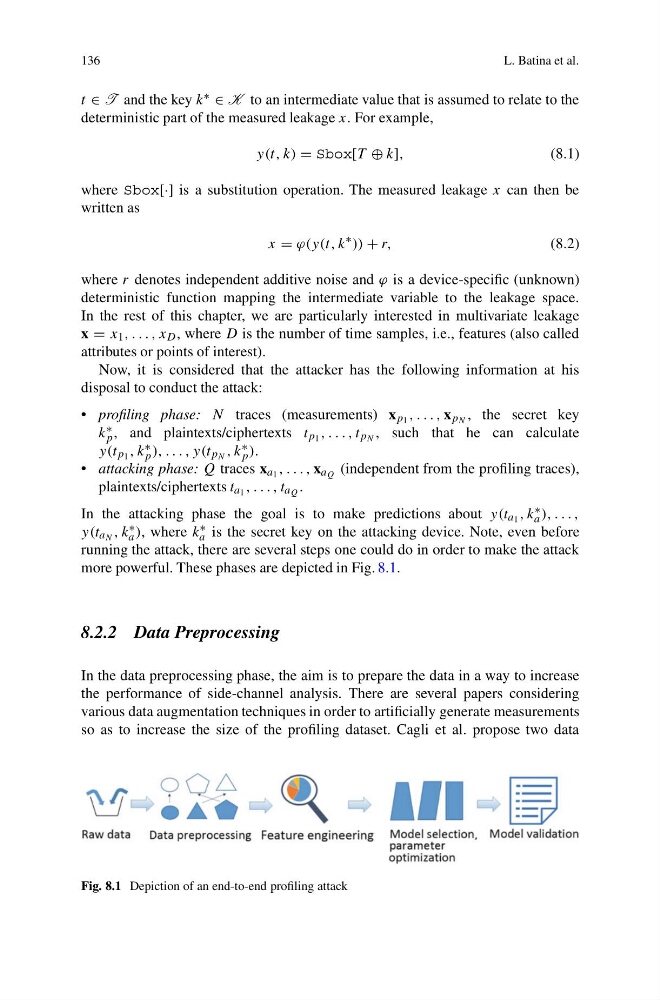
more powerful. These phases are depicted in Fig. 8.1.
8.2.2 Data Preprocessing
In the data preprocessing phase, the aim is to prepare the data in a way to increase
the performance of side-channel analysis. There are several papers considering
various data augmentation techniques in order to artificially generate measurements
so as to increase the size of the profiling dataset. Cagli et al. propose two data
Fig. 8.1 Depiction of an end-to-end profiling attack
L. Batina et al.
t ∈ T and the key k ∗ ∈ K to an intermediate value that is assumed to relate to the
deterministic part of the measured leakage x. For example,
y(t, k) = Sbox[T ⊕ k],
(8.1)
where Sbox[·] is a substitution operation. The measured leakage x can then be
written as
x = ϕ(y(t, k
∗ )) + r,
(8.2)
where r denotes independent additive noise and ϕ is a device-specific (unknown)
deterministic function mapping the intermediate variable to the leakage space.
In the rest of this chapter, we are particularly interested in multivariate leakage
x = x 1 , . . . , x D , where D is the number of time samples, i.e., features (also called
attributes or points of interest).
Now, it is considered that the attacker has the following information at his
disposal to conduct the attack:
• profiling phase: N traces (measurements) x p 1 , . . . , x p N , the secret key
k ∗
p , and plaintexts/ciphertexts t p 1 , . . . , t p N , such that he can calculate
y(t p 1 , k ∗
p ), . . . , y(t p N , k ∗
p ).
• attacking phase: Q traces x a 1 , . . . , x a Q (independent from the profiling traces),
plaintexts/ciphertexts t a 1 , . . . , t a Q .
In the attacking phase the goal is to make predictions about y(t a 1 , k ∗
a ), . . . ,
y(t a N , k ∗
a ), where k ∗
a is the secret key on the attacking device. Note, even before
running the attack, there are several steps one could do in order to make the attack
more powerful. These phases are depicted in Fig. 8.1.
8.2.2 Data Preprocessing
In the data preprocessing phase, the aim is to prepare the data in a way to increase
the performance of side-channel analysis. There are several papers considering
various data augmentation techniques in order to artificially generate measurements
so as to increase the size of the profiling dataset. Cagli et al. propose two data
Fig. 8.1 Depiction of an end-to-end profiling attack