

40
2 The Contested Sustainability of Biofuels …
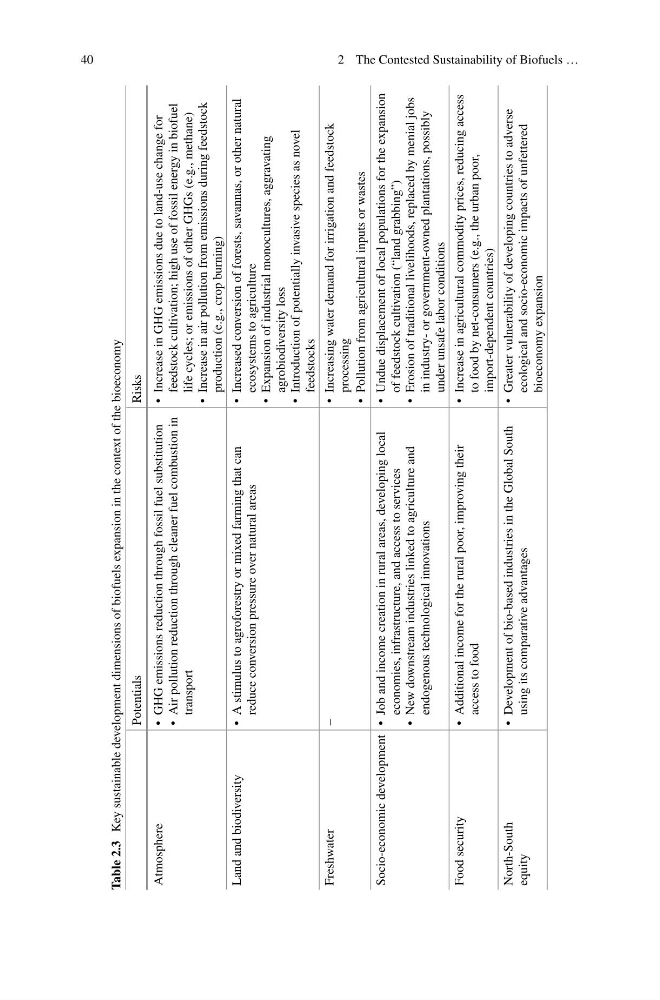
Table 2.3
Key sustainable development dimensions of biofuels expansion in the context of the bioeconomy
Potentials
Risks
Atmosphere
• GHG emissions reduction through fossil fuel substitution
• Air pollution reduction through cleaner fuel combustion in
transport
• Increase in GHG emissions due to land-use change for
feedstock cultivation; high use of fossil energy in biofuel
life cycles; or emissions of other GHGs (e.g., methane)
• Increase in air pollution from emissions during feedstock
production (e.g., crop burning)
Land and biodiversity
• A stimulus to agroforestry or mixed farming that can
reduce conversion pressure over natural areas
• Increased conversion of forests, savannas, or other natural
ecosystems to agriculture
• Expansion of industrial monocultures, aggravating
agrobiodiversity loss
• Introduction of potentially invasive species as novel
feedstocks
Freshwater
–
• Increasing water demand for irrigation and feedstock
processing
• Pollution from agricultural inputs or wastes
Socio-economic development • Job and income creation in rural areas, developing local
economies, infrastructure, and access to services
• New downstream industries linked to agriculture and
endogenous technological innovations
• Undue displacement of local populations for the expansion
of feedstock cultivation (“land grabbing”)
• Erosion of traditional livelihoods, replaced by menial jobs
in industry- or government-owned plantations, possibly
under unsafe labor conditions
Food security
• Additional income for the rural poor, improving their
access to food
• Increase in agricultural commodity prices, reducing access
to food by net-consumers (e.g., the urban poor,
import-dependent countries)
North-South
equity
• Development of bio-based industries in the Global South
using its comparative advantages
• Greater vulnerability of developing countries to adverse
ecological and socio-economic impacts of unfettered
bioeconomy expansion
2 The Contested Sustainability of Biofuels …
Table 2.3
Key sustainable development dimensions of biofuels expansion in the context of the bioeconomy
Potentials
Risks
Atmosphere
• GHG emissions reduction through fossil fuel substitution
• Air pollution reduction through cleaner fuel combustion in
transport
• Increase in GHG emissions due to land-use change for
feedstock cultivation; high use of fossil energy in biofuel
life cycles; or emissions of other GHGs (e.g., methane)
• Increase in air pollution from emissions during feedstock
production (e.g., crop burning)
Land and biodiversity
• A stimulus to agroforestry or mixed farming that can
reduce conversion pressure over natural areas
• Increased conversion of forests, savannas, or other natural
ecosystems to agriculture
• Expansion of industrial monocultures, aggravating
agrobiodiversity loss
• Introduction of potentially invasive species as novel
feedstocks
Freshwater
–
• Increasing water demand for irrigation and feedstock
processing
• Pollution from agricultural inputs or wastes
Socio-economic development • Job and income creation in rural areas, developing local
economies, infrastructure, and access to services
• New downstream industries linked to agriculture and
endogenous technological innovations
• Undue displacement of local populations for the expansion
of feedstock cultivation (“land grabbing”)
• Erosion of traditional livelihoods, replaced by menial jobs
in industry- or government-owned plantations, possibly
under unsafe labor conditions
Food security
• Additional income for the rural poor, improving their
access to food
• Increase in agricultural commodity prices, reducing access
to food by net-consumers (e.g., the urban poor,
import-dependent countries)
North-South
equity
• Development of bio-based industries in the Global South
using its comparative advantages
• Greater vulnerability of developing countries to adverse
ecological and socio-economic impacts of unfettered
bioeconomy expansion