

34
2 The Contested Sustainability of Biofuels …
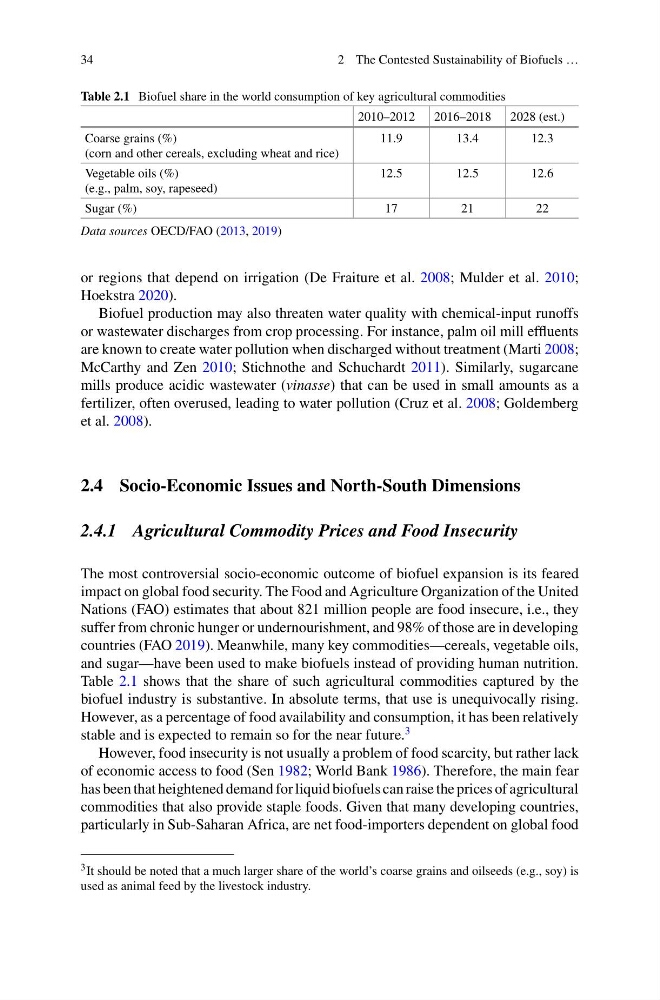
Table 2.1 Biofuel share in the world consumption of key agricultural commodities
2010–2012 2016–2018 2028 (est.)
Coarse grains (%)
(corn and other cereals, excluding wheat and rice)
11.9
13.4
12.3
Vegetable oils (%)
(e.g., palm, soy, rapeseed)
12.5
12.5
12.6
Sugar (%)
17
21
22
Data sources OECD/FAO (2013, 2019)
or regions that depend on irrigation (De Fraiture et al. 2008; Mulder et al. 2010;
Hoekstra 2020).
Biofuel production may also threaten water quality with chemical-input runoffs
or wastewater discharges from crop processing. For instance, palm oil mill effluents
are known to create water pollution when discharged without treatment (Marti 2008;
McCarthy and Zen 2010; Stichnothe and Schuchardt 2011). Similarly, sugarcane
mills produce acidic wastewater (vinasse) that can be used in small amounts as a
fertilizer, often overused, leading to water pollution (Cruz et al. 2008; Goldemberg
et al. 2008).
2.4 Socio-Economic Issues and North-South Dimensions
2.4.1 Agricultural Commodity Prices and Food Insecurity
The most controversial socio-economic outcome of biofuel expansion is its feared
impact on global food security. The Food and Agriculture Organization of the United
Nations (FAO) estimates that about 821 million people are food insecure, i.e., they
suffer from chronic hunger or undernourishment, and 98% of those are in developing
countries (FAO 2019). Meanwhile, many key commodities—cereals, vegetable oils,
and sugar—have been used to make biofuels instead of providing human nutrition.
Table 2.1 shows that the share of such agricultural commodities captured by the
biofuel industry is substantive. In absolute terms, that use is unequivocally rising.
However, as a percentage of food availability and consumption, it has been relatively
stable and is expected to remain so for the near future.
3
However, food insecurity is not usually a problem of food scarcity, but rather lack
of economic access to food (Sen 1982; World Bank 1986). Therefore, the main fear
has been that heightened demand for liquid biofuels can raise the prices of agricultural
commodities that also provide staple foods. Given that many developing countries,
particularly in Sub-Saharan Africa, are net food-importers dependent on global food
3 It should be noted that a much larger share of the world’s coarse grains and oilseeds (e.g., soy) is
used as animal feed by the livestock industry.
2 The Contested Sustainability of Biofuels …
Table 2.1 Biofuel share in the world consumption of key agricultural commodities
2010–2012 2016–2018 2028 (est.)
Coarse grains (%)
(corn and other cereals, excluding wheat and rice)
11.9
13.4
12.3
Vegetable oils (%)
(e.g., palm, soy, rapeseed)
12.5
12.5
12.6
Sugar (%)
17
21
22
Data sources OECD/FAO (2013, 2019)
or regions that depend on irrigation (De Fraiture et al. 2008; Mulder et al. 2010;
Hoekstra 2020).
Biofuel production may also threaten water quality with chemical-input runoffs
or wastewater discharges from crop processing. For instance, palm oil mill effluents
are known to create water pollution when discharged without treatment (Marti 2008;
McCarthy and Zen 2010; Stichnothe and Schuchardt 2011). Similarly, sugarcane
mills produce acidic wastewater (vinasse) that can be used in small amounts as a
fertilizer, often overused, leading to water pollution (Cruz et al. 2008; Goldemberg
et al. 2008).
2.4 Socio-Economic Issues and North-South Dimensions
2.4.1 Agricultural Commodity Prices and Food Insecurity
The most controversial socio-economic outcome of biofuel expansion is its feared
impact on global food security. The Food and Agriculture Organization of the United
Nations (FAO) estimates that about 821 million people are food insecure, i.e., they
suffer from chronic hunger or undernourishment, and 98% of those are in developing
countries (FAO 2019). Meanwhile, many key commodities—cereals, vegetable oils,
and sugar—have been used to make biofuels instead of providing human nutrition.
Table 2.1 shows that the share of such agricultural commodities captured by the
biofuel industry is substantive. In absolute terms, that use is unequivocally rising.
However, as a percentage of food availability and consumption, it has been relatively
stable and is expected to remain so for the near future.
3
However, food insecurity is not usually a problem of food scarcity, but rather lack
of economic access to food (Sen 1982; World Bank 1986). Therefore, the main fear
has been that heightened demand for liquid biofuels can raise the prices of agricultural
commodities that also provide staple foods. Given that many developing countries,
particularly in Sub-Saharan Africa, are net food-importers dependent on global food
3 It should be noted that a much larger share of the world’s coarse grains and oilseeds (e.g., soy) is
used as animal feed by the livestock industry.