

190
8 Bioeconomy Lessons from Biofuel Policies …
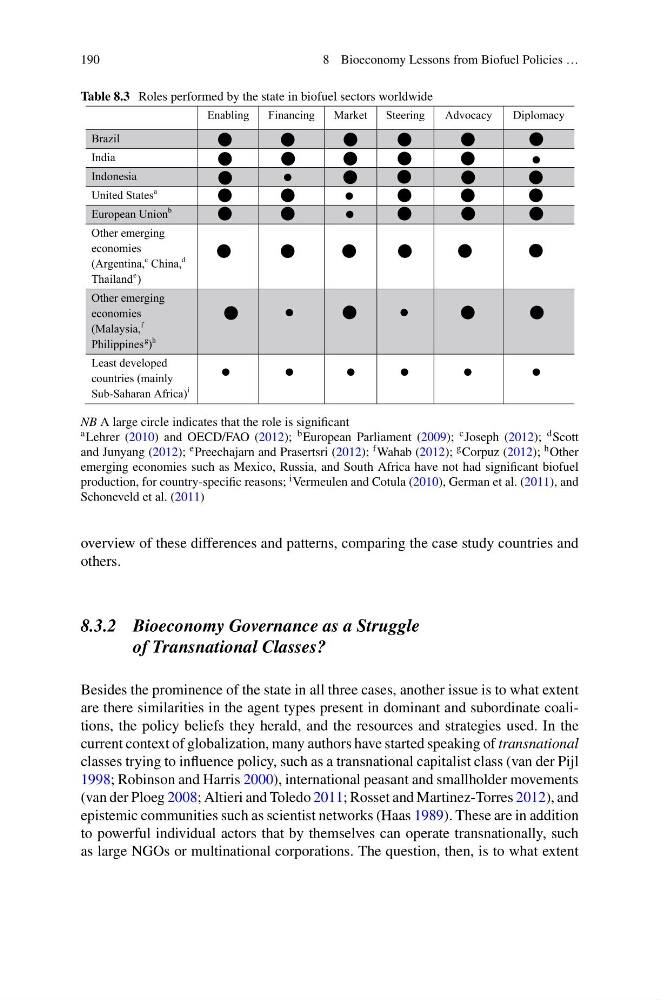
Table 8.3 Roles performed by the state in biofuel sectors worldwide
Enabling
Financing
Market
Steering
Advocacy
Diplomacy
Brazil
India
Indonesia
United States
a
European Union
b
Other emerging
economies
(Argentina,
c China,
d
Thailand
e )
Other emerging
economies
(Malaysia,
f
Philippines
g
)
h
Least developed
countries (mainly
Sub-Saharan Africa)
i
NB A large circle indicates that the role is significant
a Lehrer (2010) and OECD/FAO (2012); b European Parliament (2009); c Joseph (2012); d Scott
and Junyang (2012); e Preechajarn and Prasertsri (2012); f Wahab (2012); g Corpuz (2012); h Other
emerging economies such as Mexico, Russia, and South Africa have not had significant biofuel
production, for country-specific reasons; i Vermeulen and Cotula (2010), German et al. (2011), and
Schoneveld et al. (2011)
overview of these differences and patterns, comparing the case study countries and
others.
8.3.2 Bioeconomy Governance as a Struggle
of Transnational Classes?
Besides the prominence of the state in all three cases, another issue is to what extent
are there similarities in the agent types present in dominant and subordinate coalitions, the policy beliefs they herald, and the resources and strategies used. In the
current context of globalization, many authors have started speaking of transnational
classes trying to influence policy, such as a transnational capitalist class (van der Pijl
1998; Robinson and Harris 2000), international peasant and smallholder movements
(van der Ploeg 2008; Altieri and Toledo 2011; Rosset and Martinez-Torres 2012), and
epistemic communities such as scientist networks (Haas 1989). These are in addition
to powerful individual actors that by themselves can operate transnationally, such
as large NGOs or multinational corporations. The question, then, is to what extent
8 Bioeconomy Lessons from Biofuel Policies …
Table 8.3 Roles performed by the state in biofuel sectors worldwide
Enabling
Financing
Market
Steering
Advocacy
Diplomacy
Brazil
India
Indonesia
United States
a
European Union
b
Other emerging
economies
(Argentina,
c China,
d
Thailand
e )
Other emerging
economies
(Malaysia,
f
Philippines
g
)
h
Least developed
countries (mainly
Sub-Saharan Africa)
i
NB A large circle indicates that the role is significant
a Lehrer (2010) and OECD/FAO (2012); b European Parliament (2009); c Joseph (2012); d Scott
and Junyang (2012); e Preechajarn and Prasertsri (2012); f Wahab (2012); g Corpuz (2012); h Other
emerging economies such as Mexico, Russia, and South Africa have not had significant biofuel
production, for country-specific reasons; i Vermeulen and Cotula (2010), German et al. (2011), and
Schoneveld et al. (2011)
overview of these differences and patterns, comparing the case study countries and
others.
8.3.2 Bioeconomy Governance as a Struggle
of Transnational Classes?
Besides the prominence of the state in all three cases, another issue is to what extent
are there similarities in the agent types present in dominant and subordinate coalitions, the policy beliefs they herald, and the resources and strategies used. In the
current context of globalization, many authors have started speaking of transnational
classes trying to influence policy, such as a transnational capitalist class (van der Pijl
1998; Robinson and Harris 2000), international peasant and smallholder movements
(van der Ploeg 2008; Altieri and Toledo 2011; Rosset and Martinez-Torres 2012), and
epistemic communities such as scientist networks (Haas 1989). These are in addition
to powerful individual actors that by themselves can operate transnationally, such
as large NGOs or multinational corporations. The question, then, is to what extent