

7.2 Allocation and Access: Analyzing Institutional Performance
157
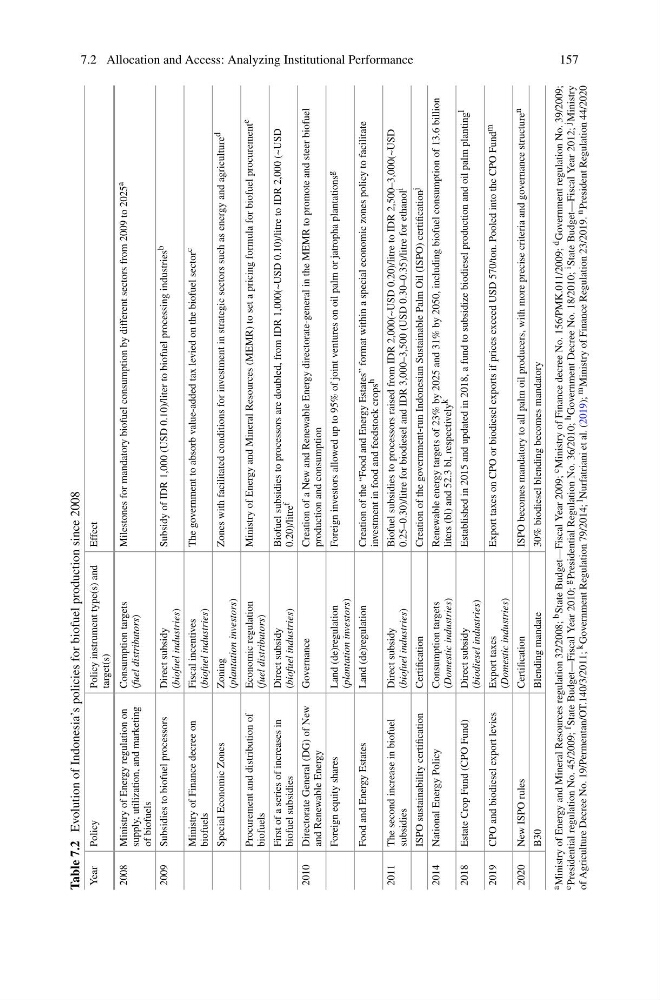
Table 7.2
Evolution of Indonesia’s policies for biofuel production since 2008
Year
Policy
Policy instrument type(s) and
target(s)
Effect
2008
Ministry of Energy regulation on
supply, utilization, and marketing
of biofuels
Consumption targets
(fuel distributors)
Milestones for mandatory biofuel consumption by different sectors from 2009 to 2025 a
2009
Subsidies to biofuel processors
Direct subsidy
(biofuel industries)
Subsidy of IDR 1,000 (USD 0.10)/liter to biofuel processing industries b
Ministry of Finance decree on
biofuels
Fiscal incentives
(biofuel industries)
The government to absorb value-added tax levied on the biofuel sector c
Special Economic Zones
Zoning
(plantation investors)
Zones with facilitated conditions for investment in strategic sectors such as energy and agriculture d
Procurement and distribution of
biofuels
Economic regulation
(fuel distributors)
Ministry of Energy and Mineral Resources (MEMR) to set a pricing formula for biofuel procurement e
First of a series of increases in
biofuel subsidies
Direct subsidy
(biofuel industries)
Biofuel subsidies to processors are doubled, from IDR 1,000(~USD 0.10)/litre to IDR 2,000 (~USD
0.20)/litre f
2010
Directorate General (DG) of New
and Renewable Energy
Governance
Creation of a New and Renewable Energy directorate-general in the MEMR to promote and steer biofuel
production and consumption
Foreign equity shares
Land (de)regulation
(plantation investors)
Foreign investors allowed up to 95% of joint ventures on oil palm or jatropha plantations g
Food and Energy Estates
Land (de)regulation
Creation of the “Food and Energy Estates” format within a special economic zones policy to facilitate
investment in food and feedstock crops h
2011
The second increase in biofuel
subsidies
Direct subsidy
(biofuel industries)
Biofuel subsidies to processors raised from IDR 2,000(~USD 0.20)/litre to IDR 2,500–3,000(~USD
0.25–0.30)/litre for biodiesel and IDR 3,000–3,500 (USD 0.30–0.35)/litre for ethanol i
ISPO sustainability certification
Certification
Creation of the government-run Indonesian Sustainable Palm Oil (ISPO) certification j
2014
National Energy Policy
Consumption targets
(Domestic industries)
Renewable energy targets of 23% by 2025 and 31% by 2050, including biofuel consumption of 13.6 billion
liters (bl) and 52.3 bl, respectively k
2018
Estate Crop Fund (CPO Fund)
Direct subsidy
(biodiesel industries)
Established in 2015 and updated in 2018, a fund to subsidize biodiesel production and oil palm planting l
2019
CPO and biodiesel export levies
Export taxes
(Domestic industries)
Export taxes on CPO or biodiesel exports if prices exceed USD 570/ton. Pooled into the CPO Fund m
2020
New ISPO rules
Certification
ISPO becomes mandatory to all palm oil producers, with more precise criteria and governance structure n
B30
Blending mandate
30% biodiesel blending becomes mandatory
a
Ministry of Energy and Mineral Resources regulation 32/2008; b
State Budget—Fiscal Year 2009; c
Ministry of Finance decree No. 156/PMK.011/2009; d
Government regulation No. 39/2009;
e
Presidential regulation No. 45/2009; f
State Budget—Fiscal Year 2010; g
Presidential Regulation No. 36/2010; h
Government Decree No. 18/2010; i
State Budget—Fiscal Year 2012; j
Ministry
of Agriculture Decree No. 19/Permentan/OT.140/3/2011; k
Government Regulation 79/2014; l
Nurfatriani et al. (2019); m
Ministry of Finance Regulation 23/2019. n
President Regulation 44/2020
157
Table 7.2
Evolution of Indonesia’s policies for biofuel production since 2008
Year
Policy
Policy instrument type(s) and
target(s)
Effect
2008
Ministry of Energy regulation on
supply, utilization, and marketing
of biofuels
Consumption targets
(fuel distributors)
Milestones for mandatory biofuel consumption by different sectors from 2009 to 2025 a
2009
Subsidies to biofuel processors
Direct subsidy
(biofuel industries)
Subsidy of IDR 1,000 (USD 0.10)/liter to biofuel processing industries b
Ministry of Finance decree on
biofuels
Fiscal incentives
(biofuel industries)
The government to absorb value-added tax levied on the biofuel sector c
Special Economic Zones
Zoning
(plantation investors)
Zones with facilitated conditions for investment in strategic sectors such as energy and agriculture d
Procurement and distribution of
biofuels
Economic regulation
(fuel distributors)
Ministry of Energy and Mineral Resources (MEMR) to set a pricing formula for biofuel procurement e
First of a series of increases in
biofuel subsidies
Direct subsidy
(biofuel industries)
Biofuel subsidies to processors are doubled, from IDR 1,000(~USD 0.10)/litre to IDR 2,000 (~USD
0.20)/litre f
2010
Directorate General (DG) of New
and Renewable Energy
Governance
Creation of a New and Renewable Energy directorate-general in the MEMR to promote and steer biofuel
production and consumption
Foreign equity shares
Land (de)regulation
(plantation investors)
Foreign investors allowed up to 95% of joint ventures on oil palm or jatropha plantations g
Food and Energy Estates
Land (de)regulation
Creation of the “Food and Energy Estates” format within a special economic zones policy to facilitate
investment in food and feedstock crops h
2011
The second increase in biofuel
subsidies
Direct subsidy
(biofuel industries)
Biofuel subsidies to processors raised from IDR 2,000(~USD 0.20)/litre to IDR 2,500–3,000(~USD
0.25–0.30)/litre for biodiesel and IDR 3,000–3,500 (USD 0.30–0.35)/litre for ethanol i
ISPO sustainability certification
Certification
Creation of the government-run Indonesian Sustainable Palm Oil (ISPO) certification j
2014
National Energy Policy
Consumption targets
(Domestic industries)
Renewable energy targets of 23% by 2025 and 31% by 2050, including biofuel consumption of 13.6 billion
liters (bl) and 52.3 bl, respectively k
2018
Estate Crop Fund (CPO Fund)
Direct subsidy
(biodiesel industries)
Established in 2015 and updated in 2018, a fund to subsidize biodiesel production and oil palm planting l
2019
CPO and biodiesel export levies
Export taxes
(Domestic industries)
Export taxes on CPO or biodiesel exports if prices exceed USD 570/ton. Pooled into the CPO Fund m
2020
New ISPO rules
Certification
ISPO becomes mandatory to all palm oil producers, with more precise criteria and governance structure n
B30
Blending mandate
30% biodiesel blending becomes mandatory
a
Ministry of Energy and Mineral Resources regulation 32/2008; b
State Budget—Fiscal Year 2009; c
Ministry of Finance decree No. 156/PMK.011/2009; d
Government regulation No. 39/2009;
e
Presidential regulation No. 45/2009; f
State Budget—Fiscal Year 2010; g
Presidential Regulation No. 36/2010; h
Government Decree No. 18/2010; i
State Budget—Fiscal Year 2012; j
Ministry
of Agriculture Decree No. 19/Permentan/OT.140/3/2011; k
Government Regulation 79/2014; l
Nurfatriani et al. (2019); m
Ministry of Finance Regulation 23/2019. n
President Regulation 44/2020