

154
7 Bioeconomy in the Oil Palm Republic of Indonesia
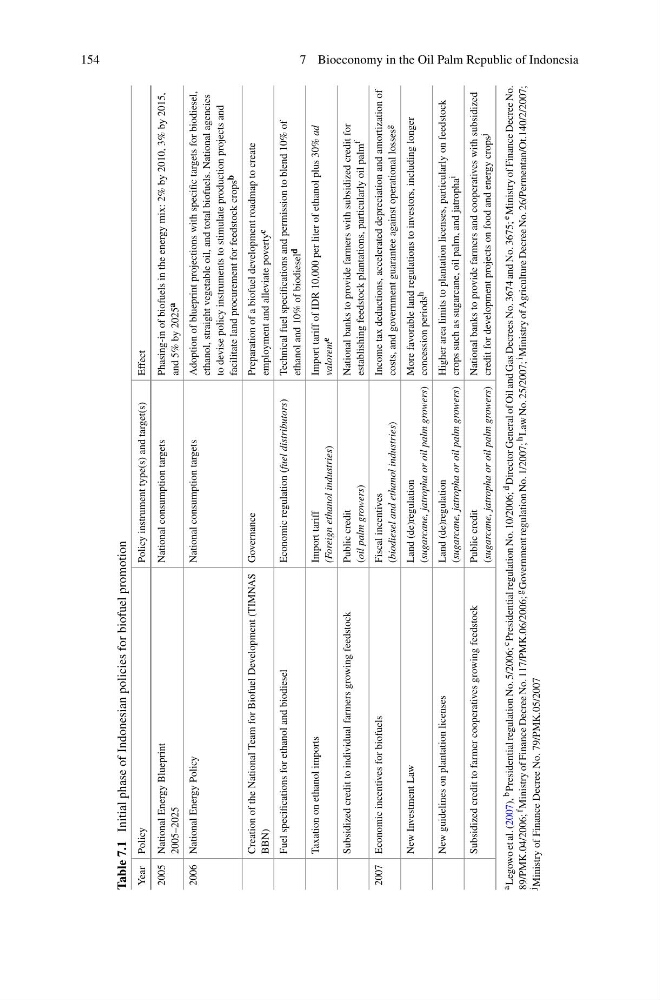
Table 7.1
Initial phase of Indonesian policies for biofuel promotion
Year Policy
Policy instrument type(s) and target(s)
Effect
2005 National Energy Blueprint
2005–2025
National consumption targets
Phasing-in of biofuels in the energy mix: 2% by 2010, 3% by 2015,
and 5% by 2025 a
2006 National Energy Policy
National consumption targets
Adoption of blueprint projections with specific targets for biodiesel,
ethanol, straight vegetable oil, and total biofuels. National agencies
to devise policy instruments to stimulate production projects and
facilitate land procurement for feedstock crops b
Creation of the National Team for Biofuel Development (TIMNAS
BBN)
Governance
Preparation of a biofuel development roadmap to create
employment and alleviate poverty c
Fuel specifications for ethanol and biodiesel
Economic regulation (fuel distributors)
Technical fuel specifications and permission to blend 10% of
ethanol and 10% of biodiesel d
Taxation on ethanol imports
Import tariff
(Foreign ethanol industries)
Import tariff of IDR 10,000 per liter of ethanol plus 30% ad
valorem e
Subsidized credit to individual farmers growing feedstock
Public credit
(oil palm growers)
National banks to provide farmers with subsidized credit for
establishing feedstock plantations, particularly oil palm f
2007 Economic incentives for biofuels
Fiscal incentives
(biodiesel and ethanol industries)
Income tax deductions, accelerated depreciation and amortization of
costs, and government guarantee against operational losses g
New Investment Law
Land (de)regulation
(sugarcane, jatropha or oil palm growers)
More favorable land regulations to investors, including longer
concession periods h
New guidelines on plantation licenses
Land (de)regulation
(sugarcane, jatropha or oil palm growers)
Higher area limits to plantation licenses, particularly on feedstock
crops such as sugarcane, oil palm, and jatropha i
Subsidized credit to farmer cooperatives growing feedstock
Public credit
(sugarcane, jatropha or oil palm growers)
National banks to provide farmers and cooperatives with subsidized
credit for development projects on food and energy crops j
a
Legowo et al. (2007), b
Presidential regulation No. 5/2006; c
Presidential regulation No. 10/2006; d
Director General of Oil and Gas Decrees No. 3674 and No. 3675; e
Ministry of Finance Decree No.
89/PMK.04/2006; f
Ministry of Finance Decree No. 117/PMK.06/2006; g
Government regulation No. 1/2007; h
Law No. 25/2007; i
Ministry of Agriculture Decree No. 26/Permentan/Ot.140/2/2007;
j
Ministry of Finance Decree No. 79/PMK.05/2007
7 Bioeconomy in the Oil Palm Republic of Indonesia
Table 7.1
Initial phase of Indonesian policies for biofuel promotion
Year Policy
Policy instrument type(s) and target(s)
Effect
2005 National Energy Blueprint
2005–2025
National consumption targets
Phasing-in of biofuels in the energy mix: 2% by 2010, 3% by 2015,
and 5% by 2025 a
2006 National Energy Policy
National consumption targets
Adoption of blueprint projections with specific targets for biodiesel,
ethanol, straight vegetable oil, and total biofuels. National agencies
to devise policy instruments to stimulate production projects and
facilitate land procurement for feedstock crops b
Creation of the National Team for Biofuel Development (TIMNAS
BBN)
Governance
Preparation of a biofuel development roadmap to create
employment and alleviate poverty c
Fuel specifications for ethanol and biodiesel
Economic regulation (fuel distributors)
Technical fuel specifications and permission to blend 10% of
ethanol and 10% of biodiesel d
Taxation on ethanol imports
Import tariff
(Foreign ethanol industries)
Import tariff of IDR 10,000 per liter of ethanol plus 30% ad
valorem e
Subsidized credit to individual farmers growing feedstock
Public credit
(oil palm growers)
National banks to provide farmers with subsidized credit for
establishing feedstock plantations, particularly oil palm f
2007 Economic incentives for biofuels
Fiscal incentives
(biodiesel and ethanol industries)
Income tax deductions, accelerated depreciation and amortization of
costs, and government guarantee against operational losses g
New Investment Law
Land (de)regulation
(sugarcane, jatropha or oil palm growers)
More favorable land regulations to investors, including longer
concession periods h
New guidelines on plantation licenses
Land (de)regulation
(sugarcane, jatropha or oil palm growers)
Higher area limits to plantation licenses, particularly on feedstock
crops such as sugarcane, oil palm, and jatropha i
Subsidized credit to farmer cooperatives growing feedstock
Public credit
(sugarcane, jatropha or oil palm growers)
National banks to provide farmers and cooperatives with subsidized
credit for development projects on food and energy crops j
a
Legowo et al. (2007), b
Presidential regulation No. 5/2006; c
Presidential regulation No. 10/2006; d
Director General of Oil and Gas Decrees No. 3674 and No. 3675; e
Ministry of Finance Decree No.
89/PMK.04/2006; f
Ministry of Finance Decree No. 117/PMK.06/2006; g
Government regulation No. 1/2007; h
Law No. 25/2007; i
Ministry of Agriculture Decree No. 26/Permentan/Ot.140/2/2007;
j
Ministry of Finance Decree No. 79/PMK.05/2007