

5.1 Biofuels in Brazil: How and Why
99
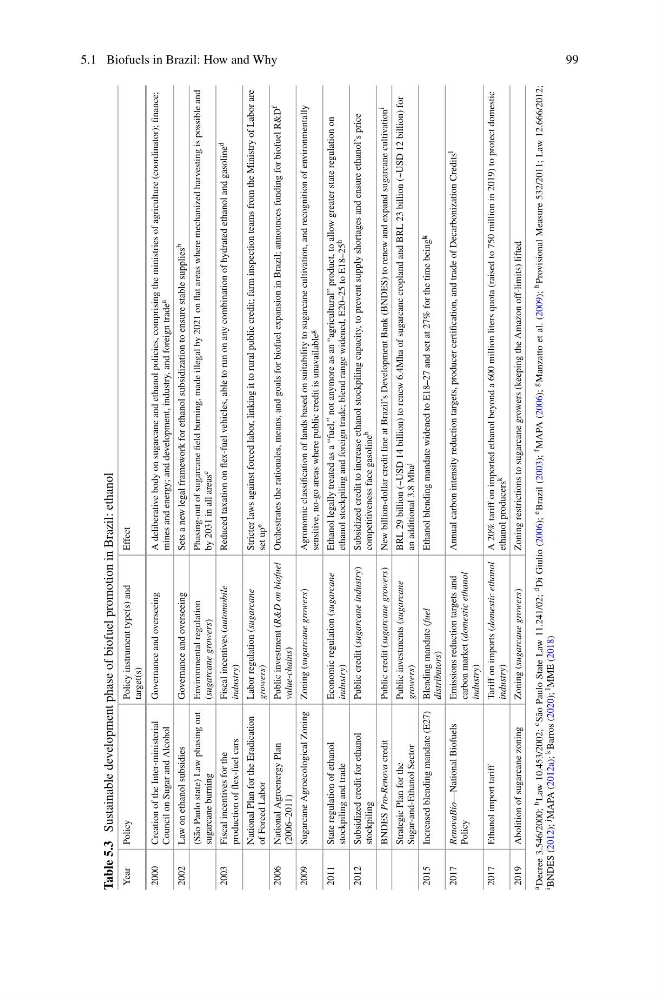
Table 5.3
Sustainable development phase of biofuel promotion in Brazil: ethanol
Year
Policy
Policy instrument type(s) and
target(s)
Effect
2000
Creation of the Inter-ministerial
Council on Sugar and Alcohol
Governance and overseeing
A deliberative body on sugarcane and ethanol policies, comprising the ministries of agriculture (coordinator); finance;
mines and energy; and development, industry, and foreign trade a
2002
Law on ethanol subsidies
Governance and overseeing
Sets a new legal framework for ethanol subsidization to ensure stable supplies b
(São Paulo state) Law phasing out
sugarcane burning
Environmental regulation
(sugarcane growers)
Phasing-out of sugarcane field burning, made illegal by 2021 on flat areas where mechanized harvesting is possible and
by 2031 in all areas c
2003
Fiscal incentives for the
production of flex-fuel cars
Fiscal incentives (automobile
industry)
Reduced taxation on flex-fuel vehicles, able to run on any combination of hydrated ethanol and gasoline d
National Plan for the Eradication
of Forced Labor
Labor regulation (sugarcane
growers)
Stricter laws against forced labor, linking it to rural public credit; farm inspection teams from the Ministry of Labor are
set up e
2006
National Agroenergy Plan
(2006–2011)
Public investment (R&D on biofuel
value-chains)
Orchestrates the rationales, means, and goals for biofuel expansion in Brazil; announces funding for biofuel R&D f
2009
Sugarcane Agroecological Zoning Zoning (sugarcane growers)
Agronomic classification of lands based on suitability to sugarcane cultivation, and recognition of environmentally
sensitive, no-go areas where public credit is unavailable g
2011
State regulation of ethanol
stockpiling and trade
Economic regulation (sugarcane
industry)
Ethanol legally treated as a “fuel,” not anymore as an “agricultural” product, to allow greater state regulation on
ethanol stockpiling and foreign trade; blend range widened, E20–25 to E18–25 h
2012
Subsidized credit for ethanol
stockpiling
Public credit (sugarcane industry)
Subsidized credit to increase ethanol stockpiling capacity, to prevent supply shortages and ensure ethanol’s price
competitiveness face gasoline h
BNDES Pro-Renova
credit
Public credit (sugarcane growers)
New billion-dollar credit line at Brazil’s Development Bank (BNDES) to renew and expand sugarcane cultivation i
Strategic Plan for the
Sugar-and-Ethanol Sector
Public investments (sugarcane
growers)
BRL 29 billion (~USD 14 billion) to renew 6.4Mha of sugarcane cropland and BRL 23 billion (~USD 12 billion) for
an additional 3.8 Mha j
2015
Increased blending mandate (E27) Blending mandate (fuel
distributors)
Ethanol blending mandate widened to E18–27 and set at 27% for the time being k
2017
RenovaBio—National
Biofuels
Policy
Emissions reduction targets and
carbon market (domestic ethanol
industry)
Annual carbon intensity reduction targets, producer certification, and trade of Decarbonization Credits l
2017
Ethanol import tariff
Tariff on imports (domestic ethanol
industry)
A 20% tariff on imported ethanol beyond a 600 million liters quota (raised to 750 million in 2019) to protect domestic
ethanol producers k
2019
Abolition of sugarcane zoning
Zoning (sugarcane growers)
Zoning restrictions to sugarcane growers (keeping the Amazon off-limits) lifted
a
Decree 3.546/2000; b
Law 10.453/2002; c
São Paulo State Law 11.241/02; d
Di Giulio (2006); e
Brazil (2003); f
MAPA (2006); g
Manzatto et al. (2009); h
Provisional Measure 532/2011; Law 12.666/2012;
i
BNDES (2012); j
MAPA (2012a); k
Barros (2020); l
MME (2018)
99
Table 5.3
Sustainable development phase of biofuel promotion in Brazil: ethanol
Year
Policy
Policy instrument type(s) and
target(s)
Effect
2000
Creation of the Inter-ministerial
Council on Sugar and Alcohol
Governance and overseeing
A deliberative body on sugarcane and ethanol policies, comprising the ministries of agriculture (coordinator); finance;
mines and energy; and development, industry, and foreign trade a
2002
Law on ethanol subsidies
Governance and overseeing
Sets a new legal framework for ethanol subsidization to ensure stable supplies b
(São Paulo state) Law phasing out
sugarcane burning
Environmental regulation
(sugarcane growers)
Phasing-out of sugarcane field burning, made illegal by 2021 on flat areas where mechanized harvesting is possible and
by 2031 in all areas c
2003
Fiscal incentives for the
production of flex-fuel cars
Fiscal incentives (automobile
industry)
Reduced taxation on flex-fuel vehicles, able to run on any combination of hydrated ethanol and gasoline d
National Plan for the Eradication
of Forced Labor
Labor regulation (sugarcane
growers)
Stricter laws against forced labor, linking it to rural public credit; farm inspection teams from the Ministry of Labor are
set up e
2006
National Agroenergy Plan
(2006–2011)
Public investment (R&D on biofuel
value-chains)
Orchestrates the rationales, means, and goals for biofuel expansion in Brazil; announces funding for biofuel R&D f
2009
Sugarcane Agroecological Zoning Zoning (sugarcane growers)
Agronomic classification of lands based on suitability to sugarcane cultivation, and recognition of environmentally
sensitive, no-go areas where public credit is unavailable g
2011
State regulation of ethanol
stockpiling and trade
Economic regulation (sugarcane
industry)
Ethanol legally treated as a “fuel,” not anymore as an “agricultural” product, to allow greater state regulation on
ethanol stockpiling and foreign trade; blend range widened, E20–25 to E18–25 h
2012
Subsidized credit for ethanol
stockpiling
Public credit (sugarcane industry)
Subsidized credit to increase ethanol stockpiling capacity, to prevent supply shortages and ensure ethanol’s price
competitiveness face gasoline h
BNDES Pro-Renova
credit
Public credit (sugarcane growers)
New billion-dollar credit line at Brazil’s Development Bank (BNDES) to renew and expand sugarcane cultivation i
Strategic Plan for the
Sugar-and-Ethanol Sector
Public investments (sugarcane
growers)
BRL 29 billion (~USD 14 billion) to renew 6.4Mha of sugarcane cropland and BRL 23 billion (~USD 12 billion) for
an additional 3.8 Mha j
2015
Increased blending mandate (E27) Blending mandate (fuel
distributors)
Ethanol blending mandate widened to E18–27 and set at 27% for the time being k
2017
RenovaBio—National
Biofuels
Policy
Emissions reduction targets and
carbon market (domestic ethanol
industry)
Annual carbon intensity reduction targets, producer certification, and trade of Decarbonization Credits l
2017
Ethanol import tariff
Tariff on imports (domestic ethanol
industry)
A 20% tariff on imported ethanol beyond a 600 million liters quota (raised to 750 million in 2019) to protect domestic
ethanol producers k
2019
Abolition of sugarcane zoning
Zoning (sugarcane growers)
Zoning restrictions to sugarcane growers (keeping the Amazon off-limits) lifted
a
Decree 3.546/2000; b
Law 10.453/2002; c
São Paulo State Law 11.241/02; d
Di Giulio (2006); e
Brazil (2003); f
MAPA (2006); g
Manzatto et al. (2009); h
Provisional Measure 532/2011; Law 12.666/2012;
i
BNDES (2012); j
MAPA (2012a); k
Barros (2020); l
MME (2018)