

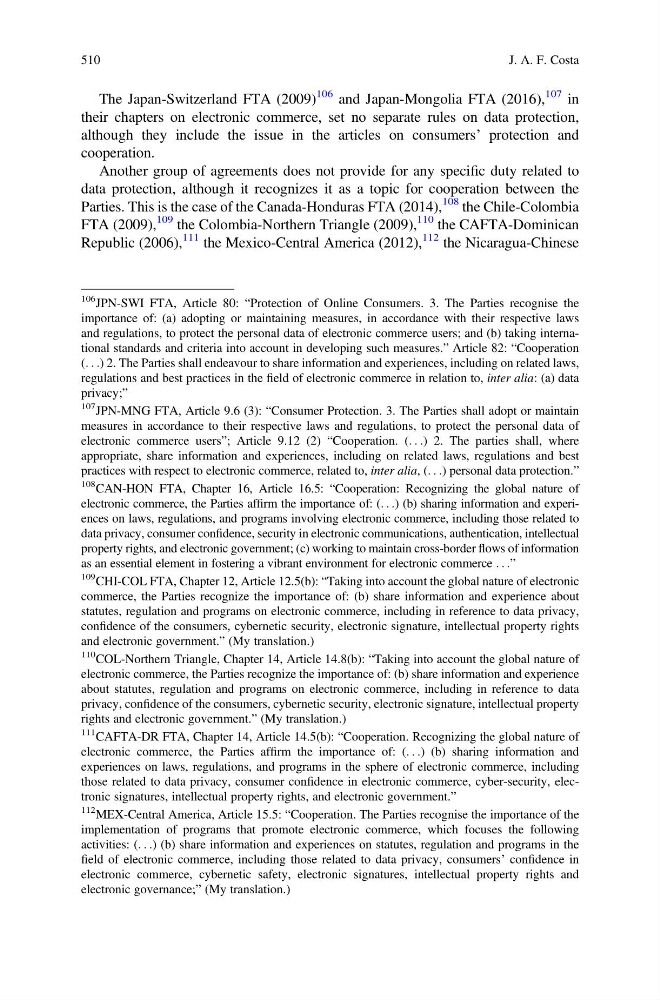
The Japan-Switzerland FTA (2009)
106 and Japan-Mongolia FTA (2016),
107 in
their chapters on electronic commerce, set no separate rules on data protection,
although they include the issue in the articles on consumers’ protection and
cooperation.
Another group of agreements does not provide for any specific duty related to
data protection, although it recognizes it as a topic for cooperation between the
Parties. This is the case of the Canada-Honduras FTA (2014),
108 the Chile-Colombia
FTA (2009),
109 the Colombia-Northern Triangle (2009),
110 the CAFTA-Dominican
Republic (2006),
111 the Mexico-Central America (2012),
112 the Nicaragua-Chinese
106 JPN-SWI FTA, Article 80: “Protection of Online Consumers. 3. The Parties recognise the
importance of: (a) adopting or maintaining measures, in accordance with their respective laws
and regulations, to protect the personal data of electronic commerce users; and (b) taking international standards and criteria into account in developing such measures.” Article 82: “Cooperation
(. . .) 2. The Parties shall endeavour to share information and experiences, including on related laws,
regulations and best practices in the field of electronic commerce in relation to, inter alia: (a) data
privacy;”
107 JPN-MNG FTA, Article 9.6 (3): “Consumer Protection. 3. The Parties shall adopt or maintain
measures in accordance to their respective laws and regulations, to protect the personal data of
electronic commerce users”; Article 9.12 (2) “Cooperation. (. . .) 2. The parties shall, where
appropriate, share information and experiences, including on related laws, regulations and best
practices with respect to electronic commerce, related to, inter alia, (. . .) personal data protection.”
108 CAN-HON FTA, Chapter 16, Article 16.5: “Cooperation: Recognizing the global nature of
electronic commerce, the Parties affirm the importance of: (. . .) (b) sharing information and experiences on laws, regulations, and programs involving electronic commerce, including those related to
data privacy, consumer confidence, security in electronic communications, authentication, intellectual
property rights, and electronic government; (c) working to maintain cross-border flows of information
as an essential element in fostering a vibrant environment for electronic commerce . . .”
109 CHI-COL FTA, Chapter 12, Article 12.5(b): “Taking into account the global nature of electronic
commerce, the Parties recognize the importance of: (b) share information and experience about
statutes, regulation and programs on electronic commerce, including in reference to data privacy,
confidence of the consumers, cybernetic security, electronic signature, intellectual property rights
and electronic government.” (My translation.)
110 COL-Northern Triangle, Chapter 14, Article 14.8(b): “Taking into account the global nature of
electronic commerce, the Parties recognize the importance of: (b) share information and experience
about statutes, regulation and programs on electronic commerce, including in reference to data
privacy, confidence of the consumers, cybernetic security, electronic signature, intellectual property
rights and electronic government.” (My translation.)
111 CAFTA-DR FTA, Chapter 14, Article 14.5(b): “Cooperation. Recognizing the global nature of
electronic commerce, the Parties affirm the importance of: (. . .) (b) sharing information and
experiences on laws, regulations, and programs in the sphere of electronic commerce, including
those related to data privacy, consumer confidence in electronic commerce, cyber-security, electronic signatures, intellectual property rights, and electronic government.”
112 MEX-Central America, Article 15.5: “Cooperation. The Parties recognise the importance of the
implementation of programs that promote electronic commerce, which focuses the following
activities: (. . .) (b) share information and experiences on statutes, regulation and programs in the
field of electronic commerce, including those related to data privacy, consumers’ confidence in
electronic commerce, cybernetic safety, electronic signatures, intellectual property rights and
electronic governance;” (My translation.)
510
J. A. F. Costa
106 and Japan-Mongolia FTA (2016),
107 in
their chapters on electronic commerce, set no separate rules on data protection,
although they include the issue in the articles on consumers’ protection and
cooperation.
Another group of agreements does not provide for any specific duty related to
data protection, although it recognizes it as a topic for cooperation between the
Parties. This is the case of the Canada-Honduras FTA (2014),
108 the Chile-Colombia
FTA (2009),
109 the Colombia-Northern Triangle (2009),
110 the CAFTA-Dominican
Republic (2006),
111 the Mexico-Central America (2012),
112 the Nicaragua-Chinese
106 JPN-SWI FTA, Article 80: “Protection of Online Consumers. 3. The Parties recognise the
importance of: (a) adopting or maintaining measures, in accordance with their respective laws
and regulations, to protect the personal data of electronic commerce users; and (b) taking international standards and criteria into account in developing such measures.” Article 82: “Cooperation
(. . .) 2. The Parties shall endeavour to share information and experiences, including on related laws,
regulations and best practices in the field of electronic commerce in relation to, inter alia: (a) data
privacy;”
107 JPN-MNG FTA, Article 9.6 (3): “Consumer Protection. 3. The Parties shall adopt or maintain
measures in accordance to their respective laws and regulations, to protect the personal data of
electronic commerce users”; Article 9.12 (2) “Cooperation. (. . .) 2. The parties shall, where
appropriate, share information and experiences, including on related laws, regulations and best
practices with respect to electronic commerce, related to, inter alia, (. . .) personal data protection.”
108 CAN-HON FTA, Chapter 16, Article 16.5: “Cooperation: Recognizing the global nature of
electronic commerce, the Parties affirm the importance of: (. . .) (b) sharing information and experiences on laws, regulations, and programs involving electronic commerce, including those related to
data privacy, consumer confidence, security in electronic communications, authentication, intellectual
property rights, and electronic government; (c) working to maintain cross-border flows of information
as an essential element in fostering a vibrant environment for electronic commerce . . .”
109 CHI-COL FTA, Chapter 12, Article 12.5(b): “Taking into account the global nature of electronic
commerce, the Parties recognize the importance of: (b) share information and experience about
statutes, regulation and programs on electronic commerce, including in reference to data privacy,
confidence of the consumers, cybernetic security, electronic signature, intellectual property rights
and electronic government.” (My translation.)
110 COL-Northern Triangle, Chapter 14, Article 14.8(b): “Taking into account the global nature of
electronic commerce, the Parties recognize the importance of: (b) share information and experience
about statutes, regulation and programs on electronic commerce, including in reference to data
privacy, confidence of the consumers, cybernetic security, electronic signature, intellectual property
rights and electronic government.” (My translation.)
111 CAFTA-DR FTA, Chapter 14, Article 14.5(b): “Cooperation. Recognizing the global nature of
electronic commerce, the Parties affirm the importance of: (. . .) (b) sharing information and
experiences on laws, regulations, and programs in the sphere of electronic commerce, including
those related to data privacy, consumer confidence in electronic commerce, cyber-security, electronic signatures, intellectual property rights, and electronic government.”
112 MEX-Central America, Article 15.5: “Cooperation. The Parties recognise the importance of the
implementation of programs that promote electronic commerce, which focuses the following
activities: (. . .) (b) share information and experiences on statutes, regulation and programs in the
field of electronic commerce, including those related to data privacy, consumers’ confidence in
electronic commerce, cybernetic safety, electronic signatures, intellectual property rights and
electronic governance;” (My translation.)
510
J. A. F. Costa