

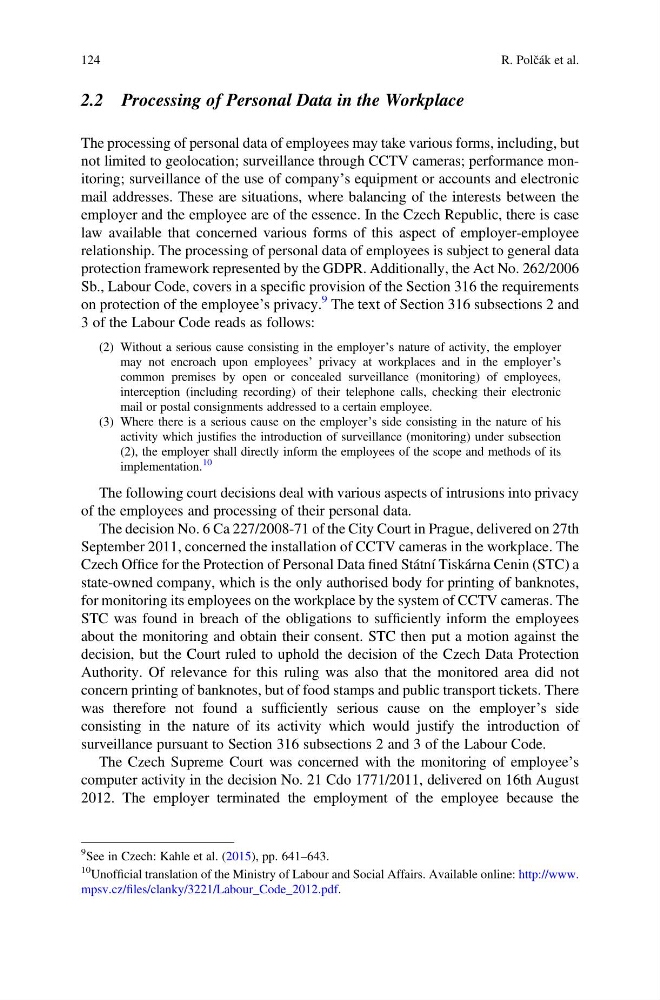
2.2 Processing of Personal Data in the Workplace
The processing of personal data of employees may take various forms, including, but
not limited to geolocation; surveillance through CCTV cameras; performance monitoring; surveillance of the use of company’s equipment or accounts and electronic
mail addresses. These are situations, where balancing of the interests between the
employer and the employee are of the essence. In the Czech Republic, there is case
law available that concerned various forms of this aspect of employer-employee
relationship. The processing of personal data of employees is subject to general data
protection framework represented by the GDPR. Additionally, the Act No. 262/2006
Sb., Labour Code, covers in a specific provision of the Section 316 the requirements
on protection of the employee’s privacy.
9 The text of Section 316 subsections 2 and
3 of the Labour Code reads as follows:
(2) Without a serious cause consisting in the employer’s nature of activity, the employer
may not encroach upon employees’ privacy at workplaces and in the employer’s
common premises by open or concealed surveillance (monitoring) of employees,
interception (including recording) of their telephone calls, checking their electronic
mail or postal consignments addressed to a certain employee.
(3) Where there is a serious cause on the employer’s side consisting in the nature of his
activity which justifies the introduction of surveillance (monitoring) under subsection
(2), the employer shall directly inform the employees of the scope and methods of its
implementation.
10
The following court decisions deal with various aspects of intrusions into privacy
of the employees and processing of their personal data.
The decision No. 6 Ca 227/2008-71 of the City Court in Prague, delivered on 27th
September 2011, concerned the installation of CCTV cameras in the workplace. The
Czech Office for the Protection of Personal Data fined Státní Tiskárna Cenin (STC) a
state-owned company, which is the only authorised body for printing of banknotes,
for monitoring its employees on the workplace by the system of CCTV cameras. The
STC was found in breach of the obligations to sufficiently inform the employees
about the monitoring and obtain their consent. STC then put a motion against the
decision, but the Court ruled to uphold the decision of the Czech Data Protection
Authority. Of relevance for this ruling was also that the monitored area did not
concern printing of banknotes, but of food stamps and public transport tickets. There
was therefore not found a sufficiently serious cause on the employer’s side
consisting in the nature of its activity which would justify the introduction of
surveillance pursuant to Section 316 subsections 2 and 3 of the Labour Code.
The Czech Supreme Court was concerned with the monitoring of employee’s
computer activity in the decision No. 21 Cdo 1771/2011, delivered on 16th August
2012. The employer terminated the employment of the employee because the
9 See in Czech: Kahle et al. (2015), pp. 641–643.
10 Unofficial translation of the Ministry of Labour and Social Affairs. Available online: http://www.
mpsv.cz/files/clanky/3221/Labour_Code_2012.pdf.
124
R. Polčák et al.
The processing of personal data of employees may take various forms, including, but
not limited to geolocation; surveillance through CCTV cameras; performance monitoring; surveillance of the use of company’s equipment or accounts and electronic
mail addresses. These are situations, where balancing of the interests between the
employer and the employee are of the essence. In the Czech Republic, there is case
law available that concerned various forms of this aspect of employer-employee
relationship. The processing of personal data of employees is subject to general data
protection framework represented by the GDPR. Additionally, the Act No. 262/2006
Sb., Labour Code, covers in a specific provision of the Section 316 the requirements
on protection of the employee’s privacy.
9 The text of Section 316 subsections 2 and
3 of the Labour Code reads as follows:
(2) Without a serious cause consisting in the employer’s nature of activity, the employer
may not encroach upon employees’ privacy at workplaces and in the employer’s
common premises by open or concealed surveillance (monitoring) of employees,
interception (including recording) of their telephone calls, checking their electronic
mail or postal consignments addressed to a certain employee.
(3) Where there is a serious cause on the employer’s side consisting in the nature of his
activity which justifies the introduction of surveillance (monitoring) under subsection
(2), the employer shall directly inform the employees of the scope and methods of its
implementation.
10
The following court decisions deal with various aspects of intrusions into privacy
of the employees and processing of their personal data.
The decision No. 6 Ca 227/2008-71 of the City Court in Prague, delivered on 27th
September 2011, concerned the installation of CCTV cameras in the workplace. The
Czech Office for the Protection of Personal Data fined Státní Tiskárna Cenin (STC) a
state-owned company, which is the only authorised body for printing of banknotes,
for monitoring its employees on the workplace by the system of CCTV cameras. The
STC was found in breach of the obligations to sufficiently inform the employees
about the monitoring and obtain their consent. STC then put a motion against the
decision, but the Court ruled to uphold the decision of the Czech Data Protection
Authority. Of relevance for this ruling was also that the monitored area did not
concern printing of banknotes, but of food stamps and public transport tickets. There
was therefore not found a sufficiently serious cause on the employer’s side
consisting in the nature of its activity which would justify the introduction of
surveillance pursuant to Section 316 subsections 2 and 3 of the Labour Code.
The Czech Supreme Court was concerned with the monitoring of employee’s
computer activity in the decision No. 21 Cdo 1771/2011, delivered on 16th August
2012. The employer terminated the employment of the employee because the
9 See in Czech: Kahle et al. (2015), pp. 641–643.
10 Unofficial translation of the Ministry of Labour and Social Affairs. Available online: http://www.
mpsv.cz/files/clanky/3221/Labour_Code_2012.pdf.
124
R. Polčák et al.