

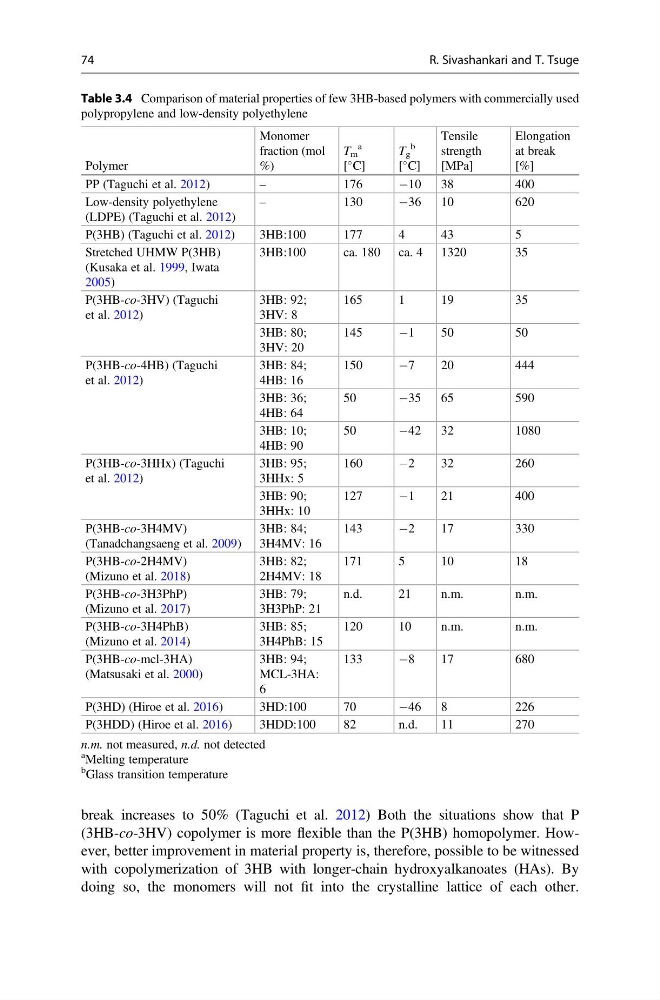
break increases to 50% (Taguchi et al. 2012) Both the situations show that P
(3HB-co-3HV) copolymer is more flexible than the P(3HB) homopolymer. However, better improvement in material property is, therefore, possible to be witnessed
with copolymerization of 3HB with longer-chain hydroxyalkanoates (HAs). By
doing so, the monomers will not fit into the crystalline lattice of each other.
Table 3.4 Comparison of material properties of few 3HB-based polymers with commercially used
polypropylene and low-density polyethylene
Polymer
Monomer
fraction (mol
%)
T m
a
[
C]
T g
b
[
C]
Tensile
strength
[MPa]
Elongation
at break
[%]
PP (Taguchi et al. 2012)
–
176
À10
38
400
Low-density polyethylene
(LDPE) (Taguchi et al. 2012)
–
130
À36
10
620
P(3HB) (Taguchi et al. 2012)
3HB:100
177
4
43
5
Stretched UHMW P(3HB)
(Kusaka et al. 1999, Iwata
2005)
3HB:100
ca. 180 ca. 4 1320
35
P(3HB-co-3HV) (Taguchi
et al. 2012)
3HB: 92;
3HV: 8
165
1
19
35
3HB: 80;
3HV: 20
145
À1
50
50
P(3HB-co-4HB) (Taguchi
et al. 2012)
3HB: 84;
4HB: 16
150
À7
20
444
3HB: 36;
4HB: 64
50
À35
65
590
3HB: 10;
4HB: 90
50
À42
32
1080
P(3HB-co-3HHx) (Taguchi
et al. 2012)
3HB: 95;
3HHx: 5
160
À2
32
260
3HB: 90;
3HHx: 10
127
À1
21
400
P(3HB-co-3H4MV)
(Tanadchangsaeng et al. 2009)
3HB: 84;
3H4MV: 16
143
À2
17
330
P(3HB-co-2H4MV)
(Mizuno et al. 2018)
3HB: 82;
2H4MV: 18
171
5
10
18
P(3HB-co-3H3PhP)
(Mizuno et al. 2017)
3HB: 79;
3H3PhP: 21
n.d.
21
n.m.
n.m.
P(3HB-co-3H4PhB)
(Mizuno et al. 2014)
3HB: 85;
3H4PhB: 15
120
10
n.m.
n.m.
P(3HB-co-mcl-3HA)
(Matsusaki et al. 2000)
3HB: 94;
MCL-3HA:
6
133
À8
17
680
P(3HD) (Hiroe et al. 2016)
3HD:100
70
À46
8
226
P(3HDD) (Hiroe et al. 2016)
3HDD:100
82
n.d.
11
270
n.m. not measured, n.d. not detected
a Melting temperature
b
Glass transition temperature
74
R. Sivashankari and T. Tsuge
(3HB-co-3HV) copolymer is more flexible than the P(3HB) homopolymer. However, better improvement in material property is, therefore, possible to be witnessed
with copolymerization of 3HB with longer-chain hydroxyalkanoates (HAs). By
doing so, the monomers will not fit into the crystalline lattice of each other.
Table 3.4 Comparison of material properties of few 3HB-based polymers with commercially used
polypropylene and low-density polyethylene
Polymer
Monomer
fraction (mol
%)
T m
a
[
C]
T g
b
[
C]
Tensile
strength
[MPa]
Elongation
at break
[%]
PP (Taguchi et al. 2012)
–
176
À10
38
400
Low-density polyethylene
(LDPE) (Taguchi et al. 2012)
–
130
À36
10
620
P(3HB) (Taguchi et al. 2012)
3HB:100
177
4
43
5
Stretched UHMW P(3HB)
(Kusaka et al. 1999, Iwata
2005)
3HB:100
ca. 180 ca. 4 1320
35
P(3HB-co-3HV) (Taguchi
et al. 2012)
3HB: 92;
3HV: 8
165
1
19
35
3HB: 80;
3HV: 20
145
À1
50
50
P(3HB-co-4HB) (Taguchi
et al. 2012)
3HB: 84;
4HB: 16
150
À7
20
444
3HB: 36;
4HB: 64
50
À35
65
590
3HB: 10;
4HB: 90
50
À42
32
1080
P(3HB-co-3HHx) (Taguchi
et al. 2012)
3HB: 95;
3HHx: 5
160
À2
32
260
3HB: 90;
3HHx: 10
127
À1
21
400
P(3HB-co-3H4MV)
(Tanadchangsaeng et al. 2009)
3HB: 84;
3H4MV: 16
143
À2
17
330
P(3HB-co-2H4MV)
(Mizuno et al. 2018)
3HB: 82;
2H4MV: 18
171
5
10
18
P(3HB-co-3H3PhP)
(Mizuno et al. 2017)
3HB: 79;
3H3PhP: 21
n.d.
21
n.m.
n.m.
P(3HB-co-3H4PhB)
(Mizuno et al. 2014)
3HB: 85;
3H4PhB: 15
120
10
n.m.
n.m.
P(3HB-co-mcl-3HA)
(Matsusaki et al. 2000)
3HB: 94;
MCL-3HA:
6
133
À8
17
680
P(3HD) (Hiroe et al. 2016)
3HD:100
70
À46
8
226
P(3HDD) (Hiroe et al. 2016)
3HDD:100
82
n.d.
11
270
n.m. not measured, n.d. not detected
a Melting temperature
b
Glass transition temperature
74
R. Sivashankari and T. Tsuge