

accumulate PHA over 90 wt% of dry cell. The literature on this versatile microbe’s
ability in PHA production from the past 50 years has revealed its vast biotechnological potential. The availability of the complete genome sequence of R. eutropha
(Pohlmann et al. 2006) has given a useful insight to fine-tune the microorganism for
enhanced PHA production meeting industrial requirements.
In this section, three key components for the biosynthesis of PHA which are PHA
synthase, potential carbon sources, and metabolic pathways will be discussed, and
recent approaches in PHA biosynthesis are summarized.
3.2.1 PHA Synthase
PHA synthase holds a unique ability to polymerize high molecular weight of waterinsoluble PHA monomers in a water-based environment such as in cell cytoplasm
without needing a template unlike other macromolecules (Tsuge 2016) at ambient
temperature. It polymerizes monomeric substrates acyl-CoA with the release
of CoA.
The best understanding of PHA biosynthesis has clarified that substrate specificity of PHA synthase is one of the salient factors in deciding the type of PHA polymer
synthesized in a microorganism (Sudesh et al. 2000). Therefore, many efforts to
understand PHA synthase in details are being carried out, and this has gotten easier
with the availability of partial crystal structure of the catalytic subunit PhaC of PHA
synthase from R. eutropha (Kim et al. 2017) and Chromobacterium sp. USM (Chek
et al. 2017). The information from crystal structure aids in the process of elucidating
the mechanism of PHA polymerization at molecular levels which remained as a
bigger challenge in previous days. Also, many PhaC structural genes from a diverse
group of gram-positive, gram-negative bacteria and cyanobacteria have been cloned
(Sudesh et al. 2000). PHA can be classified into 4 distinct classes based on its
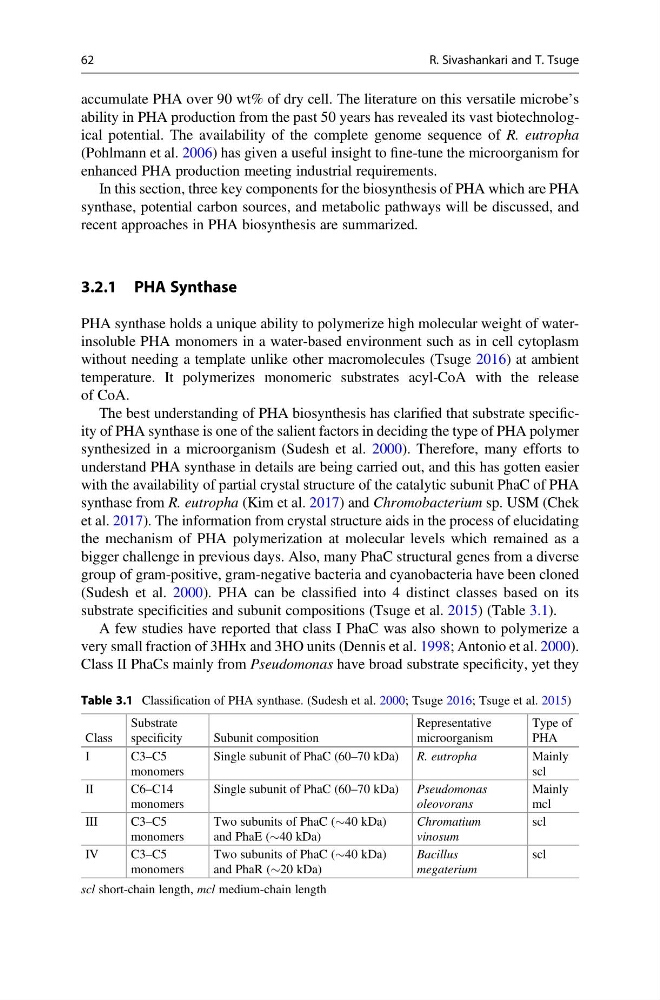
substrate specificities and subunit compositions (Tsuge et al. 2015) (Table 3.1).
A few studies have reported that class I PhaC was also shown to polymerize a
very small fraction of 3HHx and 3HO units (Dennis et al. 1998; Antonio et al. 2000).
Class II PhaCs mainly from Pseudomonas have broad substrate specificity, yet they
Table 3.1 Classification of PHA synthase. (Sudesh et al. 2000; Tsuge 2016; Tsuge et al. 2015)
Class
Substrate
specificity
Subunit composition
Representative
microorganism
Type of
PHA
I
C 3 –C5
monomers
Single subunit of PhaC (60–70 kDa) R. eutropha
Mainly
scl
II
C6–C14
monomers
Single subunit of PhaC (60–70 kDa) Pseudomonas
oleovorans
Mainly
mcl
III
C3–C5
monomers
Two subunits of PhaC ($40 kDa)
and PhaE ($40 kDa)
Chromatium
vinosum
scl
IV
C3–C5
monomers
Two subunits of PhaC ($40 kDa)
and PhaR ($20 kDa)
Bacillus
megaterium
scl
scl short-chain length, mcl medium-chain length
62
R. Sivashankari and T. Tsuge
ability in PHA production from the past 50 years has revealed its vast biotechnological potential. The availability of the complete genome sequence of R. eutropha
(Pohlmann et al. 2006) has given a useful insight to fine-tune the microorganism for
enhanced PHA production meeting industrial requirements.
In this section, three key components for the biosynthesis of PHA which are PHA
synthase, potential carbon sources, and metabolic pathways will be discussed, and
recent approaches in PHA biosynthesis are summarized.
3.2.1 PHA Synthase
PHA synthase holds a unique ability to polymerize high molecular weight of waterinsoluble PHA monomers in a water-based environment such as in cell cytoplasm
without needing a template unlike other macromolecules (Tsuge 2016) at ambient
temperature. It polymerizes monomeric substrates acyl-CoA with the release
of CoA.
The best understanding of PHA biosynthesis has clarified that substrate specificity of PHA synthase is one of the salient factors in deciding the type of PHA polymer
synthesized in a microorganism (Sudesh et al. 2000). Therefore, many efforts to
understand PHA synthase in details are being carried out, and this has gotten easier
with the availability of partial crystal structure of the catalytic subunit PhaC of PHA
synthase from R. eutropha (Kim et al. 2017) and Chromobacterium sp. USM (Chek
et al. 2017). The information from crystal structure aids in the process of elucidating
the mechanism of PHA polymerization at molecular levels which remained as a
bigger challenge in previous days. Also, many PhaC structural genes from a diverse
group of gram-positive, gram-negative bacteria and cyanobacteria have been cloned
(Sudesh et al. 2000). PHA can be classified into 4 distinct classes based on its
substrate specificities and subunit compositions (Tsuge et al. 2015) (Table 3.1).
A few studies have reported that class I PhaC was also shown to polymerize a
very small fraction of 3HHx and 3HO units (Dennis et al. 1998; Antonio et al. 2000).
Class II PhaCs mainly from Pseudomonas have broad substrate specificity, yet they
Table 3.1 Classification of PHA synthase. (Sudesh et al. 2000; Tsuge 2016; Tsuge et al. 2015)
Class
Substrate
specificity
Subunit composition
Representative
microorganism
Type of
PHA
I
C 3 –C5
monomers
Single subunit of PhaC (60–70 kDa) R. eutropha
Mainly
scl
II
C6–C14
monomers
Single subunit of PhaC (60–70 kDa) Pseudomonas
oleovorans
Mainly
mcl
III
C3–C5
monomers
Two subunits of PhaC ($40 kDa)
and PhaE ($40 kDa)
Chromatium
vinosum
scl
IV
C3–C5
monomers
Two subunits of PhaC ($40 kDa)
and PhaR ($20 kDa)
Bacillus
megaterium
scl
scl short-chain length, mcl medium-chain length
62
R. Sivashankari and T. Tsuge