

Keywords
Plastic pollution · Polyhydroxyalkanoate · Petroleum-based plastics ·
Biosynthesis · Copolymer
3.1
Introduction: Polyhydroxyalkanoate (PHA) as a Possible
Substitute for Petroleum-Based Plastics (PBP)
Polyhydroxyalkanoate (PHA) is a family of biopolymer and falls into polyester class
(Anderson and Dawes 1990). PHAs are typically made from biomass, unlike
conventional plastics which are made from petroleum. Biomass is a renewable
energy; thus, it will be present as long as this planet exists. Soybean oil (Kahar
et al. 2004), rice husk (Heng et al. 2017), vegetable oil (Xia and Larock 2010), and
molasses (Albuquerque et al. 2010) are few types of biomasses that have been tested
for the biosynthesis of PHA. On the other hand, petroleum is a nonrenewable source
of energy, so it will be completely depleted with continuous exploitation for various
applications. Moreover, petroleum also contributes to climate change (Ruddiman
2010) by emitting excessive carbon to the atmosphere throughout the refinement
processes. Meanwhile, processes involving in the making of biopolymers such as
PHA will be indisputably nature friendly.
Despite the drawbacks, mankind is heavily dependent on petroleum-based
plastics (PBP) as it is highly convenient mainly for its lightweight properties and
overall versatility. It is almost impossible to imagine a life without PBP because it
has been used in various items we use in daily life such as in food packaging,
clothing, electronic devices, medical equipment, and many others. Therefore, it is
very crucial to find an alternative material which is similitude to PBP in terms of
physicochemical properties but capable to be produced in environmentally friendly
ways and importantly can be disposed without leaving any damages to nature.
From previous studies, PHA has been demonstrated to fit this criterion, hence
garnered an enormous research interest. PHA is a naturally occurring polymer in
bacteria (Anderson and Dawes 1990); thus, it can be biosynthesized by feeding
microbes with carbon sources from biomass. In this section, the biosynthesis of
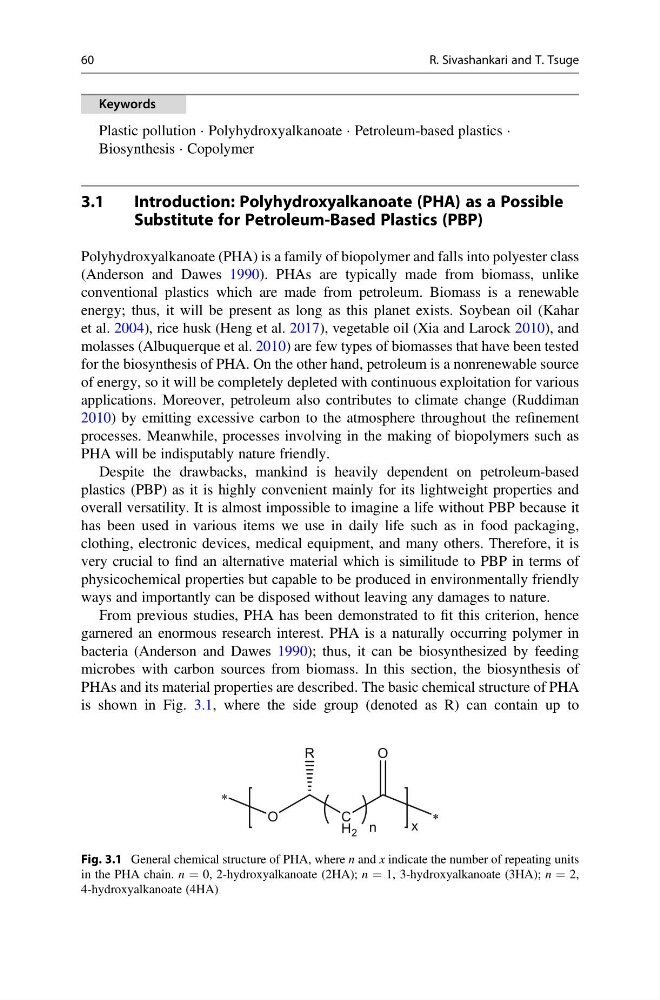
PHAs and its material properties are described. The basic chemical structure of PHA
is shown in Fig. 3.1, where the side group (denoted as R) can contain up to
Fig. 3.1 General chemical structure of PHA, where n and x indicate the number of repeating units
in the PHA chain. n ¼ 0, 2-hydroxyalkanoate (2HA); n ¼ 1, 3-hydroxyalkanoate (3HA); n ¼ 2,
4-hydroxyalkanoate (4HA)
60
R. Sivashankari and T. Tsuge
Plastic pollution · Polyhydroxyalkanoate · Petroleum-based plastics ·
Biosynthesis · Copolymer
3.1
Introduction: Polyhydroxyalkanoate (PHA) as a Possible
Substitute for Petroleum-Based Plastics (PBP)
Polyhydroxyalkanoate (PHA) is a family of biopolymer and falls into polyester class
(Anderson and Dawes 1990). PHAs are typically made from biomass, unlike
conventional plastics which are made from petroleum. Biomass is a renewable
energy; thus, it will be present as long as this planet exists. Soybean oil (Kahar
et al. 2004), rice husk (Heng et al. 2017), vegetable oil (Xia and Larock 2010), and
molasses (Albuquerque et al. 2010) are few types of biomasses that have been tested
for the biosynthesis of PHA. On the other hand, petroleum is a nonrenewable source
of energy, so it will be completely depleted with continuous exploitation for various
applications. Moreover, petroleum also contributes to climate change (Ruddiman
2010) by emitting excessive carbon to the atmosphere throughout the refinement
processes. Meanwhile, processes involving in the making of biopolymers such as
PHA will be indisputably nature friendly.
Despite the drawbacks, mankind is heavily dependent on petroleum-based
plastics (PBP) as it is highly convenient mainly for its lightweight properties and
overall versatility. It is almost impossible to imagine a life without PBP because it
has been used in various items we use in daily life such as in food packaging,
clothing, electronic devices, medical equipment, and many others. Therefore, it is
very crucial to find an alternative material which is similitude to PBP in terms of
physicochemical properties but capable to be produced in environmentally friendly
ways and importantly can be disposed without leaving any damages to nature.
From previous studies, PHA has been demonstrated to fit this criterion, hence
garnered an enormous research interest. PHA is a naturally occurring polymer in
bacteria (Anderson and Dawes 1990); thus, it can be biosynthesized by feeding
microbes with carbon sources from biomass. In this section, the biosynthesis of
PHAs and its material properties are described. The basic chemical structure of PHA
is shown in Fig. 3.1, where the side group (denoted as R) can contain up to
Fig. 3.1 General chemical structure of PHA, where n and x indicate the number of repeating units
in the PHA chain. n ¼ 0, 2-hydroxyalkanoate (2HA); n ¼ 1, 3-hydroxyalkanoate (3HA); n ¼ 2,
4-hydroxyalkanoate (4HA)
60
R. Sivashankari and T. Tsuge