

and As by C. zizanioides; however, their phyto-uptake was decreased significantly
with increase in red mud addition (5, 10 and 15% (w/w)) to sludge-amended soil.
Similarly, increased phytoavailability of heavy metal(loid)s (Al, Fe, Zn, Co, Cu, Ni,
Mn, Mg, Cd, Cr, Pb and As) to lemongrass due to biowaste amendments (cow dung
manure and sewage sludge) in soil was remarkably reduced by red mud treatments
which was mainly accredited to increased soil pH and oxides of iron and aluminium
(Gautam et al. 2017).
Highest accumulation of Pb in roots and shoot was attained by Eucalyptus
camaldulensis cultivated in Pb-contaminated soil inoculated with Alcaligenes
eutrophus when compared to other soil amendments (EDTA, compost, Hoagland
solution and their mixture). Crude oil-polluted soil of Akala-Olu, Nigeria,
characterized by the presence of ten non-carcinogenic and six carcinogenic PAHs
was efficiently remediated by Fimbristylis littoralis (87%), Hevea brasiliensis
(92%), C. citratus (85%) and Vigna subterranea (89%) grown in soil amended
with organic as compared to inorganic amendments (Nwaichi et al. 2015). Plants
used for phytoremediation of PCBs in contaminated soil include Lespedeza cuneate,
Phalaris arundinacea, M. sativa, Lathyrus sylvestris, Salix alaxensis, Sparganium
sp. and Picea glauca (Jing et al. 2018). Tu et al. (2011) validated a significant
reduction in PCB content of soil by 31.4 and 78.4% after the first and second years of
study using M. sativa.
Microbe-Assisted Phytoremediation The effectiveness of bioremediation could
be enhanced using integrated approach of plants and microbes (Qi et al. 2019;
Hussain et al. 2018). Microbial community in the rhizospheric region is stimulated
by the release of plant rhizodeposits, thus establishing a gradient of interactions
between both (Tabassum et al., 2017). The plant-microbe associations influence the
pH and composition of root exudates, thereby affecting the bioavailability and
phyto-uptake of pollutants in the soil (Sarwar et al. 2017). Non-symbiotic and
symbiotic relationships between plants and microbes are making them a single
candidate for bioremediation of contaminated soil. Microbes specifically plant
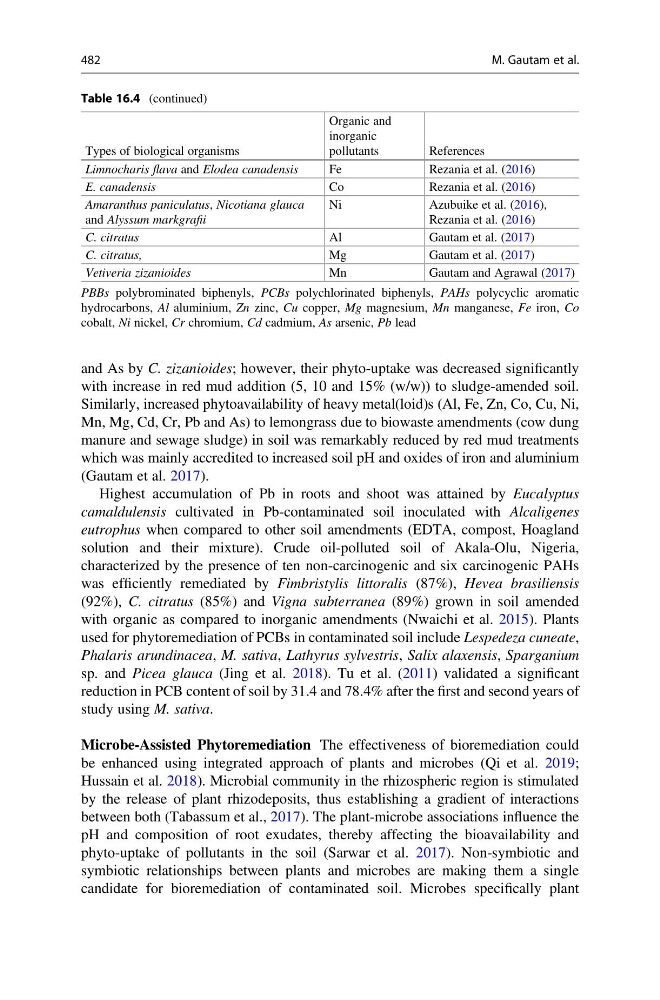
Table 16.4 (continued)
Types of biological organisms
Organic and
inorganic
pollutants
References
Limnocharis flava and Elodea canadensis
Fe
Rezania et al. (2016)
E. canadensis
Co
Rezania et al. (2016)
Amaranthus paniculatus, Nicotiana glauca
and Alyssum markgrafii
Ni
Azubuike et al. (2016),
Rezania et al. (2016)
C. citratus
Al
Gautam et al. (2017)
C. citratus,
Mg
Gautam et al. (2017)
Vetiveria zizanioides
Mn
Gautam and Agrawal (2017)
PBBs polybrominated biphenyls, PCBs polychlorinated biphenyls, PAHs polycyclic aromatic
hydrocarbons, Al aluminium, Zn zinc, Cu copper, Mg magnesium, Mn manganese, Fe iron, Co
cobalt, Ni nickel, Cr chromium, Cd cadmium, As arsenic, Pb lead
482
M. Gautam et al.
with increase in red mud addition (5, 10 and 15% (w/w)) to sludge-amended soil.
Similarly, increased phytoavailability of heavy metal(loid)s (Al, Fe, Zn, Co, Cu, Ni,
Mn, Mg, Cd, Cr, Pb and As) to lemongrass due to biowaste amendments (cow dung
manure and sewage sludge) in soil was remarkably reduced by red mud treatments
which was mainly accredited to increased soil pH and oxides of iron and aluminium
(Gautam et al. 2017).
Highest accumulation of Pb in roots and shoot was attained by Eucalyptus
camaldulensis cultivated in Pb-contaminated soil inoculated with Alcaligenes
eutrophus when compared to other soil amendments (EDTA, compost, Hoagland
solution and their mixture). Crude oil-polluted soil of Akala-Olu, Nigeria,
characterized by the presence of ten non-carcinogenic and six carcinogenic PAHs
was efficiently remediated by Fimbristylis littoralis (87%), Hevea brasiliensis
(92%), C. citratus (85%) and Vigna subterranea (89%) grown in soil amended
with organic as compared to inorganic amendments (Nwaichi et al. 2015). Plants
used for phytoremediation of PCBs in contaminated soil include Lespedeza cuneate,
Phalaris arundinacea, M. sativa, Lathyrus sylvestris, Salix alaxensis, Sparganium
sp. and Picea glauca (Jing et al. 2018). Tu et al. (2011) validated a significant
reduction in PCB content of soil by 31.4 and 78.4% after the first and second years of
study using M. sativa.
Microbe-Assisted Phytoremediation The effectiveness of bioremediation could
be enhanced using integrated approach of plants and microbes (Qi et al. 2019;
Hussain et al. 2018). Microbial community in the rhizospheric region is stimulated
by the release of plant rhizodeposits, thus establishing a gradient of interactions
between both (Tabassum et al., 2017). The plant-microbe associations influence the
pH and composition of root exudates, thereby affecting the bioavailability and
phyto-uptake of pollutants in the soil (Sarwar et al. 2017). Non-symbiotic and
symbiotic relationships between plants and microbes are making them a single
candidate for bioremediation of contaminated soil. Microbes specifically plant
Table 16.4 (continued)
Types of biological organisms
Organic and
inorganic
pollutants
References
Limnocharis flava and Elodea canadensis
Fe
Rezania et al. (2016)
E. canadensis
Co
Rezania et al. (2016)
Amaranthus paniculatus, Nicotiana glauca
and Alyssum markgrafii
Ni
Azubuike et al. (2016),
Rezania et al. (2016)
C. citratus
Al
Gautam et al. (2017)
C. citratus,
Mg
Gautam et al. (2017)
Vetiveria zizanioides
Mn
Gautam and Agrawal (2017)
PBBs polybrominated biphenyls, PCBs polychlorinated biphenyls, PAHs polycyclic aromatic
hydrocarbons, Al aluminium, Zn zinc, Cu copper, Mg magnesium, Mn manganese, Fe iron, Co
cobalt, Ni nickel, Cr chromium, Cd cadmium, As arsenic, Pb lead
482
M. Gautam et al.