

suitable for phytostabilization. Conocarpus erectus grown in soil spiked with Ni
(0, 50, 100 and 200 mg kg
À1 ), Pb (0, 600, 1200 and 2400 mg kg
À1 ), Cd (0, 20,
40 and 80 mg kg
À1
) and Cr (0, 150, 300 and 600 mg kg
À1
) has enormous potential
for the phytostabilization of Cr, Ni and Cd in its roots (Tauqeer et al. 2019). Ferro
et al. (1997) observed that alfalfa (Medicago sativa) did not cause the degradation of
volatile organic constituents in soil treated with 40 and 660 μg kg
À1 of
14 C-benzene,
rather it enhanced its phytostabilization in soil.
Phytoextraction Plants absorb organic and inorganic chemical species from soil
and translocate them to the aboveground harvestable parts to accumulate. In general,
roots contain higher levels of contaminants than shoot despite the translocation is
high which is primarily attributed to maximum accumulation capacity of the aboveground biomass (Suman et al. 2018; Wuana and Felix 2011). Malik and Ravindran
(2018) reported that Suaeda maritima was found efficient in phytoextraction of
metals (Zn, Cu, Cd, Cr, Mg, calcium (Ca) and potassium (K)) and chloride salts
from soil contaminated with paper mill effluents. Cymbopogon citratus showed
potentiality in extraction of Al, Zn, Ni, Pb, Cd, Pb, Cr and As, while Chrysopogon
zizanioides was found efficient in extraction of Mn and Cu from soil mixed with
sewage sludge at different red mud combinations (Gautam et al. 2017; Gautam and
Agrawal 2017). White et al. (2003) in their study revealed that amongst 21 cultivars
of Cucurbita pepo grown at Lockwood Farm of Hamden, CT, USA (contaminated
with p, p
0 -DDE levels ranged from 200 to 1200 ng g
À1 ), cultivar ssp pepo had
potentiality to phytoextract POPs from soil and translocate large quantities to aerial
tissues. Moreover, plant species such as C. pepo, Carex normalis and Festuca
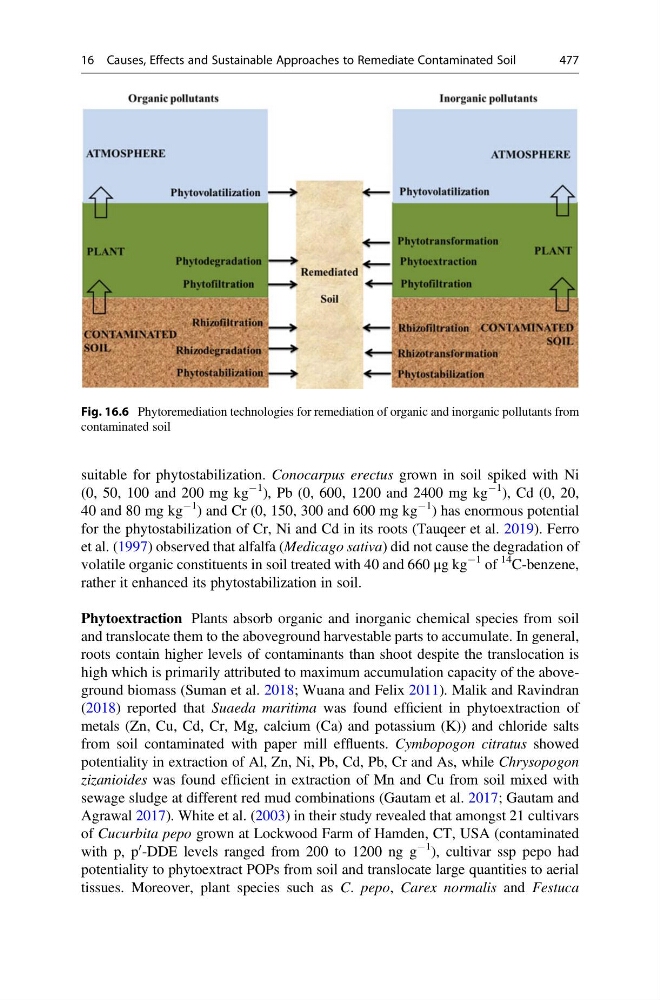
Fig. 16.6 Phytoremediation technologies for remediation of organic and inorganic pollutants from
contaminated soil
16 Causes, Effects and Sustainable Approaches to Remediate Contaminated Soil
477
(0, 50, 100 and 200 mg kg
À1 ), Pb (0, 600, 1200 and 2400 mg kg
À1 ), Cd (0, 20,
40 and 80 mg kg
À1
) and Cr (0, 150, 300 and 600 mg kg
À1
) has enormous potential
for the phytostabilization of Cr, Ni and Cd in its roots (Tauqeer et al. 2019). Ferro
et al. (1997) observed that alfalfa (Medicago sativa) did not cause the degradation of
volatile organic constituents in soil treated with 40 and 660 μg kg
À1 of
14 C-benzene,
rather it enhanced its phytostabilization in soil.
Phytoextraction Plants absorb organic and inorganic chemical species from soil
and translocate them to the aboveground harvestable parts to accumulate. In general,
roots contain higher levels of contaminants than shoot despite the translocation is
high which is primarily attributed to maximum accumulation capacity of the aboveground biomass (Suman et al. 2018; Wuana and Felix 2011). Malik and Ravindran
(2018) reported that Suaeda maritima was found efficient in phytoextraction of
metals (Zn, Cu, Cd, Cr, Mg, calcium (Ca) and potassium (K)) and chloride salts
from soil contaminated with paper mill effluents. Cymbopogon citratus showed
potentiality in extraction of Al, Zn, Ni, Pb, Cd, Pb, Cr and As, while Chrysopogon
zizanioides was found efficient in extraction of Mn and Cu from soil mixed with
sewage sludge at different red mud combinations (Gautam et al. 2017; Gautam and
Agrawal 2017). White et al. (2003) in their study revealed that amongst 21 cultivars
of Cucurbita pepo grown at Lockwood Farm of Hamden, CT, USA (contaminated
with p, p
0 -DDE levels ranged from 200 to 1200 ng g
À1 ), cultivar ssp pepo had
potentiality to phytoextract POPs from soil and translocate large quantities to aerial
tissues. Moreover, plant species such as C. pepo, Carex normalis and Festuca
Fig. 16.6 Phytoremediation technologies for remediation of organic and inorganic pollutants from
contaminated soil
16 Causes, Effects and Sustainable Approaches to Remediate Contaminated Soil
477