

technologies are available on the basic principles of solid waste management
(Agarwal et al. 2015):
1. 4Rs (refuse, reduce, reuse and recycle):
• Refusal of buying anything which actually does not require
• Reduction in the generation of garbage
• Reutilizing the things to its maximum
• Recycling the waste materials into useful forms wherever possible
2. Segregation of organic/biodegradable and inorganic/non-biodegradable wastes in
separate container
3. Inculcation of different treatment techniques for different types of wastes to its
nearest possible points
16.6.1 Conventional and Advanced Management Techniques
Composting It is simple and economically viable technique to manage agricultural
and domestic (biodegradable) wastes using microorganisms and earthworm
(Banerjee et al. 2019). Composts are very much rich in nutrients and are widely
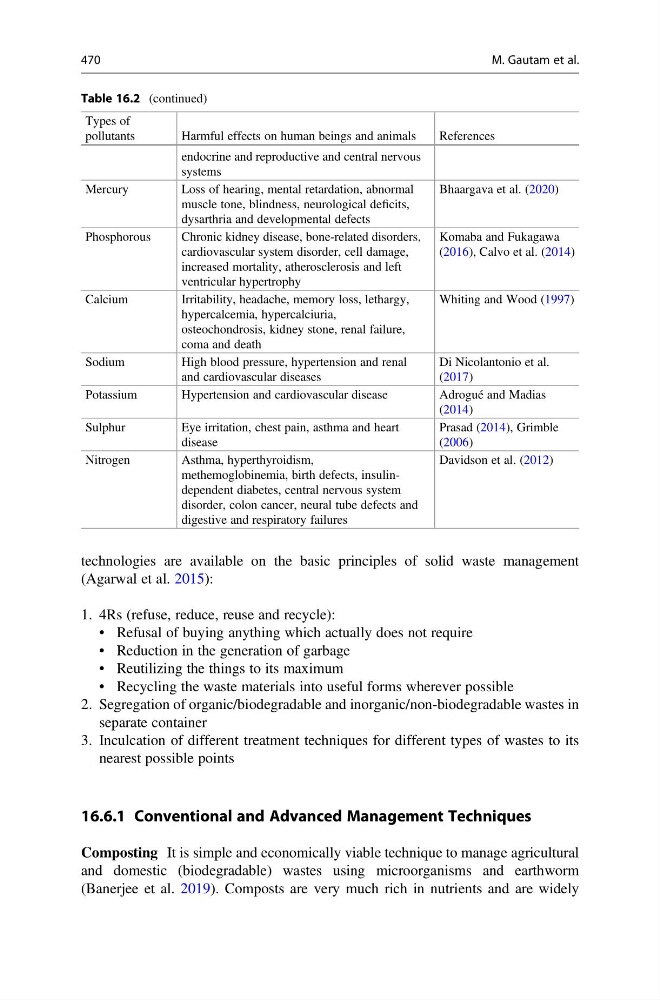
Table 16.2 (continued)
Types of
pollutants
Harmful effects on human beings and animals
References
endocrine and reproductive and central nervous
systems
Mercury
Loss of hearing, mental retardation, abnormal
muscle tone, blindness, neurological deficits,
dysarthria and developmental defects
Bhaargava et al. (2020)
Phosphorous
Chronic kidney disease, bone-related disorders,
cardiovascular system disorder, cell damage,
increased mortality, atherosclerosis and left
ventricular hypertrophy
Komaba and Fukagawa
(2016), Calvo et al. (2014)
Calcium
Irritability, headache, memory loss, lethargy,
hypercalcemia, hypercalciuria,
osteochondrosis, kidney stone, renal failure,
coma and death
Whiting and Wood (1997)
Sodium
High blood pressure, hypertension and renal
and cardiovascular diseases
Di Nicolantonio et al.
(2017)
Potassium
Hypertension and cardiovascular disease
Adrogué and Madias
(2014)
Sulphur
Eye irritation, chest pain, asthma and heart
disease
Prasad (2014), Grimble
(2006)
Nitrogen
Asthma, hyperthyroidism,
methemoglobinemia, birth defects, insulindependent diabetes, central nervous system
disorder, colon cancer, neural tube defects and
digestive and respiratory failures
Davidson et al. (2012)
470
M. Gautam et al.
(Agarwal et al. 2015):
1. 4Rs (refuse, reduce, reuse and recycle):
• Refusal of buying anything which actually does not require
• Reduction in the generation of garbage
• Reutilizing the things to its maximum
• Recycling the waste materials into useful forms wherever possible
2. Segregation of organic/biodegradable and inorganic/non-biodegradable wastes in
separate container
3. Inculcation of different treatment techniques for different types of wastes to its
nearest possible points
16.6.1 Conventional and Advanced Management Techniques
Composting It is simple and economically viable technique to manage agricultural
and domestic (biodegradable) wastes using microorganisms and earthworm
(Banerjee et al. 2019). Composts are very much rich in nutrients and are widely
Table 16.2 (continued)
Types of
pollutants
Harmful effects on human beings and animals
References
endocrine and reproductive and central nervous
systems
Mercury
Loss of hearing, mental retardation, abnormal
muscle tone, blindness, neurological deficits,
dysarthria and developmental defects
Bhaargava et al. (2020)
Phosphorous
Chronic kidney disease, bone-related disorders,
cardiovascular system disorder, cell damage,
increased mortality, atherosclerosis and left
ventricular hypertrophy
Komaba and Fukagawa
(2016), Calvo et al. (2014)
Calcium
Irritability, headache, memory loss, lethargy,
hypercalcemia, hypercalciuria,
osteochondrosis, kidney stone, renal failure,
coma and death
Whiting and Wood (1997)
Sodium
High blood pressure, hypertension and renal
and cardiovascular diseases
Di Nicolantonio et al.
(2017)
Potassium
Hypertension and cardiovascular disease
Adrogué and Madias
(2014)
Sulphur
Eye irritation, chest pain, asthma and heart
disease
Prasad (2014), Grimble
(2006)
Nitrogen
Asthma, hyperthyroidism,
methemoglobinemia, birth defects, insulindependent diabetes, central nervous system
disorder, colon cancer, neural tube defects and
digestive and respiratory failures
Davidson et al. (2012)
470
M. Gautam et al.