

16.5.2 Harmful Effects of Pollutants on Plants
Pollutants, specifically degradable, undergo physico-chemical and biological
alterations before and after being deposited onto terrestrial ecosystems (Karthikeyan
et al. 2004). Both organic and inorganic pollutants are available to plants either from
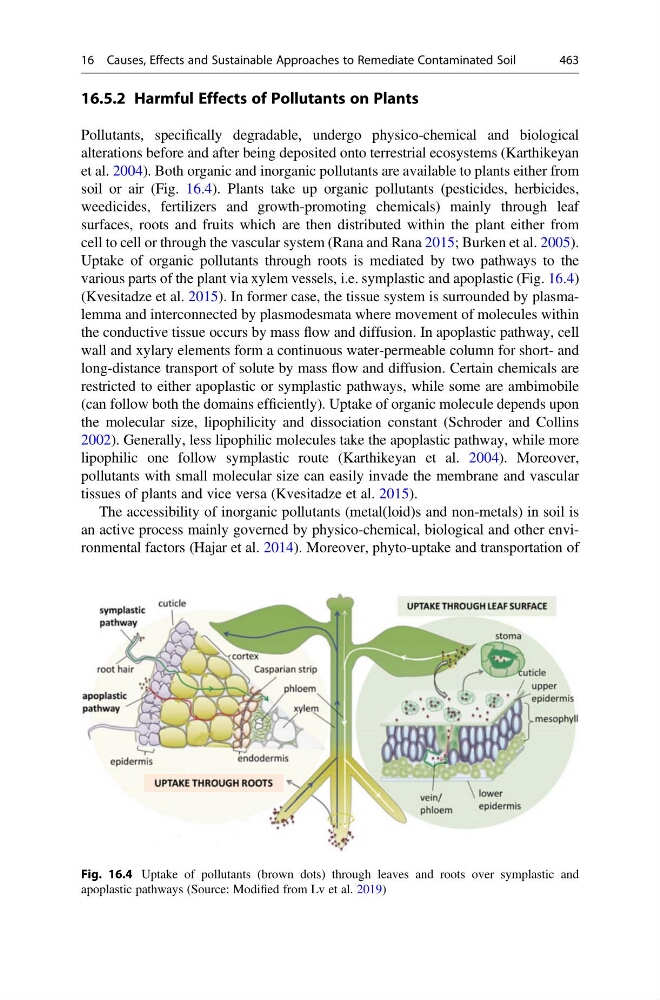
soil or air (Fig. 16.4). Plants take up organic pollutants (pesticides, herbicides,
weedicides, fertilizers and growth-promoting chemicals) mainly through leaf
surfaces, roots and fruits which are then distributed within the plant either from
cell to cell or through the vascular system (Rana and Rana 2015; Burken et al. 2005).
Uptake of organic pollutants through roots is mediated by two pathways to the
various parts of the plant via xylem vessels, i.e. symplastic and apoplastic (Fig. 16.4)
(Kvesitadze et al. 2015). In former case, the tissue system is surrounded by plasmalemma and interconnected by plasmodesmata where movement of molecules within
the conductive tissue occurs by mass flow and diffusion. In apoplastic pathway, cell
wall and xylary elements form a continuous water-permeable column for short- and
long-distance transport of solute by mass flow and diffusion. Certain chemicals are
restricted to either apoplastic or symplastic pathways, while some are ambimobile
(can follow both the domains efficiently). Uptake of organic molecule depends upon
the molecular size, lipophilicity and dissociation constant (Schroder and Collins
2002). Generally, less lipophilic molecules take the apoplastic pathway, while more
lipophilic one follow symplastic route (Karthikeyan et al. 2004). Moreover,
pollutants with small molecular size can easily invade the membrane and vascular
tissues of plants and vice versa (Kvesitadze et al. 2015).
The accessibility of inorganic pollutants (metal(loid)s and non-metals) in soil is
an active process mainly governed by physico-chemical, biological and other environmental factors (Hajar et al. 2014). Moreover, phyto-uptake and transportation of
Fig. 16.4 Uptake of pollutants (brown dots) through leaves and roots over symplastic and
apoplastic pathways (Source: Modified from Lv et al. 2019)
16 Causes, Effects and Sustainable Approaches to Remediate Contaminated Soil
463
Pollutants, specifically degradable, undergo physico-chemical and biological
alterations before and after being deposited onto terrestrial ecosystems (Karthikeyan
et al. 2004). Both organic and inorganic pollutants are available to plants either from
soil or air (Fig. 16.4). Plants take up organic pollutants (pesticides, herbicides,
weedicides, fertilizers and growth-promoting chemicals) mainly through leaf
surfaces, roots and fruits which are then distributed within the plant either from
cell to cell or through the vascular system (Rana and Rana 2015; Burken et al. 2005).
Uptake of organic pollutants through roots is mediated by two pathways to the
various parts of the plant via xylem vessels, i.e. symplastic and apoplastic (Fig. 16.4)
(Kvesitadze et al. 2015). In former case, the tissue system is surrounded by plasmalemma and interconnected by plasmodesmata where movement of molecules within
the conductive tissue occurs by mass flow and diffusion. In apoplastic pathway, cell
wall and xylary elements form a continuous water-permeable column for short- and
long-distance transport of solute by mass flow and diffusion. Certain chemicals are
restricted to either apoplastic or symplastic pathways, while some are ambimobile
(can follow both the domains efficiently). Uptake of organic molecule depends upon
the molecular size, lipophilicity and dissociation constant (Schroder and Collins
2002). Generally, less lipophilic molecules take the apoplastic pathway, while more
lipophilic one follow symplastic route (Karthikeyan et al. 2004). Moreover,
pollutants with small molecular size can easily invade the membrane and vascular
tissues of plants and vice versa (Kvesitadze et al. 2015).
The accessibility of inorganic pollutants (metal(loid)s and non-metals) in soil is
an active process mainly governed by physico-chemical, biological and other environmental factors (Hajar et al. 2014). Moreover, phyto-uptake and transportation of
Fig. 16.4 Uptake of pollutants (brown dots) through leaves and roots over symplastic and
apoplastic pathways (Source: Modified from Lv et al. 2019)
16 Causes, Effects and Sustainable Approaches to Remediate Contaminated Soil
463