

quite inexpensive and exhibits less deleterious effects on the surroundings along
with limited production of secondary pollutants (Ateia et al. 2016).
15.3.2 Ex Situ Bioremediation
“Ex situ bioremediation” process involves the physical excavation of polluted soil or
water from the environment and subsequent transport to other sites for treatment
(Shah 2017). Ex situ bioremediation strategy is considered by interventions to
biodegrade chemical contaminants (Kulkarni and Chaudhari 2007).
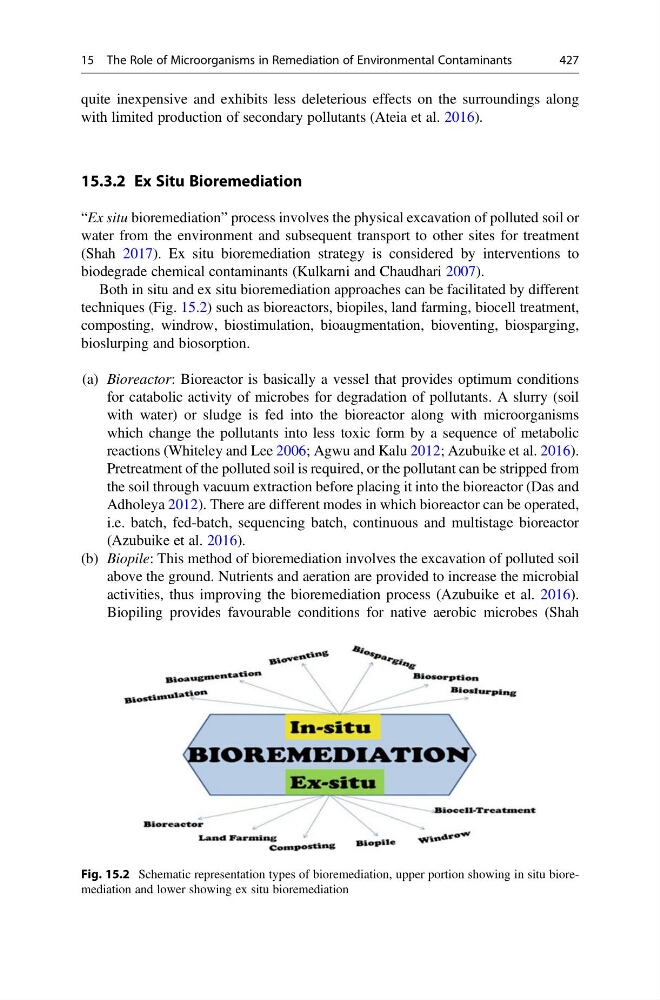
Both in situ and ex situ bioremediation approaches can be facilitated by different
techniques (Fig. 15.2) such as bioreactors, biopiles, land farming, biocell treatment,
composting, windrow, biostimulation, bioaugmentation, bioventing, biosparging,
bioslurping and biosorption.
(a) Bioreactor: Bioreactor is basically a vessel that provides optimum conditions
for catabolic activity of microbes for degradation of pollutants. A slurry (soil
with water) or sludge is fed into the bioreactor along with microorganisms
which change the pollutants into less toxic form by a sequence of metabolic
reactions (Whiteley and Lee 2006; Agwu and Kalu 2012; Azubuike et al. 2016).
Pretreatment of the polluted soil is required, or the pollutant can be stripped from
the soil through vacuum extraction before placing it into the bioreactor (Das and
Adholeya 2012). There are different modes in which bioreactor can be operated,
i.e. batch, fed-batch, sequencing batch, continuous and multistage bioreactor
(Azubuike et al. 2016).
(b) Biopile: This method of bioremediation involves the excavation of polluted soil
above the ground. Nutrients and aeration are provided to increase the microbial
activities, thus improving the bioremediation process (Azubuike et al. 2016).
Biopiling provides favourable conditions for native aerobic microbes (Shah
Fig. 15.2 Schematic representation types of bioremediation, upper portion showing in situ bioremediation and lower showing ex situ bioremediation
15 The Role of Microorganisms in Remediation of Environmental Contaminants
427
with limited production of secondary pollutants (Ateia et al. 2016).
15.3.2 Ex Situ Bioremediation
“Ex situ bioremediation” process involves the physical excavation of polluted soil or
water from the environment and subsequent transport to other sites for treatment
(Shah 2017). Ex situ bioremediation strategy is considered by interventions to
biodegrade chemical contaminants (Kulkarni and Chaudhari 2007).
Both in situ and ex situ bioremediation approaches can be facilitated by different
techniques (Fig. 15.2) such as bioreactors, biopiles, land farming, biocell treatment,
composting, windrow, biostimulation, bioaugmentation, bioventing, biosparging,
bioslurping and biosorption.
(a) Bioreactor: Bioreactor is basically a vessel that provides optimum conditions
for catabolic activity of microbes for degradation of pollutants. A slurry (soil
with water) or sludge is fed into the bioreactor along with microorganisms
which change the pollutants into less toxic form by a sequence of metabolic
reactions (Whiteley and Lee 2006; Agwu and Kalu 2012; Azubuike et al. 2016).
Pretreatment of the polluted soil is required, or the pollutant can be stripped from
the soil through vacuum extraction before placing it into the bioreactor (Das and
Adholeya 2012). There are different modes in which bioreactor can be operated,
i.e. batch, fed-batch, sequencing batch, continuous and multistage bioreactor
(Azubuike et al. 2016).
(b) Biopile: This method of bioremediation involves the excavation of polluted soil
above the ground. Nutrients and aeration are provided to increase the microbial
activities, thus improving the bioremediation process (Azubuike et al. 2016).
Biopiling provides favourable conditions for native aerobic microbes (Shah
Fig. 15.2 Schematic representation types of bioremediation, upper portion showing in situ bioremediation and lower showing ex situ bioremediation
15 The Role of Microorganisms in Remediation of Environmental Contaminants
427